A Bit of Everything

I’ve recently developed an interest in….metal detectors.

That’s right. Metal detectors that enable the search for metallic objects hidden some inches below the surface. Contrary to other places, the geographical middle of Europe seems to be blessed with archaelogical treasures.

garrettace250

Which leads me to the actual dilemma:

1. I actually don’t have any time to waste on another hobby.

2. There are so many other interesting hobbies I have.

3. I’ve always thought it may be better to limit myself to a few leisure activities (due to 1. & 2.) and focus on them only.

4. Most of my friends are academics or intellectuals who aren’t as geeky as I am and/or won’t have an interest in …strange….hobbies such as using a metal detector to search the nearby forest for Roman coins.

So I did a quick test and asked the freakiest freak-friend of mine who usually rumbles around in military clothes all day long and looks like a potential metal detector freak (he actually looks a lot like Al Yankovic in UHF) if he would be interested in joining me on such a hobby.

“Naa…”, he said, “…not really”.

See? This is the same reaction I received from most of my friends in 1994 when I started being interested in amateur radio. Or fishing. Or guitar playing. Or shooting. Or blogging. Or while repairing my old ’89 VW Golf. Or repairing electronics with a jua kali approach. Or my recently aquired toy helicopter. Or other handicrafts….

I’ve always been interested in geeky stuff – which isn’t that bad – but I’ve so often been alone on this. And then I’ve chosen those activities although there are other things I would really like to spend more time on. Like improving my guitar playing. Or learning more foreign languages. Reading the pile of books that’s next to my table – not fiction but books related to water & sanitation or political issues.

Well I am not complaining – for I am still free at this (advanced) age to do whatever I want to (uhuru!) and actually created this space in order to enjoy this variety. It’s only that I am wondering why I’ve always chosen such rather geeky hobbies instead of playing soccer with my mates or clubbing with the fiancée*.

What a luxurious dilemma this is! Get a life…

I know. I’m just sayin, u know…?

Oh, and btw, would you join me on a walk to the forest? Hey this is really cool, we can find great stuff!

*fiancée isn’t into clubbing and also says that metal detectors are for Spanish grandmothers who are combing the beaches, improving their pension.

[Disclaimer: I am yet to decide whether my I can afford to cough up USD 200 on such a metal detector if in the end I’ll only use it about 20x and then sell it on eBay…]

4 years

It’s almost 4 years ago that I published my first post on this blog.

The facts:

  • Fellow blogger Mzeecedric inspired told me in 2005 to start my own blog. Thx, bro!
  • The initial motivation arose out of frustration – a very popular German social network had rejected a few of my texts for publication so I’d told myself: “F… them. I’ll come up with my own site.”
  • SEO kitu gani? I am still using the same WordPress template when I switched from using (the standard WordPress) Kubrick template. Am btw still searching for a suitable & modern alternative but people keep on telling me they like the Kikoi banner. And I couldn’t even take another shot of the said Kikoi as I’ve meanwhile used it on another project. Recommendations for an alternative WordPress template with lots of whitespace are highly appreciated!
  • Renamed this blog only once – from “Kikuyumoja’s Realm” to just “Kikuyumoja”. From https://kikuyumoja.com to https://kikuyumoja.com.
  • 916 posts, 46 categories, 363 tags, 3.107 comments. Still need to improve that tags thingy for older posts. Categories? Blogroll? That’s so 2005. But I still use them.
  • 4 years of using WordPress – an experience that has landed me at least two decent jobs related to the creation of blogs as well as some other unpaid WordPress blogs. Those new to WordPress and the taxonomy still prefer categories over tag clouds btw.
  • I am still blogging despite the invention of microblogging services such as Twitter.
  • I still haven’t lost my blogging mojo.
  • I’ve always tried to keep it personal instead of blogging on one specific subject range, e.g. fellow blogger Erik blogging mostly on Africa & technology (and rugby), Sokari on gender violence, racism, sexuality, HIV/AIDS and cancer, Daudi on sports and politics, and so on. It’s a balancing act for me not to blog everything that crosses my mind, but at the same time I am not too selective and try to keep a healthy mixture. I don’t know if I am that succesful with such an approach, but the truth is: I wouldn’t know how to classify this blog other than “private” or “personal”. At least, that’s how I’ve tagged my blog (and those like mine) on my Google Reader. How do you classify or categorize this blog on your linklist (if at all)?
    Also, I wouldn’t want to limit myself to one specific range of subjects. I know that it’s better to be a “theme blog” by covering only a few things (e.g. “this is a chocoloate blog where I only write about chocolate products”), but I chose not to be that. I do participate on other, theme-related blogs where I contribute to water, sanitation, health, environment, climate, technology, etc. subjects so this need for a categorized view of the world (Weinberger’s second order of order, I presume) is already covered by those sites.
  • Other than the commentators, I don’t know much about the many lurkers out here. Who are you? And why are you reading my blog? Please comment! Thank you.
  • This blog has been part of the Kenyan Blogosphere almost right from the start. And this although I am based in Germany (ok, been working and blogging from Kena in between) and will always remain being a German to an extent where I will require a work permit for jobs in Kenya. My Kenyan side probably is that I know more about Kenyan politics & history than the average Blueband Generation kid out there that grew up with [name of US-American sitcom] on KTN and then quickly left the country for the US or the UK for studies only to develope a need to rediscover their cultural heritage aborad because they’re also being asked about that, e.g. during marathons or once Kenya is back in the media with a negative story (hunger, poverty, AIDS, slums, scandals, natural disaster, tribal clashes, etc.) Don’t want to insult anyone here – guess it’s just a matter of interests. It’s like those immigrants in Germany who are much more German than I am (which isn’t that difficult).

Blogging is easy. Go to WordPress.com (or any other blogging platform), choose a username, register a blog and start writing. And publish it.

Do it anonymously, put your name under it -just do as you feel. But make sure your voice is out there.

My mother once asked me “JKE, who’s supposed to read all this stuff??”. – “Well”, I replied, “…I don’t know. But some apparently do.”.

That would be you, dear readers. Without you and your comments, I would probably never have taken it to this level. I owe you big times!

Four other things I’ve also learned during the last 4 years:

1. A blog post without a photo is like chicken soup without chicken. You feel that something is missing. So here’s the mandatory and totally random picture:

vQxdw8WwRmeyp41yCYXKSINAo1 500

2. The world is changing faster than expected. And we will need much more visionaries out there who are able to think out-of-the-box and and are willing to take a risk. Even if it means that everyone will start laughing about them.
I wouldn’t say I am a visionary, but I’ve followed my own path during the last 4 years and am happily working freelance now on projects I really like. I like my work and what I do. Do you?

3. Things I value the most: time, inspiration, freedom.

4. Everyone likes a good story. Had this colleague at work who kept on sending me links to “potentially interesting news” for our newsletter: “Here, this link is interesting”. – “Yeah, thx…”, I replied, “but where’s the connection and where’s the story to it?”. Silence.

Twitter taught us that news may be limited to 140 characters only. 140 characters that will either be read or ignored.

Now, scientists can sometimes be very complicated. Blogging really helped me shrinking news to a necessary length – and I am still only at the beginning. I wish that colleague would twitter.

Epilogue
SEO is a horrible buzzword, suitable for bullshit bingo. Thinking about this blog post, I keep on adding new stuff to the list of facts. 4 years are an interesting timeframe to draw a line and look back. Alas, this aim to categorize the blog with something else other than “personal” still remains the hardest part for me.

News/Death ratio

I’ve started sharing links to videos and other interesting stuff on Facebook, Twitter and/or Delicious.com and often only use my blog for my own content (partly because I actually dislike reblogging someone else’s content), BUT! Daktari Hans Rosling of gapminder.org is a smart man with an important message:

I sometimes wish proper sanitation would have the same media attention.

EntwicklungslanDE

Bitte lesen. Danke.

Aus einem Kommentar:

“In einer Gesellschaft, in der Unternehmertum gesellschaftlich mindestens genauso hoch angesehen ist wie Bildung und intellektueller Erfolg, werden vorrangig die Chancen des Internets gesehen (USA, Schweden).

In einer Gesellschaft, in der klassische Bildung das Maß aller Dinge ist und einem Ansehen und Einfluss garantiert, werden vorrangig die negativen Aspekte des Webs hervorgehoben. Wie in Deutschland.”

Genau das denke ich nämlich auch.

[via facebook, btw – h/t Cedric & Silke]

my take on AfricaGathering in London

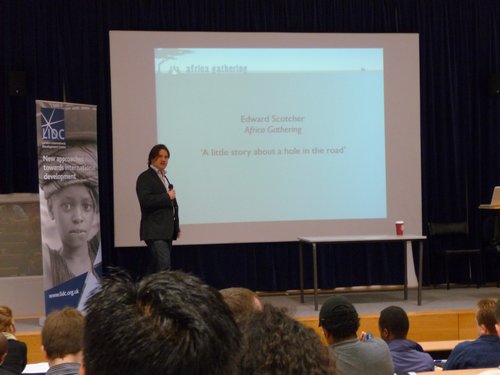
I’ve just returned home from London where I’d been attending AfricaGathering on Saturday 25 April 2009 which was held at Birkbeck College, University of London. A perfectly organised event (by Ed Scotcher & many helpful volunteers – thx!), the Gathering turned out to be quite a success, especially as it eventually provided me with the opportunity to meet some of my AfriMates in real life.
P1010882

Kudos also go out to Karola Riegler who took lots of photos throughout the day and to @RedZola & @MatthewNcube who both helped me trying to get online as the University’s WiFi didn’t work out for me.

So instead of providing you with a summary of all talks (I also presented some slides on AfriGadget and couldn’t do any liveblogging), let me just forward you to the following blogs that already did an excellent job of blogging on the event:

There may be even more interesting posts on AfricaGathering. It also helps to do a Twitter and/or Flickr search on #africagathering to catch some additional links (Twitter Search is a gold mine for anyone interested in ppl and their opinions).

Ed also filmed the event and promised to upload some talks to Vimeo this coming week – so let’s stay tuned for an update. Filming such an event is really sustainable and helps those who couldn’t make it to London in time. Teddy of ProjectDiaspora.org was also supposed to attend the panel discussion, but stupid visa regulations killed this endeavour.
P1010879

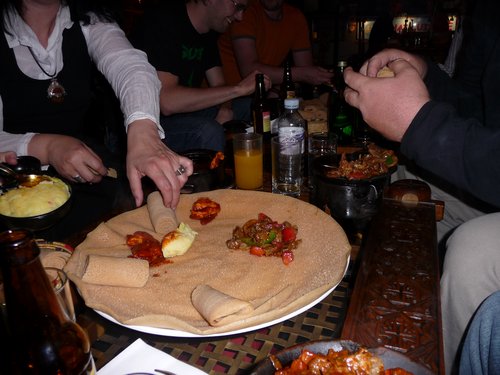
Some attendees already met on Friday evening for great Ethiopian food at Lalibela Ethiopian Restaurant – including David McQueen and Sokari Ekine. It was very nice to eventually say hello to Sokari, who I’d been spamming with links via delicious.com for the past few months. Eh, Sokari – we will be back to London in June!

There have been so many inspiring conversations and shared ideas during this AfricaGathering that it would seem to be unfair to pick out a few selected ones -so I will only add a few words to my own presentation. I also need to work on my presentation style as I am bit too nervous on stage, often speaking too fast or having too many details on my mind that I want to include and then miss out. It was a great opportunity though to present our work and I am also quite passionate about it. Oh, and pls ignore that extra slide on a Liverpool flag as seen in a pub in Garissa the other day – unless of course you are like Ken of Kiwanja.net, whose pic on mobile pay phones we’ve used on one of the slides. :-)

My presentation on AfriGadget on behalf of the whole AfriGadget team (remember, it’s a group blog and everyone is invited to contribute and share interesting AfriGadgets – even you!) wasn’t primarily focused at displaying interesting or funny AfriGadgets even though I introduced it by saying that “we are not here to help anyone, we only do this for fun”.

My message between the lines rather was that there’s still so much undiscovered potential on the continent that needs to be commercialised (I hope I got this message across?). AfriGadget is just the vehicle to showcase that there are innovative solutions that work on a local level.

There’s a new generation of young & skilled workers who grew up with mobile phones & an understanding of how technology works. Skilled IT workers who can already take over programming jobs and develope their own tools.

Of course, IT isn’t the only sector and there are other sectors that will benefit from a new perspective on development in Africa. I, for one, believe that the upcoming sea cable(s) – which will help providing better broadband internet access to many African countries – will also help in providing some incentives for the younger generation to stay in rural areas. The internet has changed the way we live and work – I am also working as a consultant from my home office. Consequently, this progress in the IT sector could hopefully also influence other sectors.

Ecological sanitation concepts, for example, currently work best in rural areas. And with an increasing urbanisation, things are only getting worse. As long as we (humans) do not come up with sustainable cities and (much) more urban agriculture (as a way to provide real livelihood for everyone), there will be a need to “upgrade” rural areas and create markets in such areas. Better internet connectivity and the provision of sustainable power supplies is a way forward as it helps ppl to go about their business.

Business, or the consumer orientation, is my 2nd point on the AG presentation. I think that commercialism has for a long time been undererstimated in the African context. We need to return to free markets and an understanding that people knew how to trade goods (and make a living out of it!) a long time before outsiders occupied SubSaharan Africa and introduced new cultural values.
SANY7326

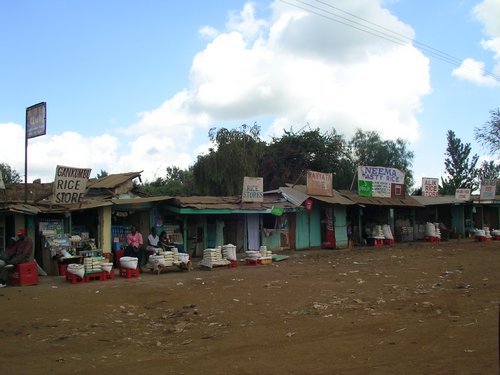
And by mentioning commerce, I am not talking about dealers in a small village who are ALL selling the same product (like the one pictured above where everyone sells rice), but instead a healthy trade of locally produced goods and services and much more diversity.

Someone from the audience asked if ppl would also be this inventive if they weren’t that poor and could afford to buy “better” products. It’s a tricky question because in reality it’s often not a question of being rich or poor, but rather the availability of affordable solutions. If you just can not buy enough welding machines that are required in the metal business and also won’t get a credit because you are not credit-worthy or because there’s no serious bank around, then you have to look for alternative solutions and make do with what is available. If the problem could be solved by being rich and just importing a welding machine from let’s say a Chinese manufacturer, the African economy wouldn’t benefit as much as when these machines are produced locally. As a consequence of that, ppl are instinctively doing the right thing by developing their own solutions and providing business opportunities for a local market. It’s a natural process that may not be that visible, or maybe even condemned by those who still believe that superior products have to come from the outside.

This btw also happened in Zimbabwe some time ago when local supply of sanitary towels was limited and women (not men) had to come up with their own solutions, e.g. using natural materials. Now, from a technical (process engineering) point of view, it’s much easier to treat natural (biodegradable) products than plastics – at least when it comes to the stuff ppl are flushing down their toilets. So these alternative sanitary towels may not be as convenient as those from the supermarket, but they are available and affordable. By the end of the day, products that work for customers will prevail. Everything else is just luxury and filed under “nice-to-have”.

Alasdair Munn also put it nicely on his blog:

“Technology solutions coming out of Africa are built with purpose, against objectives and within the boundaries of their resources. It is a solutions based approach. It is also a stripped down approach where only the relevant resources and tools are used. Simple works because less can go wrong and if it does go wrong, simple is easier to fix. There is a shift in the way tools and technologies are looked at.”

I believe that there’s no master plan for development in Africa, and even less a need for a well-meant guideline from the outside. There’s no one-way solution and this AfricaGathering certainly wasn’t meant to look for solutions “on how to help” etc. etc.. People in need know how to help themselves as most governments on this planet only exist to set a legal framework. We, the people, have to bring the change we want and so it was a valuable opportunity to team up with other like-minded folks during AfricaGathering who have understood that less help and more business may be an interesting alternative for a better way forward.

AOB: I spent less than 48h in London and met enough people to whom I was introduced as “Kikuyumoja”. It still amazes me that ppl know about this blog.


CBD comfort

How much would you spend on having the ability to take a shower in the Central Business District?

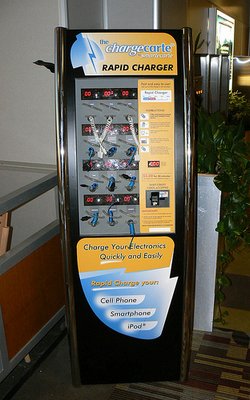
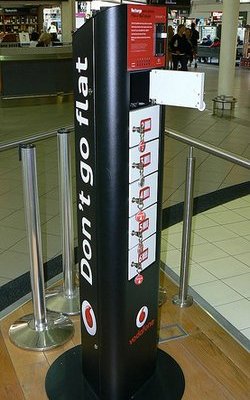
I was just going through Ken Banks’ flickr stream when I stumbled upon these two mobile recharging stations which I had seen earlier (it’s up since ~2 years) but only now I just realized that SOMEONE urgently needs to convert this into an AfriGadget/-Biashara and combine it with lockers for e.g. shoes and other facilities.

3169462407 cd6b0b2a7d3170292694 60593bff09

(source: Ken Banks, kiwanja.net)

Those of you who have been to cities like Nairobi know that a lot of people actually carry two pairs of shoes around – one for the road and one for the office. While working in Nbo, I often wondered why there are almost no public lockers available downtown that could be rented and used by commuters to deposit stuff they usually carry to the city on a daily basis for the lack of secure alternatives. Yes, there are some alternatives available, but these are(afaik) often only connected to supermarkets which means no 24h/7/365 availability of such services.

While these mobile recharging towers may work in the UK or the US in such secured places (like airports), I am wondering if this would also work in Nairobi if someone invests some money on a mobile charging cubicle with extra lockers for shoes and other office clothes, maybe also additionally secured by a watchman or someone running a kiosk.

What would it require? And how much would it cost? And what kind of licences would it require from the local institutions?

For some reasons, David Kuria’s ecotact.org website is unfortunately offline right now (so I can’t really show you what I am talking about), but it would be nice to have much more Ikotoilets all over Nairobi. While I believe that ecological sanitation projects always require a demand for fertilizers from farmers in semi-urban areas, the Ikotoilet as a 50% ecosan toilet could be one of those ideal locations for such storage facilities.

After all, it’s nice that consumers can buy airtime credit almost everywhere in the country, but there are hardly any places – even in cities – where one can take a shower after work, have a decent nature’s call or even use extra services like such lockers and mobile chargers.

There obviously is a great demand for such services / facilities – but how much would you be willing to spend on it as a customer and what’s the ROI rate for potential investors? I hope to find some answers to these questions one day…

Netbooks = AfriGadget

Over at AfriGadget, we usually call something an AfriGadget if it is a DIY solution to a problem or situation to which there just isn’t any ready-made solution available.

In places where you just can’t go to the next hardware store and buy a ready-made solution, an AfriGadget is such an attempt for a working alternative.

I would even go as far as saying that Germany, for instance, is a very modular country (with many regulations & technical norms) and consequently offers many ready-made solutions that can just be purchased and instantly used. Spare parts for cars, houses, technical equipment – you name it, there’s a norm on it and a place where you can buy it.

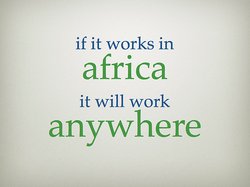
2888960873 91a4e7a7f4Erik of WhiteAfrican recently argued that “If it Works in Africa, It will Work Anywhere”.
You may or may not agree with this provocative thesis, but it also shows that we are still consuming many products in the “developed” countries which were actually made for our consumer behaviour. And these things are also exported to Africa.

Anyone in the diaspora who has ever exported his older laptop for members of the extended family back home also knows that it may probably be broken once he/she returns during the next holiday.

Most conventional laptops are just too fragile to withstand the heat, dust, unstable power supply, malware and other threats the relatively rough life on “the dark continent” has to offer. And battery runtime with an average of max. 2h is often below par.

Netbooks are different.

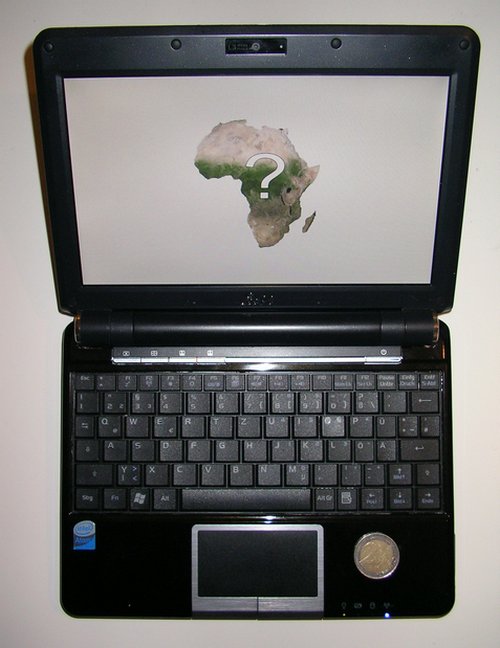
Netbooks are simple, often light-weight small computers with a simple (but modern) CPU, enough RAM, a harddisk, a small screen (7″-10″), 2-3 USB ports, a sound card, WLAN connection and a card reader. They sometimes even come with an internal Bluetooth adapter so you can connect your mobile or other Bluetooth-enabled equipment to such a little machine. Oh, and it also has a webcam which is neat.

Most importantly though, many current netbooks are quite durable and even survive rough conditions.

SANY2022

Take my netbook, for example. I’ve purchased this used Asus eee PC 901 a month ago – and while I am still struggling with it’s tiny keyboard layout – I just can’t stop thinking that it could or should actually be THE killer device for use in many developing countries.

My netbook doesn’t have a conventional magnetic (rotating) hard disk, but instead comes with (slow) SSD flash memory. Like the one found on USB memory keys. 12 GB for the operating system, programs and some private data. Battery runtime is beyond 5h on this little baby – which means that it’ll even survive the next power failure. And since the tiny CPU inside doesn’t consume too much power, it could also work from the electricity generated via solar panels (a technology that’s already quite popular in many rural areas).

And here’s the bonus: most future netbooks will be sold with an internal UMTS modem, so you just insert your SIM card and go online. From anywhere where there’s network coverage. (I am actually saving on an Asus eee 1000H Go which has a 10,2″ screen, a better keyboard and an internal 3G modem).

The term “netbook” may be a bit irritating though (besides of this legal battle) as we all know that Internet broadband connectivity is still very limited and expensive in many developing countries. Instead, these little computers are much more than just very mobile computers with very good battery runtime: they are sufficient for most needs.

I’d say that at least 90% of your average tasks can be done on such a machine. Surfing the www, checking your e-mails, writing texts, spreadsheets, games – you name it, it does it. The only thing it doesn’t have is an internal DVD player, so your illegal DVDs purchased at that junction downtown probably won’t play – unless of course you connect an external DVD player via USB.

As long as the iPhone or maybe also some new Google Android phones are the only mobiles with a decent web browser (@Nokia: the S60 browser is NOT a decent solution), netbooks may be the perfect alternative platform and substitute the missing alternative.

“If it works in Africa….”….no, if it works anywhere else, it will also work in Africa.

70% of Netbook sales so far have been in Europe – where they are often only used as second computers or desktop alternatives to those who just want to surf the net from their couch.

In many developing countries though, Netbooks could imho be the entry platform and substitute the otherwise missing or broken (older) computer system. Why? Because they are cheaper, more durable, come with their own power supply and are mobile enough to be shared by many different members of a family or local community.

And that’s why I consider netbooks to be real AfriGadgets. A solution to a problem we have in the past often tried to cure with mobile phones and their still ailing browser software.

Twestival, or why Twitter is the better alternative

Today is Twestival day and I am also attending the local gathering of Twitter users – which also happens to take place in my favourite pub here in Frankfurt (aptly named “the place to be“).

Twestival is a world-wide, almost simultaneous event (live streaming) and attendees are encouraged to donate some money to Charity Water, an NGO active in Ethiopia.

Somehow in a Prof. George Ayittey-way and having previously gained some experience on NGOs, the water business and having a different perspective (of an African/European intellectual) on it, I do of course feel a bit discomforted with such mass-donation events that a) promote water as a sexy (and innocent) cause and b) provide absolution to some Westeners who “want to do good”. Sorry, but sustainable approaches just don’t work that way. I would rather prefer institutional changes than the drilling of wells for areas on which we do not even have groundwater maps. But maybe that’s just me and my scepticism.

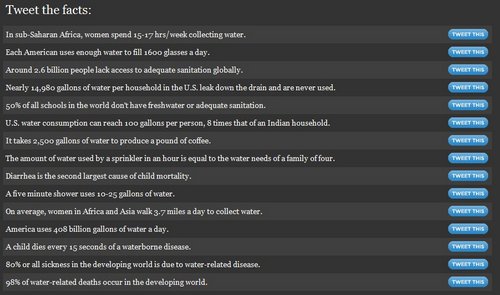
On the other hand, I somehow adore how they are making use of social media tools to mobilize the masses. Maybe this is what it takes to reach the masses. And this is also very cool:

FireShot Pro capture #84 - 'Twestival Tweet Meet Give ' - www charitywater org twestival
Tweet some facts” via Twitter.

I think we should also use this for ecological sanitation projects. Using social media to mobilize the masses. Kudos to CharityWater for this really smart approach!

One of the reaons for the success of Twitter and other micro-blogging services, I think, is also the lack of alternatives.

Yes. Even in 2009, there’s still no decent mobile blogging client except for Twitter & Co.

What I am looking for is an application designed for a smartphone that enables me to quickly post an update to my website, with annotated images, maybe also video content and the ability to edit all of this as well as moderate comments. All of the previously mentioned apps for Symbian S60 phones and plugins for WordPress.org installations just don’t do the job for me. And I don’t know about this on the iPhone. Is it any better? Would be a reason to switch phones.

So, even though Twitter is just a micro-blogging service with a limitation to 140 characters / message, it helps to serve the basic idea behind blogging: connecting people through conversations. And besides, with this character limit it is also compatible with another popular service: SMS.

I really like the idea of combining social media tools with the sector I am active in: sustainable sanitation.? Maybe that’s just the way forward for me.