the one stop resource

Ppl use Wikipedia to access encyclopedic knowledge on a certain topic.
Ppl use Google for a broader search on a topic.
Ppl use Del.icio.us to receive selected search results that have been pre-selected by human users.
Ppl use Amazon for buying books online.
Ppl use eBay to find a used spare part or other interesting items available for purchase.

The other day I saved this link to my delicious account which provides many interesting DIY manuals on various topics. You know how many websites there are that provide DIY manuals or user guides? Many! – BUT! you’ll never find them because they aren’t as SEXY as Wikipedia or Google or Delicious or Amazon. “Sexy”, as in “known + popular + easy to use”.

WHAT WE NEED to have is a 1stop-resource-online with manuals on each and every topic, all of them attributed with a CreativeCommons licence for transparency reasons and a tagged system.

THE BEST WAY to achieve this would be to ask ALL providers of DIY manuals online to enter their publications one by one into a social bookmarking system online (or a dedicated website on this topic) and tag them with appropriate keywords for further reference.

It would make things so much easier.

Besides, having them in a social bookmarking website, we wouldn’t need to create one huge server with bandwidth capacity, but instead everything could remain where it is right now… also, i am just talking about DO IT YOURSELF manuals here, not the usual corporate *soft* blabla like “discussion papers”, “***** framework”, “what ought to be done”-papers and other “please consider the environment before printing this paper”-documents that are just justifying the PhD of some authors but don’t change anything to the better for those who are willing to change the situation they are in and could actually make use of the aggregated knowledge as found in DIY manuals.

Me thinks: most organizations just don’t do this because a) they don’t know about social bookmarking websites, b) there’s no policy on this, c) they are consequently not paid for this extra work and d)? there’s a certain aim to stick to their publications = products = proof of their work = income generator for the years to come.

der Lonely Planet Sklave

Forsty, unser ehemalige Geo- und Englischlehrer mit langjähriger Safarierfahrung, schrieb letzte Woche aus Mali:

Mir wurde z.B. klar, dass ich eine gewisse Hektik sogar auf meinen Reisen in Afrika nicht ablegen kann. Ich bin z.T., übertrieben ausgedrückt, ein ‘Lonely Planet Sklave’, dem es hauptsächlich darum geht, wie er von A nach B kommt, vom bedeutsamen Wochenmarkt zu Weltkulturerbegebäuden. Dass sich zwischen A und B tolles, authentisches afrikanisches Leben abspielt, wird dabei völlig vergessen.
Die Spanierin, auf deren Visitenkarte “Monica – Traveller” steht, hat mir während der gemeinsamen Pinassenfahrt ein wenig die Augen geöffnet.
Sie reist hauptsächlich nach Straßenkarte, zu Orten, die ihr vom Namen oder der Lage her gefallen und benutzt den Reiseführer überwiegend, um sich über Transport- und Unterkunftsmöglichkeiten zu informieren.

Dieses Zitat hier in meinem Blog, weil ich mir vor ca. einem Jahr einen ähnlichen “Vorwurf” gefallen lassen musste. Reisen als Beschäftigung und ohne ein örtliches Ankommen? Wo, oder besser: was ist das Ziel?

Gute Reiseberichte kann man sicherlich auch daheim schreiben (und an dieser Stelle vielleicht der Hinweis, dass der von mir überaus geschätze und letztes Jahr leider verstorbene Ryszard Kapuscinski seine meisten Bücher auch erst zu Hause zusammenschrieb). Reisen als Solches habe ich für mich noch nie als ein Abklappern von Sehenswürdigkeiten empfunden, aber es beinhaltete für mich auch immer ein Ankommen an einem Ziel. Ziellos durch die Gegend fahren und Erfahrungen zu sammeln – das widerstrebt meinem Naturell und meiner – ich nenne es – “afrikanischen Effizienz”. So wie ich auch über die vielen Autos staune, in denen nur eine Person von A nach B reist (= ungenutzte Kapazitäten).

Freilich, ein solches Herumtreiben muss man sich leisten können – finanziell und karrieretechnisch. Ein Herumreisen muss für mein Verständnis aber vor allem mental, im Kopf stattfinden. Der örtliche Transfer, der oft kurzweilige Aufenthalt an einem anderen Ort bedeutet nichts, sofern es keine Bereitschaft oder Möglichkeit zur intensiven Wahrnehmung der neuen Umgebung gibt. Und das geht vor allem über die anderen Menschen, da die subjektive Wahrnehmung alleine meiner Meinung nach zu einem einseitigen, zu verfältschen Eindruck führt.

Wäre ich Journalist, würde ich sicherlich nur über Technik schreiben wollen. Abstrakte Zustände und Gegenheiten, deren breite Attraktivität nur in der Benutzung durch Menschen ensteht (~ siehe auch: was ist so toll am iPhone? => die einmalige Benutzerführung / UI, user interface).
Als Blogger habe ich diese Vorgaben alle nicht und kann schreiben, was und wie es mir passt. Dass es dann teilweise zu Vorwürfen kommt, weil man ständig Gefahr läuft, Dinge oder Zustände zu Verallgemeinern oder zu übertreiben, ist das schöne Risiko dabei. Schön, weil es zu mehr Kommunikation mit den Lesern verhilft und teilweise rhetorisch gewollt ist.

Forsty habe ich übrigens letztens nahegelegt, für seine nächste Reise ein Blog einzurichten. Und da er überaus interessant und alltäglich schreibt, wird sich das sicherlich auch sehr lohnen.

Für meine nächste Reise bzw. lokalen Bericht habe ich mir vorgenommen, noch mehr auf die Sichtweise anderer einzugehen und entsprechend mehr aus ihrem Leben zu berichten. Gestern frug ich zB meinen einen Arbeitskollegen, der letztes Wochenende bei der Africasan (Water & Sanitation Conference) in Durban (SA) war, wie er es denn gefunden hätte. Seine Antwort: “Außer dem Hotel, dem Tagungsort und dem Flughafen habe ich nicht so viel mitbekommen vom Land…”.

Wie gut, dass ich dann nicht mitgefahren bin (obwohl ich da ursprünglich unbedingt hinwollte und auch das Angebot hatte, mitzufahren…).

AOB: bei mir gibts heute Tortellini mit Mais-Schmand-helle-Sauce + Trockenpetersilie ausm Glas. Ein weiteres 15 Minuten Gericht für wenig Geld (ca. 2,50 EUR).

21022008204

Dieses Geschirr is der Burner….

Liebe Birgit Virnich,

dafür, dass unser musikalischer Botschafter Walter Lindner im ersten Jahr seines Schaffens den goldenen Käfig Nairobi gut ausgetestet hat, war das jetzt aber ein sehr, sehr positiver Bericht im Weltspiegel (mit Video).

Lindner in Mützelburgischer Art bei der Erkundung Kamukunjis Kiberas im Gespräch mit Einheimischen zu beobachten, zeigt wohl das momentan Mögliche auf.

Für seine Sicherheitsbeamten sind seine Alleingänge im Slum ein Albtraum. Doch immer wieder zieht er ohne Bodyguards los, denn sonst käme kein vernünftiges Gespräch zustande. “Sie geben uns Hoffnung,“ meint der Mann. „Diese Größe haben unsere eigenen Politiker nicht. Keinen von denen hat sich hier je blicken lassen.“

Sorry, es sind einfach diese beiden Nairobi Welten, die hier für mich nicht immer zusammenpassen wollen. Auf der einen Seite ein widerspruchsloser MA des AA, auf der anderen Seite der Wunsch zur Anteilnahme am Zeitgeschehen in Kenia. Und doch ist es vielleicht gerade dieser Widerspruch, der in der Diplomatie und, viel wichtiger, beim Volk ankommt.
Anzumerken habe ich außerdem noch, dass es beim scheinbaren Desinteresse der meisten kenianischen Politiker (wohl aus politischem Kalkül/Angst/etc.) gar nicht so schwer sein dürfte, Aufmerksamkeit zu erregen.

Freilich, wenn man andere Diplomatie gewöhnt ist, erscheint es manchmal eher sonderbar. Fand ich jetzt aber gut, den Bericht.

Außerdem: Musik verbindet.

who fills the gap?

Just a short longer note on something I would actually like to expand into a post for Afrigadget: mobile phone repairs.

Back in 1998 when I first started fixing my mobile phone, things were a bit simpler. Fast forward in 2008, mobile phones have become a commodity and there are at least two or three guys in most rural towns (in Kenya and elsewhere) that will know how to fix such a phone.

So why blog on it? – Because it’s the way ppl are looking for alternative solutions on how to fix an advanced mobile phone based on SMD technology that makes the story interesting.
SANY7197
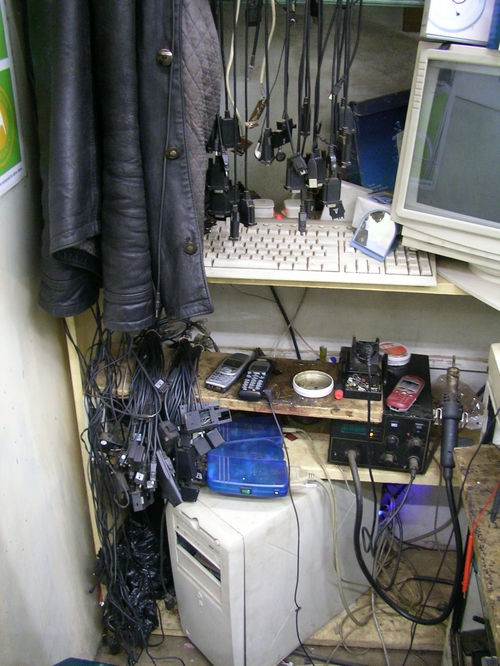
mobile phone repair booth in downtown Nairobi, picture taken in May 2006

In a world that has become more and more modular, where spare parts are exchangable or product life cycles reduced to a lifetime of about 2-3 years (best example: printers), not all is waste or wasted, and many things may often be repaired with simple and sometimes even very rough methods. Ask any mobile phone repair shop @ Moi Avenue Nairobi and they will tell you how they managed to save this or that phone. This, to me, is especially interesting, as they are using similar tools like other jua kali fundis in Europe – in a different environment. Whereas phones in Europe are often owned and used by one person only, phones in dev. countries are often shared between family members or friends. No wonder Nokia came up with two new phone models for emerging markets the other day, offering more than one phonebook / user profile on a single phone. Hence the need for a different approach to service repairs…or not?

What you see above in the pic – and I desp. tried to get a decent pic of such a booth back in May 2006 when I last tried to cover this subject – are normal flasher cables. Serial & parallel cables, like datacables, ppl use to connect a phone to a computer to unlock a handset, flash the firmware or run some tests. Your handset is blocked by the network? Don’t worry, just reprogramme it (illegally) with a new serial number (~ IMEI). These are things done everywhere in the world – in the Middle East, in Asia, in Europe, Africa, etc. – only: they are all based on reverse engineering.

Modern phones come with some more sophisticated algorithms and require a slightly different equipment – but that’s just a question of money and consequently there are, again, a few guys who will own a Twister Flasher or a BB5 unlock box in town (I really dig this microscope, sigh :-)

Coming back to the initial question – why is it so interesting? Well, because manufacturers like Nokia or SonyEricsson create service manuals for their phones (which are then circulated over the internet), giving the schematics and parameters of each and every part. But they usually don’t train those jua kali fundis. And a licenced Nokia Service Center? Apparently, they often do apply the same techniques and may or may not be equipped with special and better service gadgets. And they are expensive.

In other words: it’s cheaper and much more interesting for manufacturers to produce new phones than to train service staff on how to fix a mobile phone. Simple, new or refurbished phones are sold for something like 20,- EUR. And yet there’s this huge demand for quick & cheap repairs all over the world. This also applies to other electronics, cars or even lighters.

Anyone out there remembers how we used to refill one-way lighters with Butane gas (using a chopped nail and balancing the firestone on the forefinger while reassembling everything)? Back then lighters were sold for something like 25/= Kshs. and a refill was available for 10/= Kshs…

Now, while reverse engineered / alternative / jua kali (phone) repairs are interesting and will most def. make a good story on Afrigadget, I am constantly asking myself how manufacturers like Nokia will profit from this niche and use such knowledge for further engineering? Yeah, well, maybe Jan Chipchase‘s research may be part of that, but then: who will fill this gap between new products and broken gadgets (leave this market to jua kali fundis and private individuals only?) and will a break-even point be the only criterion to define this approach on when it makes sense to invest in new equipment? What about environmental damage (during production) and how is this accounted for?

The fast growing mobile phone sector is an interesting example to see how the world has changed, and I am currious to see when the majority of customers in places like Nairobi will prefer buying another phone instead of having the old one repaired.


Poire & Cognac Fine

In Zeiten, in denen es Anderen schlecht geht und persönliches Leid mit solch einer Lethargie etragen wird, einfach deswegen weil es keinen anderen Weg gibt – in diesen Zeiten muss man das Leben so genießen wie es kommt.

Und nichts mag da sympathischer daherkommen als mein österreichischer Vermieter, der mich spontan um 12 Uhr nachts noch auf einen schönen französischen Cognac Fine, mit Poire (~ Williams Birne) verfeinert, einlädt. Ein schöner, 30jähriger Cognac, der so richtig mild und ölig, aber auch sehr süß im Mund zergeht und ich mir im Kopf schon ein Rezept ausmale, wo er auf einem schönen Flan Pudding und mit einem Hauch von guter Schokolade, die Spitze des Genusses andeutet.

Essen ist hierzulande viel zu unterbewertet, und gutes Essen sowieso. Selbst in Kenia, wo meiner Meinung nach ein Paradoxon in Sachen “einheimischer Küche” herrscht, werden die wenigen bekannten Gerichte mit Liebe zubereitet. Es mag vielleicht auch ein bißchen seltsam klingen, aber meine größte Verwunderung nach all den Jahren in Kenia und den Erfahrungen dort, habe ich mich letztes Jahr (wieder) vor allem über die beschränkte Auswahl an Gerichten gewundert. Und das obwohl es in Kenia so eine reichhaltige Landwirtschaft gibt, die nach guten Maßstäben produziert! Allein der Unterschied zwischen der reichhaltigen Küche der Swahili Kultur an der Küste und der GEMA (Gikuyu Embu Meru..) Fraktion im Landesinneren verwundert mich immer noch bis heute. Als ich letztes Jahr in Embu war, hatte ich darüber ja mehrfach gebloggt und mich ausgelassen, wieso auf der einen Seite dieses “Stadtleben” in so vielen Varianten kopiert wird, auf der anderen Seite aber beim Essen die Standardgerichte bevorzugt werden. Dies ist auch keine Frage des Einkommens oder des Wohnortes, sondern der Einstellung und der Bereitschaft, gutes Essen als Genuss zu sehen.
Allein – es besteht keine Nachfrage. Noch nicht.

Zum Cognac gab es übrigens noch schönen Tafelspitz aus ganz zartem Rindfleisch und großen Gemüsestücken.

Eine Konditorei in Nairobi mit gutem, richtig gutem Kuchen und feinem Café – wäre das keine gute Geschäftsidee? Wer Nairobi kennt, wird dies nur bestätigen wollen – siehe Java House & Co..

Bei all der Trauer um die “post election violence” und einer fraglichen Entwicklung, die vielleicht aus europäischer Sicht immer mehr in Richtung des widerstandslosen Chinas abwandert, darf man nicht vergessen, dass Kenia in diesen Tagen das nachholt, was zum Wohle des “Fortschritts” in über 40 Jahren kenianischer Republik unter den Teppich gekehrt oder nur für Wahlkampfzwecke missbraucht wurde: die Auseinandersetzung mit der eigenen Identität in einer neuen Weltordnung. Vom Konflikt betroffen sind aber die richtig Armen – und das ist genau der Knackpunkt: die Menschen werden für Ideologien missbraucht, die in der heutigen Welt nicht mehr Bestand haben.

Ich wünsche mir für Kenia ein friedliches Miteinander, in dem diese Euphorie des Vorwahlkampfes (“auch Deine Stimme zählt”) den Ruck in die Gesellschaft bringt, den man für positive Veränderungen braucht. Von einer Regierung, und das hat wohl jetzt jeder verstanden, kann man bestenfalls nur das Abstecken legislativer Rahmenbedingungen erwarten.

Ach, und besseren Kuchen in Nairobi – den wünsche ich mir auch! :-)

United

Been on the road and had problems getting online. An irritating situation as I wanted to stay informed on the news from Kenya.
486 lives lost (according to official figures) due to such unnecessary, avoidable and stupid riots. An uncountable number of causalties and displaced persons, a nation in shock – not because of riots which everyone more or less anticipated at one point, but because of a conflict that – according to the international media – boiled down to a tribalistic reasoning and the clear failure of the so-called “leaders”. And those who did actually contribute to the conversations had to rely on citizen media as the official broadcasters were muzzled.

Anyone remembers the floods in Garissa in Nov 2006? It took the GoK at least three days to send the local police helicopter to save some lost kids from trees (who had stayed there for three days without any food or water). While floods are temporary, a government that has cheated its own people will stay for good.

I had dreamed about Kenya during these days, had to think of my friends and loved ones who are struggling hard to make a living in an environment where the Government will only intervene when business is at stake.

I am so grateful for the various bloggers out there who took their time and money to keep us – everyone – up to date on what’s going on in Kenya. We didn’t have Blog Awards for the Kenyan blogosphere in 2007, but maybe we should just give them to those who contributed content during the Kenyan elections 2007.
Also, I comment Ory on her work as she lets others speak up and posts their very own stories. Global Voices taken to another level. I say: if you’re interested in Kenya as a country and have something to share, go ahead, come up with a blog, comment on other blogs and contribute to the ongoing conversations. People are connected in 2008, even via mobile phones, and the ban on live coverage does not help to end any conflicts. We cannot rely on “leaders” to come up with a top-down approach to implement any peace approaches. This is why I am so convinced of the power of these online tools.

Oh and btw: a Happy New Year to everyone! 2008. What a start.

AOB:

05012008111

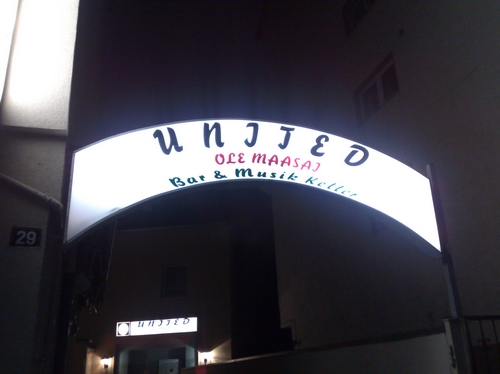
UNITED Ole Maasai. UNITED!!!

Been to this (great!) Kenyan bar right here in Frankfurt on Sato evening. My wife Ische has never been to Kenya before, so I wanted to introduce her to some important things she needs to be aware of. Sort of a “soft start”, if you like.

1. loud music (even if there’s no one dancing)

2. people ordering more than one bottle of beer

3. Kenyan hospitality.

Verdict: she likes it A LOT and even liked the beer…

05012008108

I felt a bit irritated, nipping on a Kenyan beer in a Kenyan bar while people are dying at the same time back home. This is also why I am a bit lost for words these days as I am struggling to adjust to this world. There’s so much more even words couldn’t describe – and I just couldnt stop thinking about this old, worn-out proverb that once again proved to be so true:

“When elephants fight, the grass gets hurt.”

Quote of the day:

Before the elections, the majority of Kenyans were in an upbeat mood, expecting their parties to clinch victory, but the violence that broke out after the announcement of the presidential result has terribly eroded our democratic gains, says Thomas Odhiambo. He now wishes that President Kibaki could reactivate the SMS number he had advertised for voters to use to discuss issues with him during the campaign period. “I would have informed him that many of us are suffering, having fled our homes due to violence,” says Thomas. (src, reg needeed)

ach…

Probably like many others, I’ve been following the intense coverage of the current situation in Kenya through the media and especially the Kenyan Blogosphere online. Kudos to everyone within the blogosphere (bloggers & commentators) who contributed valuable news & information!

Ory of KenyanPundit already pointed out a few good things how we – those that are sitting in the save heavens during these days and watching the unfolding events with sadness – may be able to help and contribute our share, i.e. by documenting the events online with names of all the victims, buying airtime for our family & friends online or maybe also by pushing our local government to assist Kenya in finding a quick solution. While the latter one may not be possible, I’d still like to second her ideas on this and offer my help. For those of you who are able to read German, pls have a look at this interesting article on why Germany would have an interest in helping Kenya. I also heared that Germany’s foreign minister, Mr Frank-Walter Steinmeier, today talked to Raila A. Odinga.
I wonder how Germany may be able to assist Kenya on this? Maybe Daimler-Chrysler should build a remote control / backdoor access to their Mercedes cars so that whenever a president or government does something “undemocratical” (sic!), they can stall the entire car pool. Ha!

Besides all the pain and sadness of the recent developments, I am with Bankelele when he concludes that the Kenyan voters are the actual winners (despite the rigged tallying) as they turned out in record numbers. And I believe it’s these very same people who will make a difference for Kenya and show to the world that Kenya isn’t ruled by a handful of powerful people, some executive forces and rioting youth, but instead a strong electorate that knows how to do business, care for itself and those in need and thus also knows how to maintain peace in a multi-ethnic society.

In an attempt to do some bridge blogging, I will try to compile a short summary in German during the next few days pole, sina saa…, also because the German media has in the past few days reported about the riots under the usual Kikuyu vs. Luo label – something that has really put me off!