Nivio

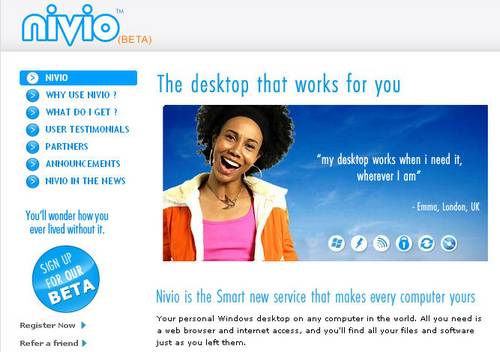
A friend of mine forwarded this article from Der Spiegel Online to me which talks about Nivio.com, a new start-up that offers a remote, virtual Windows Desktop to its users.
I haven’t tested this so far, but according to the website, there’s a trial periode of 30 days and then it costs US-$ 12,99 / month. The virtual desktop is supposed to come with Windows XP, 5 GB space and a bunch of commercial and open free software.

nivio

While I appreciate any efforts towards this direction and since I believe that software should be independent from hardware issues, there’s still one thing that bugs me about this: in order to use this kind of technology, you’ll need to have a broadband connection. How fast? AT LEAST 128 kbit/s.

Sorry guys, but I think you’ve missed the target. While many users definitely appreciate the Windows desktop, what we – the users around the world who aren’t on broadband – need are secure Windows-styled GUIs that offer the same services but don’t require so much bandwidth.

Maybe something like the already mentioned Jahazi package that comes bundled with portableapps.com on a pre-configured USB stick or LiveCDs such as the (still alpha) ReactOS which is a WinXP clone. Something that just works and doesn’t require any virus scanners, extra firewall software and multiple installations because someone accidentally deleted a Dynamik Link Library (dll) or other horror scenarios any admin fears.

So, what’s the alternative? Simple: get a LiveCD of your favourite OS, plug it in any computer (LiveCD on a USB stick!), restart it (ok, this may not always be possible), load your favourite OS and just start working. Inet access may still be a problem though, but maybe there’s a DHCP server runing somewhere.

I would just like to see more and more ppl using their own (virtual) desktops, stored on their own USB sticks with their own preferences. This of course isn’t the best solution, but it could help having better desktop environments at internet cafés or other places where a single computer is often shared by many users.

attention, Eurosphere!

Is there anything such as a European blogosphere? A Eurosphere? Maybe a EUROspehre.

“I don’t read your blog”, some of my German friends told me, “coz you’re blogging in English”. English isn’t my mothertongue, but hey, we have to start somewhere, and there are a lot of people around the world who write in English although it isn’t their mothertongue.

With the recent elections in France that saw a very conservative candidate becoming the next President, one thing remains certain: national interest are still more important than European ones.

There may be different historical and political reasons for this behaviour, however, the outside sees us – the Europeans – as a unit. More than we actually are.

Something similar may apply to the African continent: whereas someone from Egypt or Morocco wouldn’t like to be called “an African”, the rest of the continent is still regarded as one big dark continent – by those who are not well informed.

It’s those messages such as the recent crashing of a Kenyan airplane where newspapers list all nationalities of the passengers and mention that “the remainder are Africans“. As if there is anything such as “the African”. Because those ppl hail from the same continent? Yeah, right…

The European blogosphere, if there is anything like that, the European media, all those fancy Web 2.0 websites are orientated towards the USA. This isn’t bad. In fact, most Inet startups in Europe are 1:1 copies of succesful sites from the US. However, there’s the Atlantic Ocean between the USA and Europe. And between Europe and the African continent? A rather small Mediterranean Sea.

Imperialists from European countries had conquered the African continent in the past and subdivided it into different countries, regardless of ethnical boundaries. Some of the main languages there are English and French, however, this European connection doesn’t seem to matter when it comes to intellectual stuff from the continent.

So much about background information for those who still need to check the world map to see where Ghana or Tanzania are located on the continent.

Having said this, let me pls introduce you to some fine African websites that have come up in the past. African, yes, as in Pan-Africanism.
I don’t know if there’s anything like Pan-Africanism apart from political institutions, but if it takes the digital age to connect different ethnical groups into one big unit – hey, why not? Now let’s see what this is all about:

1. Muti
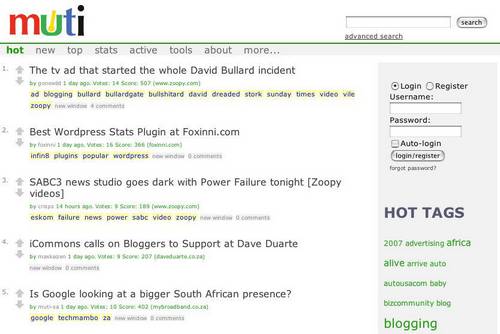
muti screen

“Muti is a social bookmarking site inspired by reddit and Digg but dedicated to content of interest to Africans or those interested in Africa”.

Muti is a perfect resource for the African content – and the obvious advantage of social bookmarking and why you would want to use it (and there are still a lot of friends who haven’t understood this): don’t waste your time combing the internet for interesting content but instead rely on that what others have already filtered for you. It’s like using Google with a human filter. That’s quality!

2. Afrigator

afrigator screen

“Afrigator is a social media aggregator and directory built especially for African digital citizens who publish and consume content on the Web. (…) You can use Afrigator to index your blog, podcast, videocast or news site (i.e. any site that publishes an RSS feed) and market it to the rest of Africa and the world. You can also use it to discover new sites in the Afrosphere.”

The Afrosphere!

3. BlogAfrica
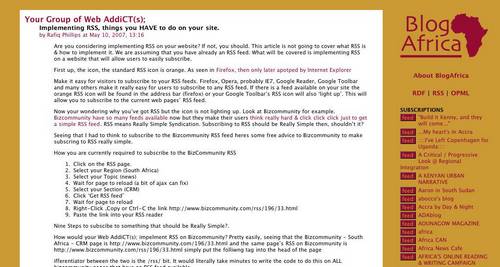
blogafrica screen

“BlogAfrica is intended as a collection of weblogs by Africans, both living on the continent and in the diaspora, and of non-Africans writing about Africa.”

BlogAfrica also is part of Globalvoices, “a non-profit global citizens’ media project”.

4. African Signals
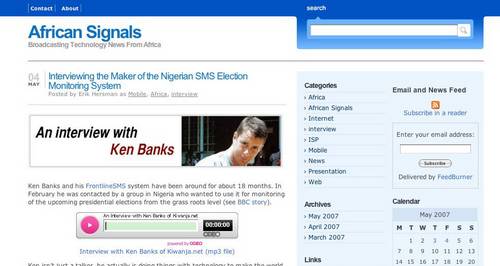
africansignals screen

AfricanSignals is a new, blog-styled website that aims to “broadcast technology news from Africa”. AfricanSignals was created by fellow blogger Hash, who also blessed us with:

5. AfriGadget
afrigadget screen

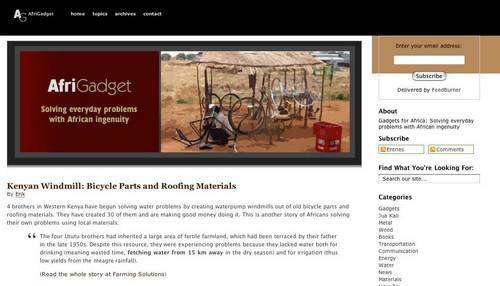
“Gadgets for Africa: Solving everyday problems with African ingenuity”

AfriGadget is another blog-styled website that tries to portray some neat technical solutions. Or as I would call it: the MacGyver solutions that come up in situations when your tools and materials are limited. If you think of solutions, and not problems – this is your site.
(disclaimer: I am part of the team that contributes articles – want to join us?).

6. African Path
africanpath screen

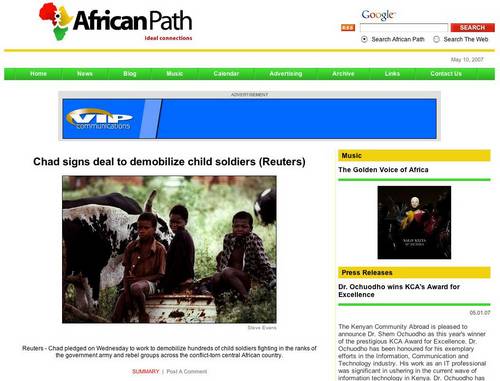
African Path is the premier online destination for Africans online providing daily breaking news and discussions on issues affecting Africans and Africa.”

7. AllAfrica
allafrica screen

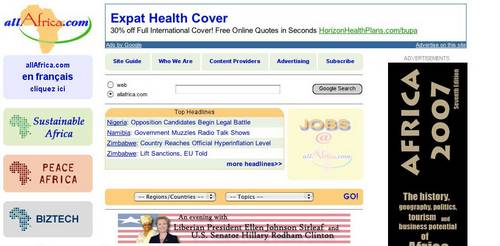
“AllAfrica Global Media is a multi-media content service provider, systems technology developer and the largest electronic distributor of African news and information worldwide.” (…) it…”is among the Internet’s largest content sites, posting over 1000 stories daily in English and French and offering a diversity of multi-lingual streaming programming as well as over 900,000 articles..”.

8. TimbuktuChronicles
timbuktu screen

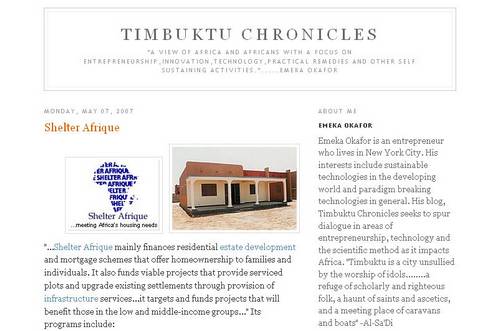
TimbuktuChronicles, a blog by Emeka Okafor on “sustainable technologies in the developing world and paradigm breaking technologies in general”.

This blog is particularly interesting as it tries to highlight some sustainable technologies and business ideas which, I believe, have in the past and will also remain the driving forces for development in Africa.
This isnt’t about some well-meant development aid by industrial countries, but about working solutions that put food on the table at the end of the day.

There are of course many other interesting websites (this listing will never be complete), and while most of them are focused on a national level, we must not forget that I only mentioned those in English. How about the Francoblogosphere?

As for Kenya – my 50% home – there are interesting sites like Mzalendo (a pretty interesting database on the Parliament of Kenya and its members and their outputs), Mashada (a community platform with a blog aggregator, forum, market place, etc.), KenyaUnlimited (KBW, the Kenyan Blogs Webring with an interesting 400+ blog feed) as well as new start-ups such as Jahazi (an online application based on XML that enables its users to configure their applications, something like portableapps.com for the many users who are bound to internet cafés) and I just received an email from the brand-new Kenyan startup Nivipi, which claims to be a “Full Community Website” like MySpace for Kenyans.

ALL of these aforementioned websites are a perfect example that WE EUROPEANS shouldn’t forget about that huge continent in the south of the globe, so close to Europe, which already provides many interesting and smart projects as well as intellecual property that shouldn’t be left out.

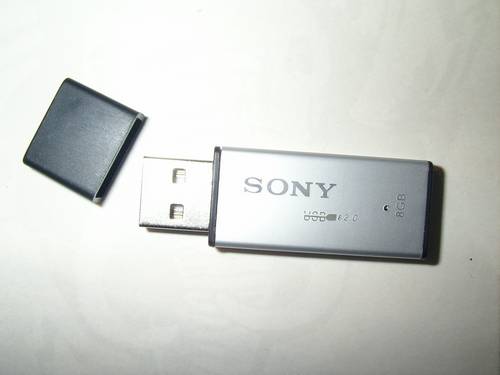
fake usb sticks

A friend of mine recently travelled for business to Guangzhou in China and was offered the following USB flash sticks at a size of 8GB each.

SANY0005

At a price of about EUR 11,- ( ~0,73 EUR/ MB) each, he quickly decided to buy two sticks. Since he was afraid of being lured into bogus deals by conmen (hey, China is evil :-), he asked for some testing – and on the salesman’s computer, these sticks just worked fine. Windows declared their size at 8 GB each.

Upon returning home, he quickly realized that these sticks actually only offer 16 MB each. 16 MB vs. 8000 MB. What a bummer!

Some quick googleing revealed the following information on the Ebay user forum:

More than 95% of all 1GB, 2GB, 4GB and 8GB USB Flash Drives listed on eBay are counterfeit items and have ‘fake’ capacities. 100% of all 16GB and 32GB USB Flash Drives are FAKE.

They were reprogrammed from much smaller cousins 128MB, 256MB and 512MB capacity drives for quick profit!

Difficult to differentiate visually, as they look like cousin to a real mccoy. Most of them even have brand new packaging, serial numbers like a real mccoy. (source)

And further down it says:

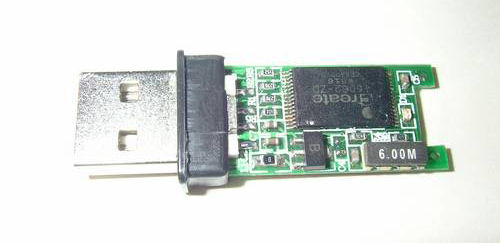
A very high percentage of the counterfeit flash memories are using Hyperstone and iCreate memory controllers, instead of the original manufacturer’s own memory controller!

Aii??

SANY0008

Now what’s that? An iCreate controller chip, isn’t it? Bingo!

And the article also informs us that “you MUST perform data test by writing a BIG (1GB/2GB/4GB/8GB) file to the usb drive, then READ back the same file from the usb drive to another location on your PC to compare. The READ back process is the only proven way to uncover its ‘REAL’ capacity.”

I am mentioning this because I know USB flash sticks have become very popular all over the world, and while I dislike them for security reasons (import of viruses to computers, quick theft of sensitive edata from companies, etc.), I also know that some of these fake sticks have been sold in Kenya as well.

Someone at our office in Embu bought a bunch of Sony “Vaio” (LOL!!) sticks in the past, and those sticks quickly quit working properly. Upon opening, we found them being made in a very cheap way and any bigger memory chip was in fact missing. And those were 1 GB sticks each which were by that time procured for a price of about Ksh. 5.000 – per stick! Argh!! Also, the office is part of the MW&I, so there you go, wondering who would actually want to cheat the GoK, and, indirectly also the rest of Kenyans.

So please, if you feel that your USB stick isn’t working the way it is supposed to be, or if you want to avoid any future problems while buying that neat 1 GB stick in downtown Nairobi, pls use a programme like this one to double check them before purchase. Might help to avoid some frustrations…

Ahh, this btw also applies to (fake) memory cards!

More on this here, here and here.

trouvailles (part 3)

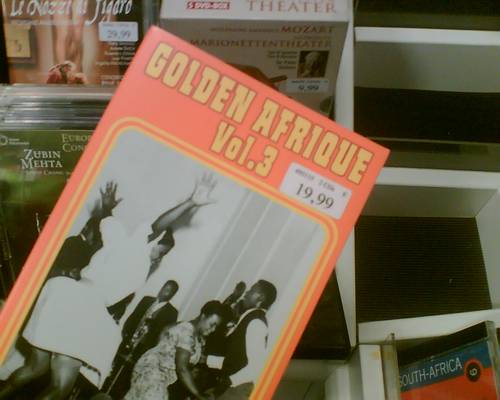
07-02d-010

Vol. 3 of the “Golden Afrique” series I mentioned some time ago….

(@Steve & Mshairi: yes, that’s something for our collection, right?)

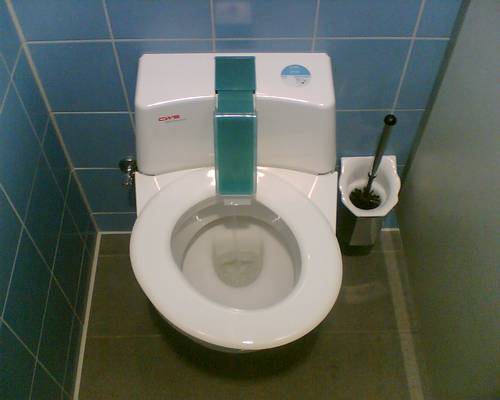
07-02d-008

An automatic, self-cleaning toilet seat. Amazing.

Just one day, Mental & yours truly will buy 1000 toilets like these and install them all over Kenya. Right?

(No no no, we will install Ecosan toilets instead and teach ppl not to dispose their old batteries inside and other waste one so often finds in public toilets around the world…).

07-02d-004

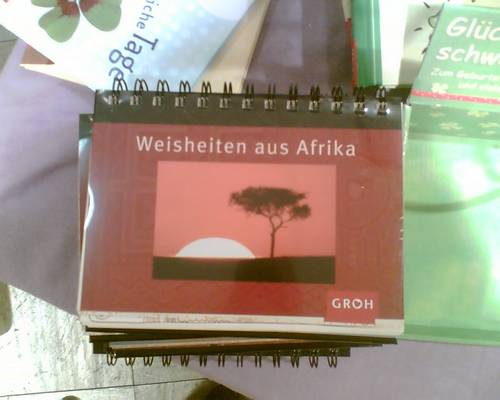
Came across this booklet with proverbs from Africa.

So, are there any books for sale in “Africa” with proverbs from “Europe”?

Dear Safaricom…

I’ve been successfully using your GPRS service on my (branded Vodafone!) Nokia 6230i in the past three months, and also took the opportunity to blog about this fine service (here and here) so that other users benefit from this technical progress which really makes a difference for wireless internet access in Kenya.

I am located in a rural area and it just adds lots of convenience to access my emails and surfing the net via my mobile and/or my computer. I wouldn’t want to miss it anymore, and I think wireless telco solutions are the future in Kenya in terms of reliability and accessibility. Thx!

However, there are still some open questions regarding your service which have come in as comments on my blog – and I would like to kindly ask you, or whoever is authorized to give an official statement on GPRS support on Safaricom.

Here are our questions:

  1. How much does it actually cost per Megabyte + V.A.T.? And how much is a megaybte? 1000 kb or 1.024 kb?
  2. How do you enable your customers to use GPRS? Is it just an activation for the SIM card / line?
  3. Are customers required to buy special GPRS phones which are supported by the network, or are the GPRS settings universal and only a few phones may receive automatic settings sent out by your service?
  4. How long does it take to activate customers on GPRS? I know there have been some users in the past months who are still waiting for their GPRS settings and/or line activation.
  5. How come the customer care line (100) is almost never available? Or is it just bad luck that I never got through so far?
  6. When will you update your (mobile office) website on GPRS usage? When I google for “safaricom gprs kenya settings” (and similar keywords), I first of all get to my own blog. Hmm. You know I am just a user who wants to share his joy with others. The blogging approach though might add to the Google ranking.
    In other words: update your website more often, and potential customers/users will figure it out themselves on how to use GPRS with Safaricom. Just like we did.
    (Please correct me if I am wrong on this one, but my assumption is that most GPRS users in Kenya are still above the kawaida level – geeks, to be precise, who first of all google for their informations needed before they try out the busy #100 helpline.)
  7. What can customers do to speed up the process of getting their GPRS settings? Can we walk in your Westlands office on Waiyaki Way in Nairobi and ask for the settings? I went to Sarit Centre’s Safaricom retailer the other day and asked for details, but the guy there just didn’t even know that GPRS also works for prepaid customers.
    UPDATES:
  8. aegeus asks: “I have been unable to use the GPRS service beyond 10 pm weekdays, is this interruption scheduled or part of the limits of the service?”
  9. and: “And can they provide a discounted price preference like the competitors whose postpaid customers are charged at 8 bob per 1mb, down from 10 bob if their usage exceeds a certain level?”
  10. AfroM asks: “…those of us in US have been having issues with their SMS services, our counterparts in Kenya receive the messages we send them but we do not receive their replies, yet they get charged for the SMS they sent to us?”
  11. 60/\/\ asks: “Why don’t the GMail app and some other applications like MJabber work.” (yeah, why not?!?!)

Any constructive comments on those questions will be highly appreciated by me and the various readers of this blog. Thx!

@everyone: if you know more or have further questions, pls put them as a comment and I’ll add them to the list…

back to shaggz

…but this time I am prepared! :-)

SANY9620

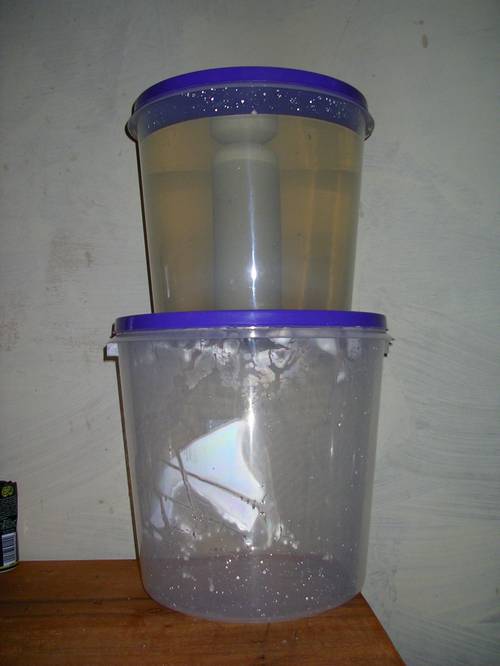
AOB: I modified my gravity water filter and bought some new parts at Nakumatt when I was in Nbo. A STEFANI water filter candooool (ceramic catridge) which is way much better than this simple ceramic filter I’ve used before. The purifying process works through a) ceramic filtration, b) sterilisation through a Coloidal Silver cover and c) granular activated carbon, which adsorbs chlorine, taste, odours and organic chemicals. Also, I’ve managed to obtain one of those really hard to get plastic water taps that make it so much easier to release the purified water from the lower bucket. I’d previously installed a normal, 1/2 inch brass tap which had a really bad hydraulic behaviour (Hola Bwana Toricelli!).

Having modified this gravity water filter, the cost scheme changes to:

2 x buckets @ Ksh. 90 => Ksh. 180
1 x water purifier candle with activated carbon & coloidal silver => Ksh. 795
1 x plastic water tap => Ksh. 415
TOTAL: Ksh. 1390 /=

The very same system sells for Ksh. 2000/= in Embu, and there’s only one shop in town (run by a retired colleague from the WRMA :-) that sells these filter systems in the whole area. Now, that’s much more than the initial Ksh. 400 /=, but still a wise investment – given that I will drink more water in future which is why I came up with my own filter in the first place.

SANY9618

As for those wondering about the yellow colour: I think that’s due to reflections by the flash. Or the camera catches more details than what meets the human eye…

@Harrycane: ich bring Dir demnächst den Messinghahn samt Tankgewinde mit – vielleicht haste da noch nen Nutzen für im Hostel?

crown caps

06-11d001

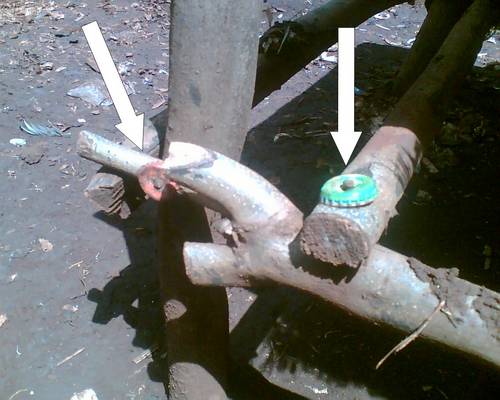
…sometimes I think an “ingenuity award” should be given to those smart ppl around the globe who have started using crown caps as washers for their various constructions. There are a lot of things one can make out of these crown caps. Ear rings, washers, knifes (?), notebook hinges :-)…anything else?

I’ll take this occasion to introduce a new category to my blog (although, yeah, categories are sooo Web 1.0 as (technorati) keywords seem to be the “in-thing” since about a year now, but wth…): imagineering.

A term introduced (to me, that is) by these guys from Denmark who have blessed the world with the Life Straw (what happened to it anyways?) and who are responsible for those PermaNet mosquito nets which are for sale in Kenya and elsewhere for something around EUR 8,-. Imagineering has its origin somewhere else though… and the crown caps used as washers are a typical example of imagineering. U know, not everyone grows up with LEGO or FisherPrice toys – and still there are a lot of ppl out there who have become quite technical (despite any missing technical machinery during their childhood) and they instantly see how things can be fixed with jua kali methods. After all, it works and it’s a great way to re-use crown caps.

Creativity is one of the sexiest things in the world.

How to make…a water filter

Almost all supermarkets in Kenya sell bottled water, and many also sell special water filters with about 1-3 filter candles inside. These filters are available in different sizes, often made out of stainless steel and will cost about Ksh. 1800/= (~ US-$ 25,- // EUR 20,-). To filter the water, all you have to do is put a litre of it on the top container and wait for it to percolate through the ceramic filter element into the container below which of course takes some time.

I also wanted to have such a filter system to filter the tap water, but I wasn’t willing to invest so much money. Also, I’ve seen this alternative filter system in use at our office – so it became clear that I had to build my own and see that I don’t spend too much money on this DIY project. Many households all over the country use these water filter systems these days – which is good!

SANY9202

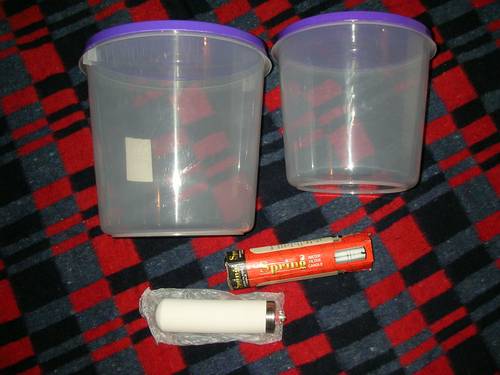
All you’ll need for the water filter are two containers with flat covers (so that they can be stacked), a ceramic water filter element and a sharp knife to drill the two holes. A tap should actually be fixed to the bottom of the bigger container to easily drain the filtered water, but isn’t needed per se for the functioning of this filter. I will add a tap within the next few days, though.

Costs:

– two containers at different sizes @ Ksh. 99 and Ksh. 89 (~ EUR 1,- each)
– ceramic water filter element @ Ksh. 179 (~ EUR 2,-)
– a small tap @ Ksh. 90 (~ EUR 1,-)

…which sums up to about Ksh. 400 /= or EUR 4,40 / US-$ 5,60 …and considering that a litre of bottled water costs around Ksh. 40 /=, this filter element makes sense after the tenth litre of filtered water. After all, every litre that doesn’t come in a PET bottle is better, as it helps to preserve the environment.

SANY9205

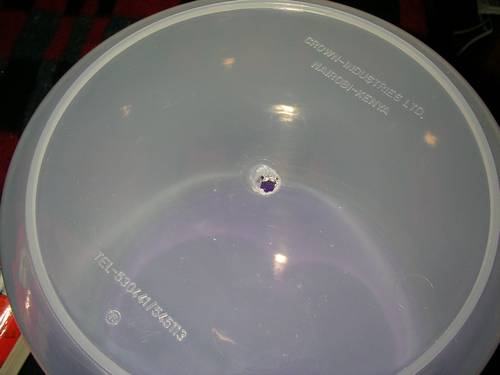
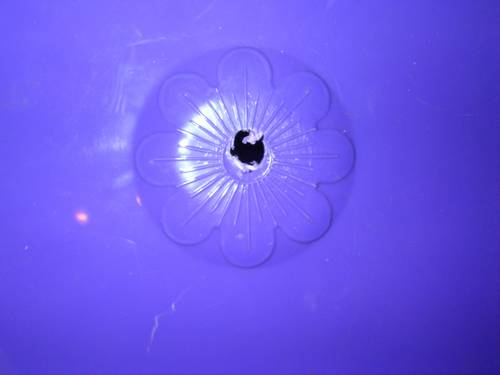
1. take a sharp knife and drill a small hole at the bottom of the top container

SANY9206

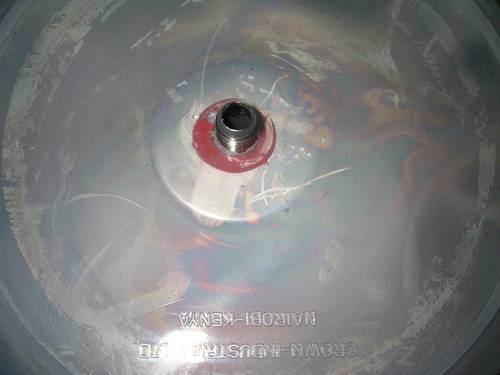
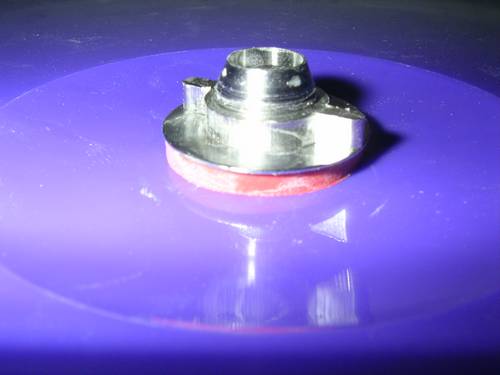
2. screw the ceramic filter element through the hole and make sure the rubber washers are in place

SANY9207

3. drill a hole into the lid of the lower container

SANY9209

4. fix the lid to the top container & the filter element – make sure to really tighten the nut

SANY9211

5. et voil? – the finished water filter in use.

Our tap water here is a bit brownish – the other day I was refiiling my water heater and found a cockroach leg in the sieve. Also, this low budget filter should be used for harvested rain and borehole water only, as the filter doesn’t remove fine traces of chemical substances.

UPDATE: I’ve meanwhile fixed a small tap – which doesn’t work that well, though. Make sure to clean any new candle before fixing it for the first time.

UPDATE #2: Tom of Aid Workers Net advised me to include a disclaimer as someone “is just waiting to replicate the steps incorrectly, make themselves ill and blame you”. True! THX!!

In a world of hot coffee pots, sharp knives and suffocating plastic bags, please be advised THAT YOU WILL BE SOLELY RESPONSIBLE FOR ANY DAMAGE RESULTING FROM YOUR OWN ACTIONS. EVERYTHING YOU DO WITH THE INFORMATION OBTAINED THROUGH THIS ARTICLE IS DONE AT YOUR OWN RISK.

UPDATE #3: There are of course different types of filtering candles. The one i used is rather cheap and only consists of ceramic and some silver lining inside, although of course of questionable quality. Hence the low price.
An alternative would be to buy bettter candles with higher filtering rates, an anticolloidal silver lining inside and activated carbon. However, such candles cost around Ksh. 1200/= (~ EUR 13,-) which is a bit too much. Also, good (plastic) taps as used on the buckets are expensive and hard to obtain in rural areas.

UPDATE #4: New filter candle + new tap!