While going through my feeds, I learned that Nintendo sold over 10 million Wii video game consoles since December 2006.
Amazing.

While going through my feeds, I learned that Nintendo sold over 10 million Wii video game consoles since December 2006.
Amazing.
There’s this lady who was recently forced to buy a new mobile phone as her old one had decided to go into early retirement.
With the option of storing names + numbers on a SIM card, the transition between two phones should be relatively easy. Storing capacities for SIM cards depend on what the network provider estimates as being sufficient for it’s customers: whereas Vodafone Germany for some particular reason keeps on issuing SIM cards that can only store 200 names + numbers, Safaricom in Kenya (which is partly owned by the Vodafone empire) gave me one for storing up to 250 names and numbers.
Being able to store 100, 150, 200 or even 250 names+numbers on your phone, most ppl will argue, may be enough for the average user. On my phone, for instance, I used to have around 240 entries, whereby some contacts come with 2-3 different numbers and an e-mail address. Copying such a telephone book from the phone’s internal memory onto the SIM card results in having one entry for each number:
e.g. Kamau Njoroge ; +254720123456 ; +491701234567
would turn into something like
Kamau Njoroge1 ; +254720123456
Kamau Njoroge2 ; +491701234567
Obviously, such a scenario (and the reality with most phone users!) isn’t very user-friendly. Another option is installing the synchronisation software that comes with most phones and creating a backup from the old phone, which is then copied onto the new one. And if you’re changing from brand A to brand B, compatibility issues may appear, as not all synchro programs are compatible. This actually is one of the reasons why many ppl out there are using MS Outlook – the common denominator for most Personal Information Manager (PIM) needs, as most mobile phone synchronisation programs are (at least) compatible with MS Outlook.
Another possible scenario is that your phone is lost or even stolen: while a phone is exchangeable, valuable contacts and important numbers often aren’t.
So instead of being forced to live with a crooked telephone book on your phone that is vulnerable to a) strange storing options on an relatively old system of SIM cards (which just allow one number per name), b) the loss of important data in case of theft, loss of equipment and c) the dependency on a commercial PIM solution (~ MS Outlook is shipped with MS Office), there’s another beautiful workaround:
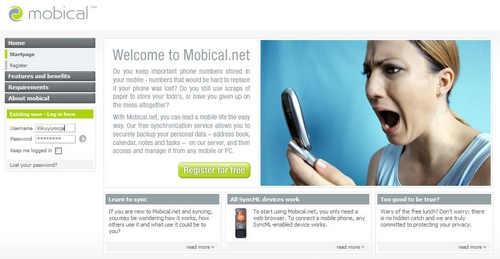
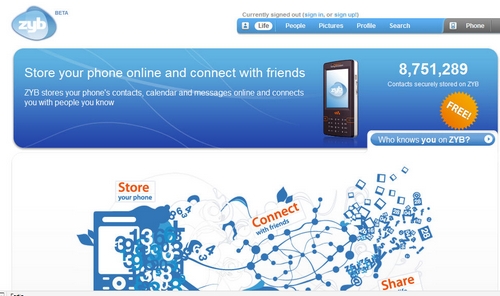
While not all phones are compatible with these services, what mobical.net and zyb.com actually offer as a basic + free service is that they allow you to completely backup your private data such as contacts, calendar entries, bookmarks, etc (no multimedia content) over the air with a synchronisation service.
Earlier last week, my new N95 had developed a problem where I had to return it to a Nokia Service Center for an exchange of the display. Fortunately, I still had an old phone around – but with an empty telephone book. This used to be a problem in the past, as I had already given up on using the SIM card as an interim storing option due to the simple fact that the SIM card was way too small for my +370 entries on the phone. The last time I synchronised my N95 with the computer, I eventually merged the phone book with the e-mail address book on my computer, resulting in a huge directoy of entries on both my phone and the computer which isn’t compatible with any SIM card and it’s limited storing options.
Now, while using mobical.net (and zyb.com as a much more interesting alternative), I was able to restore MY address book (with numbers, email & postal addresses) within 2 minutes. No need to connect the different phones to my computer (whereas the N95 wasn’t working after all, so this option wasn’t available at all), no need to install the different software packages that came with the phones – all I did was surfing on the website, selecting my phone model, asking for the synchronisation settings which were sent to my phone over the air (ota) and hitting the “synchronise now” button. The beauty is that these services actually work!
In a world where we are witnessing an almost logarithmic increase of digital data every day (~ managing e-mails, documents, contacts, etc.), it makes sense to draw a clear line between your personal data and any used hardware.
That lady I mentioned earlier was completely grounded for a few days as her old phone (an old SE 610) had a faulty joystick (a typical SonyEricsson “disease”) which, on this particular model, is directly soldered to the printed circuit board and wasn’t exchangeable. She eventually managed to access her old phone book, though, using some strange shortcuts on the still-working keypad. It took her something like 2 to 3h writing down all important numbers and another 2 to 3h re-entering those on the new phone.
With the use of a service like mobical.net (Update: now called everdroid.com), this could have been done within 2 minutes.
—————-
I am actually wondering why the two global players Google and Yahoo! still haven’t added this function to their web-based freemail services. Considering the mobile phone sector being such a fast growing market and the actual need to further develop more useful applications for this IT platform, such a service would really add value to the otherwise great services online and be a great help to the many, often already frustrated customers.
Me thinks that this is due to the “walled garden” policies we are witnessing online these days: he who controls the (user) data, also controls the market (e.g. facebook). A pity, actually, as the import and export interfaces of most applications still suck big times (im-/exporting bookmarks, im-/exporting feeds, im-/exporting contacts, etc).
Usability vs. marketing strategies?
Update August 2011 (yes!): Mobical.net is now called Everdroid and I’d recommend using them (especially if you’re on an older S40 Nokia phone that doesn’t support MS Mail for Exchange). Zyb.com was at one point in 2008 or 2009 (?) acquired by Vodafone which has since then sucked it into their empire. Whatever. So if you’re still using an older phone and/or do not yet sync your contact data with your Gmail account (MS Exchange on Nokia and the iPhone, or natively on Android devices), Everdroid may be your best option. I trust them (since 2007).
Please remember that a service like Everdroid is not the same as directly syncing your phone with Gmail. If your phone is listed here http://www.google.com/mobile/sync/, try these options. If not, then you’re better of with Everdroid (which is based on the sync protocol, unlike this Gmail mobile sync thing which is rather insufficient in my mind. Hey, we’re having 2011 now…).
I started using the free synchronisation services @ mobical.net and am pleasantly surprised at the ease with which I can now synchronize the address book on my mobile phone with an external website.
Mobical isn’t perfect, and I just use it to backup and edit my data more conveniently, but nevertheless it is a bit better than using MS Outlook (which, as an MS-Windows solution, isn’t free of charge) and best: it works. Hassle-free.
…which makes me WISH that my prefered webbased email provider should offer the possibility to actually synchronize a mobile phone’s telephone book as well as the SMS / MMS inbox, bookmarks, notes and, most importantly, the calendar with my email box. Just a neat all-in-one solution.
I wonder why in a world of wide networks and a huge repository of good, free and open software, some tasks like the exchange of data are still such an issue?! Just think of the various Character Separated Values, Comma Separated Values or Colon Separated Values (CSV) formats that exist as there’s no common standard on this. *sigh*
Which gets me to the next issue that has been bugging me for some time now: The Nokia N95 is a great telephone as it comes with lots of useful multimedia features which are still hard to find with other phones.
However, having switched from a Nokia 6230i that offered an ideal keypad to key in short messages and other text, i find the buttons on the N95 rather unuseful and also ugly. Especially the keypad just below the top screen is horrible. I wonder who passed this design from R&D to production?
Anyways, in short: i like the phone but think that it still comes in an ugly packaging. Especially the front cover could enjoy some redesign. This should actually be possible as it is only secured by four screws on the back.
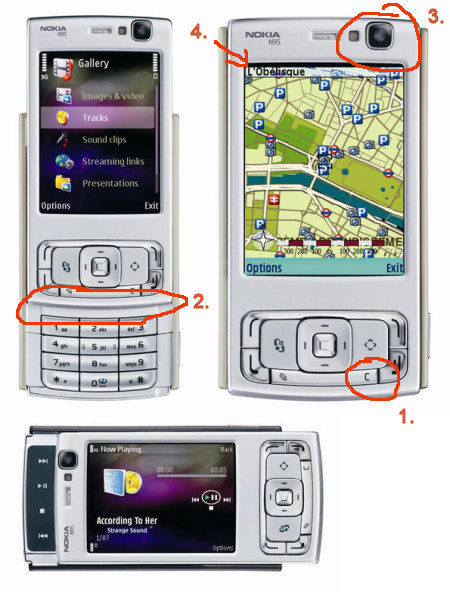
the design issues i am having with the N95…
So what’s the task?
1. the keypad on the front cover (“S60 keypad assy”) is way too narrow and I understand it was already moved down and away from the screen to shorten the distance to the actual number keypad (Nokia calls this the “ITU keypad assy”).
While writing text (e.g. sms), I sometimes type in a wrong letter which needs to be corrected. Hitting the delete (“C”) button on the front panel sometimes – unfortunately – results in hitting the red phone button by mistake => the phone goes back to the standby screen. Argh. A redesign thus should include the delete button to have a bigger size. Also, the overall size of the keypad should make use of the whole space left on the front cover.
2. Other slider phones from Nokia such as the 6110 navigator or E65 come with a gently inclined front cover. While writing text on the N95 number keypad, my thumb often hits the edge of the front panel. This could be avoided or limited by removing this artifical border and reshaping the front cover so that the thumb may freely move between the (lower) number keypad and the keypad on the front cover.
3. The front video camera on the upper right corner looks like as if it has been put there at the last moment. Obviously, there should be a better way of moulding it into the front cover.
4. I “secured” the display on my N95 with some BRANDO display protector (foil) as it a) looks as if the screen actually is a bit sensitive to scratches and b) there’s a gap between the display and the frame = no seamless transition between the display and the frame as seen with other phones (= which shows that such an approach to a better design is possible).

my 5-minutes paintshoppro’d version on a change I’d like to see on the front cover keypad..
As these modifications only apply to the cover, and exchange covers are already available via ebay & co, such a redesign should actually be possible and isn’t too far fetched. Chinese manufacturers (since you’re masters of copying adopting designs anyways) – are you listening?
Pls don’t nail me down if this has been mentioned before (as I haven’t been following KBW lately due to other obligations – which is sad because the feed is pretty much interesting these days), but I just stumpled across this interesting note on another network about a German company from Potsdam that apparently programmed a web-based interface which will allow internal whistleblowers (!) to report any cases of corruption anonymously.
In Kenya, that is.
The Kenya Anti Corruption Commission? recently implemented the Business Keeper Monitoring System (BKMS®) which shall assure “anonymity & information confidentiality” as well as an “anonymous diaologue”.
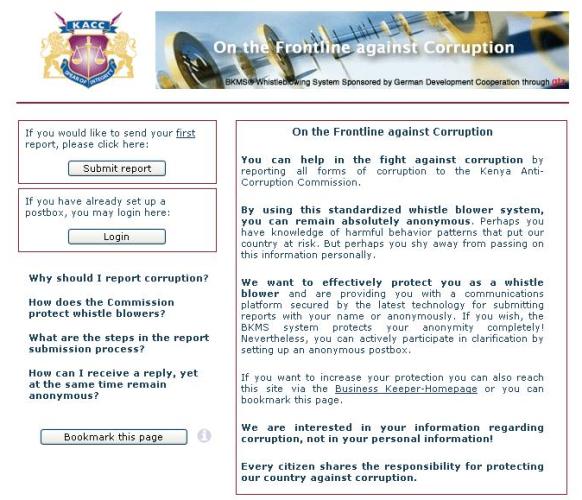
screenshot from the website
Says it on their website: “The BKMS®? system is used as an internet-based communication platform by whistleblowers worldwide (employees in companies and administrations as well as outsiders) to report misconduct and risks. If necessary, whistleblowers can remain absolutely anonymous in order to be protected against repressive measures.”
Obviously, such a system may not be working for those poor souls who are constantly harassed by the police, and may also come too late for Mr David Munyakei (1, 2, ex 3), but it’s a good start, I think. Also, I am wondering about the – fear – this may generate among members of the public service.
According to the website, the BKMS system is already? in use? with some companies and orgnanisations in Europe, but I wonder if anything like that has already been applied to the EU commission? Ah?
One of the most tiring aspects within the field of sanitation are endless debates about the sustainability of sanitation.
On one hand there are those who are interested in conventional waste water treatment, and who are making a living out of investing into, optimizing or selling waste water treatment plants. Take Germany, for instance. The sewage system is well approved, a very high percentage of houses is connected to centralized waste water treatment plants and these things just work. The aim of such systems is to reduce the organic content of waste water which then allows the “cleaned” water to be discharged into the next river.
And then there’s something commonly referred to as sustainable sanitation.
Sustainability. What does sustainability mean?
Obviously, sustainability at first sight is just another keyword such as capacity development or knowledge management. Ask your neighbours how they’d define the meaning of sustainability, and I am sure you’ll get many different answers.
According to the “Network for the development of Sustainable approaches for large scale implementation of Sanitation in Africa” (NETSSAF), sustainable sanitation refers to sanitation systems that protect and promote human health, do not contribute to environmental degradation or depletion of the resource base, are technically and institutionally appropriate, economically viable and socially acceptable, being the issue of reuse and recycling an optional feature.
“The issue of reuse and recycling” is often termed as something we call ecological (and economical) sanitation (ecosan). I am currently active in the field of ecosan, and it seems that I have to constantly explain the meaning of ecosan, and why I think this approach makes sense – despite of the many unsatisfactory issues that still come along with most ecosan concepts.
The ecosan concept is mainly based on the following principles:
Having mentioned this theoretical background, let’s look at the practical side of it, and why I felt a need to blog about this issue in the first place:
Kibera, this huge informal settlement in Nairobi is Kenya’s and even Africa’s biggest “slum”. Many of my readers know about Kibera, and many also know that there have been numerous projects in the past, trying to “promote” the living standards of people in Kibera. One of those standards actually is access to proper sanitation.
There are a few “normal” toilets latrines in Kibera that have been installed in the past, but many of them are too costly for daily use and still the number of available toilets latrines? is hilarious compared to the actual need. How many people live in Kibera? Too many!
Also, Kibera faces various problems such as a high crime rate, unstable ground which complicates the construction of proper buildings and a very unusable topography. In short: Kibera is a way too crowded piece of land with a very bad starting position.
People who live from hand-to-mouth all their life and are trying to survive each day, don’t think about sustainability issues. What they want are working toilets that don’t overflow during the rainy seasons, clean, free of charge and maybe also secure to use during night time.
If you’re into this sanitation business, there apparently is no time for endless debates on sustainable approaches to sanitation. Something needs to be done, and as the Millenium Development Goals (MDGs) predict, change has to happen – soon.
So there you are, trying to figure out the best sanitational concept for an informal settlement such as Kibera. A sustainable concept that is accepted by it’s users, reliable, convenient and affordable. This process actually is quite difficult, as most of these sustainable concepts require a certain level of ownership among its users, and, most importantly, some time and enough space to develope. Remember: Kibera is a crowded area. Just think of the Biogas latrine in Kibera we recently mentioned over at Afrigadget – I was told that the digestion tanks are too small, so the digested biomass comes out half “raw” – and is just disposed of into the next river. Obviously, while energy is generated out of the biomass, there’s still no good concept behind this installation that provides a closing of nutrient loops.
Nutrients, yes, as the human excreta contain nutrients which could be used as a fertilizer on the shamba. Just think of cow dung, and you get the point. Obviously, reusing these nutrients has to be put on the sanitation agenda as there’s no such thing as “waste”.
For those big players in the industry though, the conventional waste water treatment business where dirty water is cleaned and nutrients effectively eliminated is more interesting than relatively simple technologies such as the ecosan approach.
On one hand, there’s the (sometimes justified) critisicm towards ecosan and that it works best in theory, and on the other hand, a relatively low cost technology such as a Urine Divertion Dehydration Toilet (UDDT) – with already over one million installations in China! – simply doesn’t generate any benefit for industrialized nations. ==> How does Europe profit from disseminating low-tech, low-cost toilets to Africa? How do the various engineering companies benefit from this technology if instead they are interested in selling conventional, cost-intensive, high-tech systems that also require lots of maintenance (= revenue)?
Whenever I open the various professional journals that deal with sanitation issues, I so often only come across these high-tech systems that basically only deal with the issue of treating “dirty” water (blackwater, greywater, yellowwater) as “waste” where nutrients have to be cleaned out. And yet at the same time, these very same people talk about sustainability, and how they can optimize their systems towards more sustainability.
Well, for a green approach to sanitation that actively tries to close loops (= keeping nutrients in a biological and technical loop), a paradigm shift is actually needed. And so you can well imagine that there’s an endless debate on the definition of what ecosan actually stands for and what it brings to the people. Users, who are supposed to accept and use such systems, have to get an understanding of why such low-tech toilets are actually better than conventional flush toilets, and companies who have previously made a profit by selling high-tech machines have to understand that even in Germany, where most waste water treatment plants actually work in a very stable mode and are constantly optimized, the future is set towards sustainable sanitation. To my understanding, the production of waste water on normal (“modern”) flush toilets is far far away from any sustainability. Sure, it is an improvement to simple pit latrines, but in countries where the majority of the population doesn’t have access to any proper sanitation facilities, it makes sense (to me) to invest into good systems that provide a benefit to its users and the environment in the long run.
The Chinese understood this concept some years ago (heck, even 2.000 years ago) and consequently promoted this technology so as to keep some nutrients in a loop and water consumption for sanitation on a low level. China is a good example that this technology actually works, and so we must never forget that most “wars” on sanitation issues aren’t based on ideological reasons, but instead perilled business opportunities.
I sometimes wish more and more companies would wake up and see this as a new business opportunity. Public toilets, based on sustainable principles – that’s such a huge market ready to be skimmed.
(oh, and btw: what’s the difference between a toilet and a latrine? and for which countries does this definition apply?)
[Disclaimer: I am currently reading David Weinberger’s latest book “Everything is Miscellaneous”, which seems to be just as exciting as “The Cluetrain Manifesto” from 1999 (which I back then forwarded to my boss @ work) or my prof‘s “Cradle to Cradle” bible – books that inspired me and have a long-lasting effect…]
The organization I am currently working for (as an intern) has a relatively huge repository of technical datasheets with lots of interesting articles and archived knowledge. Most of these datasheets are saved as PDFs and published online, searchable through a site-internal search interface and only identifiable through their title. Obviously, a smart headline leads to proper search results.
The other system they are maintaining is a document management system (DMS) which is a nice step forward into the right direction. Only, what it lacks is a quality search.
Most of you have already started to appreciate the advantages of social bookmarking – where humans work as filters and often only save interesting pages, thus raising the quality of any obtained information. I prefer del.icio.us to most Google search results, unless I am e.g. looking for an image where I need to have the wider choice of search results.
Now with this above mentioned organization in mind that has in the past tried to backup its digital data into a file repository, what seems to be lacking is a tagging-mashup. Something like an add-on for the DMS (=> yeah, there goes the API question) that consists of another database which only stores a) quality keywords and b) the links to each document. So instead of doing an ordinary search on the DMS, which will return Google-alike search results (displaying all results on a certain keyword), the add-on would only deliver those results that have been declared as “quality content” by its users.
So you see, the basic idea behind this blog post was that while I know a lot of ppl are already fed up with Web2.0 terminologies and the hype around it, others have only just started to realize what this is actually all about. And while some private individuals are already power users of Flickr, Technorati & Delicious tagging-worlds, most companies still need to start realizing this huge potential. Just as many of them have never even heard of the Cluetrain Manifesto… *sigh*
(this is SUCH a huge market?!?!…)
Someone pls put a 5mpx cam + decent Xenon flash on the iPhone – and I will sell my WinXP notebook, move to the USA and become one of those Apple disciples.
The iPhone keyboard alone is reason enough for me to sit here and sigh in astonishment.
Nevertheless, I will not wait for the 2nd generation to come out, but instead go and buy that other gadgetimoja that goes by the name of Nokia N95. Because – contrary to the full price others have to pay for a new phone – we over here in Germany are able to sign for two phone line contracts for about 10,- EUR/month each (for 24 month) and get a subsidized phone for free. The only “problem” is that most users feel a bit uncomfy about the fact that they are actually having 2 inactive phone lines / SIM cards waiting in the drawer on which they are sometimes even having free airtime & sms packages bundled with…
[update]:
…but the battery life of the iPhone making calls wasn’t great; we measured it at 4 hours and 3 minutes in our first test and 5 hours and 1 minute in our second….(…)…. is significantly shorter than the LG Prada and the N95. …(…)…. For most users (such as commuters), we’d reccomend that you charge it every day. (source)
Now that’s the same thing others have said about the N95 before….however – just as everyone will be quite aware that any such gadget won’t have great battery runtimes with all these gizmos onboard – the N95 at least has an exchangeable battery. And a better camera with video recording. And GPS. And no stupid network limitations.
And… :-)
A company’s seriousness about the implementation of web technologies clearly shows when it comes to the browser question: what kind of? browser are we using today? MSIE 6.0?? Are we going to give our? users the rights to install any add-ons or extensions to a browser? etc.
Chris, a? knowledge management and communications specialist and a? really nice fellow I met through? Mzeecedric? (of Zungu.net) &? a recent barcamp in Frankfurt/M, compiled an introduction to knowledge sharing within Enterprise2.0 earlier last week. And although it’s just an introduction that symbolizes the tip of the iceberg -? an iceberg which stands for? the much awaited change within companies and their pre-cluetrain / web 1.0 world – there are still so many basic things that just have to be explained over and over again.
Social bookmarking, for instance. Although the installation of any add-ons is strictly forbidden within this institution, I took the liberty to install a del.icio.us add-on for MSIE 6.0 anyways (ooops? :-). I’d of course prefer using a better browser and already tried runing Mozilla Firefox from a USB stick (as mentioned earlier), but then: MSIE 6.0 actually is ok for the time being. I don’t want to change the system, all I want to do is getting things done. And with a social bookmarking tool like del.ico.us, I can actually share my trouvailles with others and contribute to that pre-selected pool of interesting websites – the bonus which makes social bookmarking so interesting and advantageous.
These web worlds of course aren’t everything, but I just can’t drop that crazy idea of informing my colleagues @ work about the wonderful advantages of using Web 2.0 technologies for many office jobs. We have to start somewhere, really.
Oh, and maybe I should start by convincing my boss of using a service like twitter – which would make it much easier for us to track her down and/or? forwarding calls.