“Wie-geht-das”-Anleitung für Mama & Co.

Hier jetzt mal etwas ganz anderes, nämlich eine *Wie-geht-das?*-Anleitung für meine Mum und andere (ältere) Freunde, die neben dem Internet immer noch gerne in der Papierausgabe ihrer Lieblingszeitung stöbern.

Eines auch gleich vorweg: es gibt im Internet viele Möglichkeiten, um an Informationen heranzukommen. Diese Anleitung ist nicht all-umfassend und sicherlich auch nicht der beste Weg, aber dafür meiner Meinung nach relativ zukunftssicher…

Continue reading ““Wie-geht-das”-Anleitung für Mama & Co.”

8W Computing

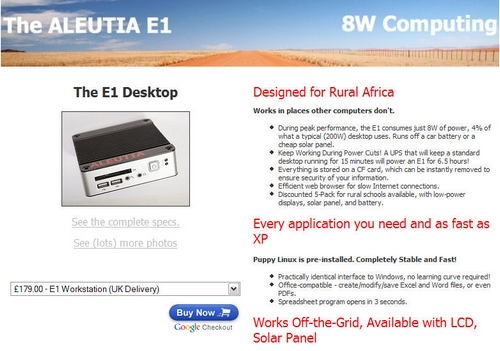
Germany’s Heise Online (IT news) carried this not-so-new-news today about the ALEUTIA E1 Desktop computer which is said to consume only 8W and comes with a 200 MHz CPU, 128 MB SDRAM, 2 GB CF card, 3 USB 2.0 ports, 10/100 NIC, VGA up to 1280×1024 and an interesting carry-on size. Best features though are that it runs on Puppy Linux (2.14) OS which looks similar to what experienced users may be to used to from the MS-Windows environment.

aleuta

This machine is based on the eBox-2300SX “Mini Green PC” and has – in my opinion – just been equipped with some sexy marketing keywords (Africa, rural, internet, power supply, solar, etc.), although these guys behind Aleutia have indeed found the right arguments to promote their product.

So….no matter what technology you prefer (given the many different systems we have been blogging about during the last two years), my question is:
would YOU buy this for your folks back home @ shaggs*?

Yes?

My other question is: IF these computers are so much better – how come they are never bought by dev aid agencies who are supposed to know the disadvantages and unreliability of a MS-Win machine in most office environments all over the world and who actually have the political and economical power to stir such purchases in this direction?
I know that in most cases, money is just given to someone who then arranges a deal with a local HP, DELL, IBM representative + WinXP + the usual setup. So instead of talking about sexier computer solutions that may be more reliable in unstable working conditions (power supply, heat, dust, many users, malware, etc.), how about some political will from top-down that directly promotes the purchase of such computers in future?

(*i think that most ppl will just have an older MS WinXP laptop which is then forwarded to younger members of the extended family and which will presumably die after the first half year in use due to an unstable power supply, some heat problems or malware and/or missing WinXP recovery CDs…now IF i was much more into IT and an unemployed graduate of any varsity, I’d buy these used computers from KTs and refurbish them with a stable X release and then sell them to folks upcountry. but hey – that’s just me thinking loud…)

will work 4 bandwidth

I’ve said it before: the moment, bandwidth becomes available at reasonable rates in Kenya, I – and I guess a lot of other KenyaTourists (KTs) – will resettle to Kenya. Ama?

“The entry of the cable is expected to cut bandwidth costs, currently standing between $6,500 (Sh435,500) and $7,500 (Sh502, 500) per megabyte to around $400 (Sh26,800) per megabyte.” ??? (src)

Seriously, with this initiative by the WB / GoK to subsidise broadband costs in Kenya for the Business Processing and Outsourcing (BPO) Sector, let’s hope that things are improving a little bit faster and that it will help to create a healthy competition within the Kenyan ICT sector + enabling them to compete with other regional players.
If you’re already on broadband, you may be interested in this video where the CEO of Kencall, Nicholas Nesbitt, talks about the relatively high monthly costs of running a call center in Kenya today. Other videos on regional players (aka the competition) are available here.

Imho, it will eventually come down to a few big players who are a) able to afford all these membership fees to this and that political lobbying group, b) able to afford 24/7/365 power supply to their machines and c) able to afford a serious admin team who will make use of *secure* software so that business doesn’t stall just because someone distributed a virus or other malware.

However, the following quote from the above mentioned article really impressed me the most:

To ensure more Kenyans access the digitized services easily, the government is also facilitating installation of Digital Villages countrywide.

This will save citizens the agony of traveling to urban centres to access the online government services and encourage growth of the sector.

To me, this is exactly what people like Prof Ayittey are trying to explain: helping the “Atingas” to promote their business in rural areas as they are the ones who contribute the biggest part to the economy.
And for me, as an environmenatlist/marketing guy for proper sanitation facilities, anything that helps to reduce urbanisation (= by creating local incentives, even if it’s the availability of enough bandwidth in rural areas) is the right approach to promote growth in rural areas. We urgently have to create a good framework for the next generation so that they want to stay in their home area.

On another note: what happens to the Raila/Kibaki virus once the elections are over? Is there any expiry date on them? :-D

mobile blogging, part 1.5

As long as part 2 on mobile blogging is in the pipe (blogging…as in “publishing content online”), check out this story on the “Mobile Journalism Toolkit“.

An impressive setup with the right, self-made (!) add-ons to improve the N95’s performance. Now I only wish Nokia would improve the firmware on the N95-1 and even add some extras to the S60 browser.

(note to myself: i should become a journalist so that I can get my hands on fancy gadgets instead of saving my mbeca for these gimmicks..)

Naaaaaaarf!

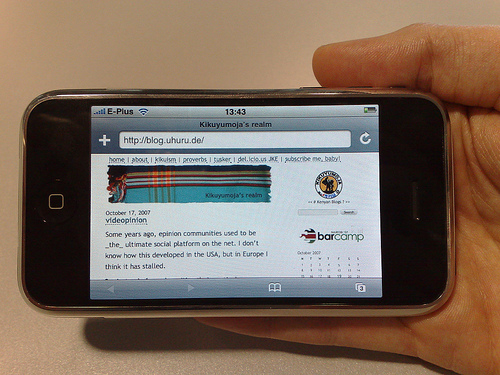
My colleague has an iPhone.
1634821822_beb6ecf64f.jpg
Kiku’s Realm on an iPhone

Interesting fact: the iPhone will be officially available in Germany via T-Mobile (the only network in Germany that supports EDGE) from November 9th onwards. Rumour has it that it will at least cost a monthly fee of EUR 50,- which will include some free airtime and free sms. Plus the subsidized cost of the phone, of course, which I think will settle somewhere between EUR 299,- and 399,- [update: it will be EUR 399,-].

The other alternative is to import it from the US and hack it yourself – this is what my colleague did. Some of these phones are selling for at least EUR 400,- on eBay Germany (most of them for something around EUR 550,-), but he bought it in the US, had it sent to someone who just came over for a visit and hacked it last night. He just showed it to me during the lunch break and I have to admit: the iPhone scores exactly where my Nokia N95 has its downsides, namely the interface / usability, speed and and internet surfing experience.

Coming to an interim conclusion of my first hands-on impression: if you’re into surfing the net via Wi-Fi and if your network provider supports EDGE technology, if you’re not the MMS person and want to use e-mail instead, if you hardly ever use the phone’s camera and just want a great substitute for your E61(i) or Blackberry…then the iPhone is the right phone for you.
All others who need more multimedia functions may go for the N95, but frankly said: if I could swap the internal GPS on my N95 for a much better battery runtime, a much better browser (both browsers are based on Apple’s Safari core!) and a brick format (no movable parts = less problems), heck – i would immediately switch phones. Comparing the N95 with the iPhone isn’t fair, though. They just happen to compete on the same market but were made for completely different user groups, I think.

Oh, and the best thing about his deal: he just spent something like EUR 280,- on the phone due to the awesome exchange rate to the US-$. With EUR 280,-, I won’t even get a Nokia E61i… and THAT is sweet. An iPhone for EUR 280,- while the N95 currently retails for EUR 559,-!

@Mental: you may want to go for the iPhone…
@Mathias: kannst Du mir bitte ein iPhone mitbringen? :-)
@Bambi: *sigh*…please? prrrreeeezzzzee?
@CK: there you go…

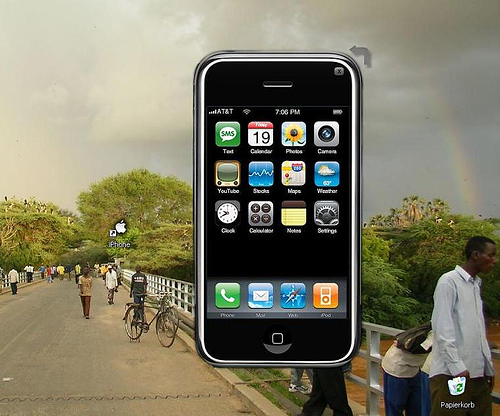
[Update]: Ok ok ok…Bambi says NO! to the iPhone (NO! as in NO!), and since Bambi also is the Minister of Finances @ Kiku’s Realm, I’ll have to stick to this virtual (but nevertheless also neat) desktop iPhone realized through Adobe’s AIR tool:
1637027105_52cbe76495.jpg

[UPDATE 2]: CG just sent me a link to macnotes where it says that the tariffs will include a flatrate for EDGE and all T-Mobile hotspots. Hmmmmm… The iPhone lacking UMTS (3G) support may be ignored with a flatrate for T-Mobile hotspots, but still: all tariffs are just too expensive. And besides – even since the iPhone doesn’t support MMS – selling sms for 0,19 EUR is just sooo…1990s. T-Mobile and Vodafone both have great coverage and network speeds, but their approach to consumers is just an insult day after day.

some things I’d like to see more often…

1. waterless urinals

urinals mstand1

Waterless instead of waterfree because you’ll always need some liquid to clean the system, but still: water is such a valuable resource – too valuable to flush it down the toilet. And while some systems require a liquid in order to transport any faeces and urine (~ waste water, sewerage), the urinals for men could easily be switched from flushing urinals to waterless urinals. These technologies work in any country and culture (!), are already available (PDF) at different technology levels (simple & cheap <=> complex & expensive) and are just as “smelly” as any other flush toilet (or even less!).

The image on top left comes from a brochure @ Urimat.com, a very inovative company that just won numerous prices for their urinal designs. Please note the read arrow which highlights the advertisment area. Now just think of the adopt-a-light concept and you’ll get the idea: public toilets that offer free sanitation and are financed through advertisment and a possible sale of urine as fertilizer (in case of waterless urinals with urine diversion). With an average exposure time of 40 seconds, these ads make sense and are read by most (male) customers.

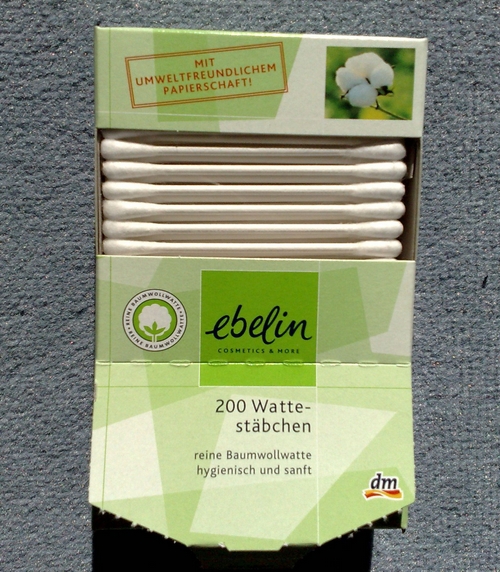
2. cotton (ear) swabs with paper sticks

14102007400

Cotton swabs or Q-Tips made out of rolled paper instead of extruded plastic. Not that the paper approach is such a new invention, but most supermarkets still only sell the plastic version so far. I bought this package as pictured above the other day for EUR 0,55 – the plastic version next to it was 10 €-cents cheaper.

My interest in these is because while working on a treatment plant, I came across HUGE amounts of plastic sticks from Q-Tips in various pumpes and pipes which had to be cleaned daily because of these plastic items some people out there for some strange reason still keep on disposing of through the toilet. I’ve blogged about this earlier here and here, and since you’ll never be able to change the human behaviour, the only solution obviously is to change the way these products are made. Rolled paper is more likely to dissolve in (waste) water than plastics, and bioplastics may at this time still be too expensive for such a usage.

(the Wikipedia entry says that the rolled paper version is still the most common but since I often only see the plastic version, I wonder on which facts this assumption is based? plastic sticks aren’t good, i think).

3. mobile tooth brushes

14102007395 14102007391

14102007394 14102007398

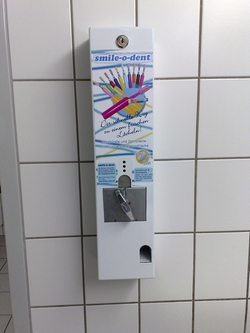
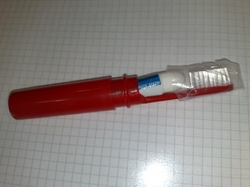
Ok now this is pure luxury, not at all sustainable and I can’t see any environmental friendliness, but these mobile, (one-way) toothbrushes are quite handy for those moments when you just need them. I wonder why their sale is limited (in Germany) to airport restrooms only. One brush with paste sells for EUR 1,-. I bought the one in red and gave it to someone special :-)

tbc…

Free Loader

B000ODRNDA.01-A1QFNL2XFCZ5IG

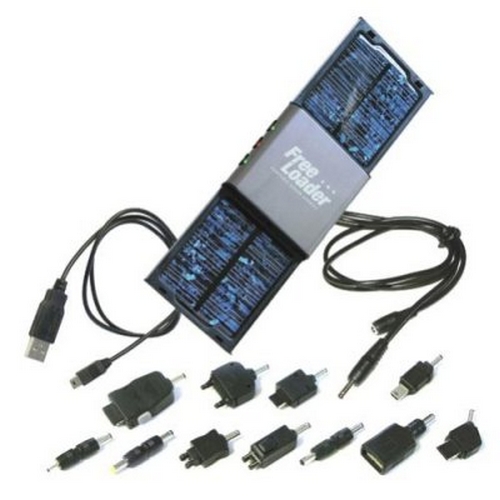
Has anyone of you ever used this little solar charger called “Free Loader”?

Found it advertised in a magazine, a blogged review here (in German), sells for EUR 49,90 or GBP 29,99 and it comes with the cables & adapters as shown in the picture.

I am bit sceptic about these gadgets because my experience based on my own tests with solar chargers many years ago (I got my first solar set in 1988 :-) proved that these chargers (of course) aren’t as powerful as they are supposed to be (from a customer perspective), but I guess when the battery on your mobile gadget is dying out, anything that helps recharging it will do just fine.

Oh, and another reason why I should just order it no matter what: this gadgetimoja has been on Mt. Kilimanjaro! *big smile*? More reviews here, here and here.

@Harry: you should blog that mobile rewinder/dynamo thing we’ve tested the other day in Nbo! What’s the current output anyways?