How to reactivate your 2,5″ HDD

I have this broken 6GB 2,5″ hard disk drive (HDD) I recently removed from an old notebook. The notebook is fine, but this HDD just refused to work. It requires some a) sweet talking, b)prayers or c) external pressure to get this thing going again. After all, all I want is to retrieve the data from this HDD.
Having said that, options a) and b) didn’t bring the required change, so I had to apply option c): external pressure.
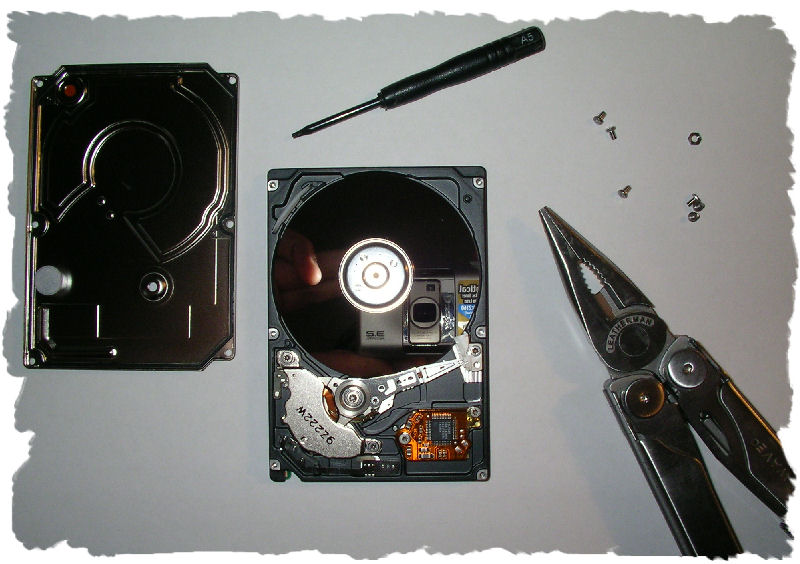
af1.jpg
Here’s what you’ll need to open a 2,5″ HDD: a TORX #6 screwdriver, a multitool / pliers to remove the small nut which is right below the sticker on the front cover (that brownish thing on the HDD plates is the reflection of my finger :-)

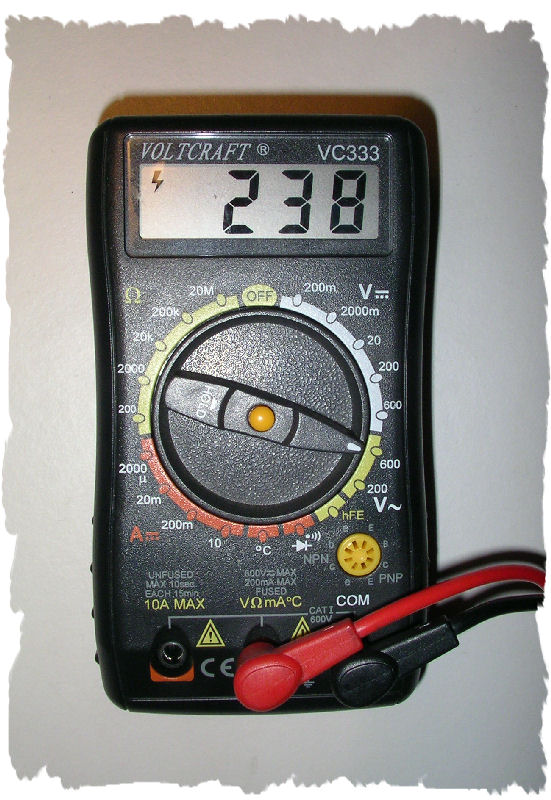
Now, what’s pressure? Think of powaaafullll women awaiting the press their husbands with a rolling pin or even a frying pan and you get the picture. In terms of electrical devices, this pressure relates to a an extra ordinary high voltage. Whereas this small 2,5″ HDD normally requires a low voltage of only 5 Volts (n.b.: USB port provides this voltage @ 500mA), I took the convenience of using the ~220 Voltage provided directly from the socket (as you can see from the picture, that voltage is even higher).
af2.jpg

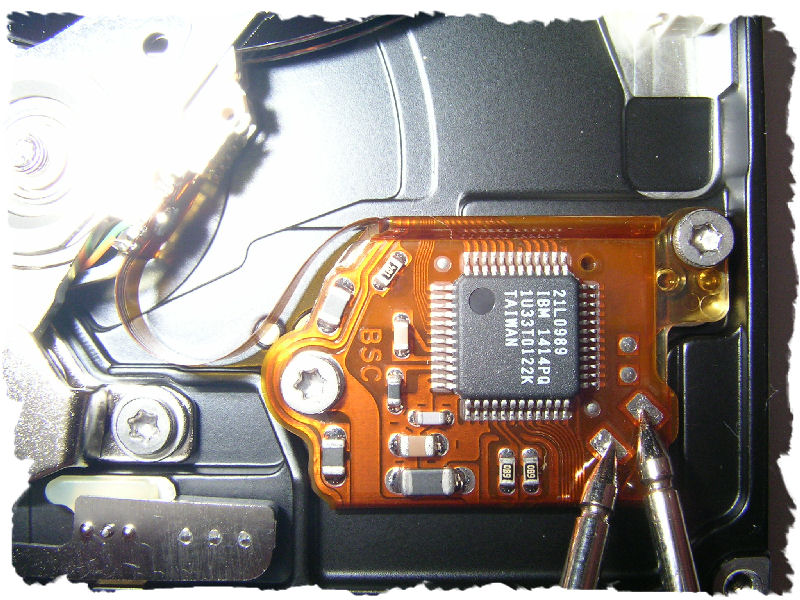
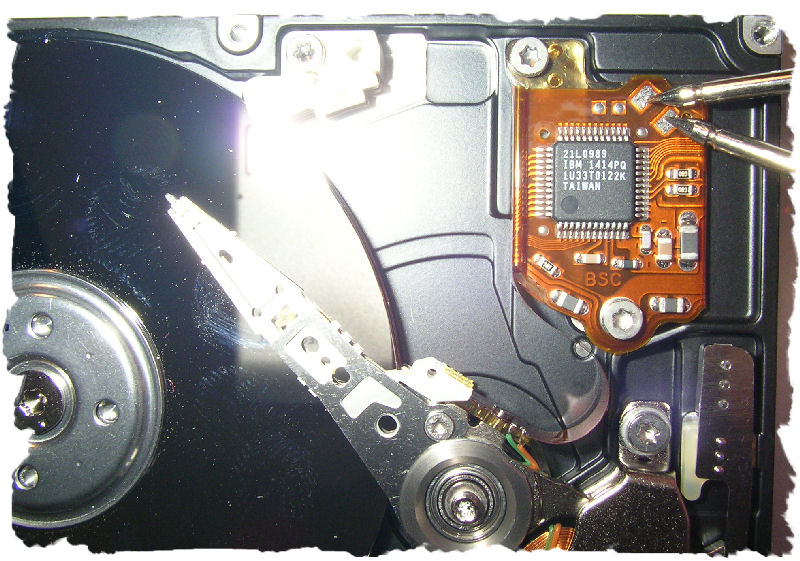
This is an IBM Travelstar DBCA-401060 HDD and it was quite easy to identify the necessary solder points on the printed circuit board (PCB) where I just needed to attach this high voltage. The IBM 1414PQ IC chip they’re using to control the stepping of the read head inside is said to be of low quality since it was made in Taiwan & China. That is, analog to any tumescent political differences between Taiwan and mainland China, the chip is said to be a direct result of having been designed in Taiwan and produced in China. Well, I don’t know if that’s the real explanation for the chip’s frequent failures (I read this on the internet, so it’s gotta be true in one way or another…you know, rumours and other viral marketing..), but the bottom-line is that the chip is used to high pressure and thus shouldn’t have any problems handling a slightly higher voltage of 220 V.
af3.jpg

And yes, right after I’ve attached the isolated pins from the socket to the hdd’s PCB, the hard disk drive came back to life and started working again. I knew it, i knew it! My sometimes brute ways of repairing stuff the jua kali way eventually work out. Remember those mobile phone PCBs I had put in a heated oven due to the lack of a hot-air-soldering station? That was SUCH a cool hot way of re-attaching the small surface mounted devices (SMD) back to the PCB…
af4.jpg

Mind you, a voltage of 220V is dangerous, so please only do this if you know what you’re doing!

AOB: ? Maxïmo Park “apply some pressure” ?

nini?

What’s this?

telephonelips.jpg

They call it “The Telephone Lips”, and it is nothing else but a fancy hands-free desk unit with synchronized lip movement for your cellular/mobile phone.

…and just one of those things out there where I think: Haiiiyaaaaa, I SO need to blog this. Who buys this crap?

Googleardhi, part 5

Having blogged about Google Earth before here, here, here and here, there’s something new to add, something we’ve all been waiting for: new maps!
I don’t know if all these maps are THAT new – but they are more detailed at least.
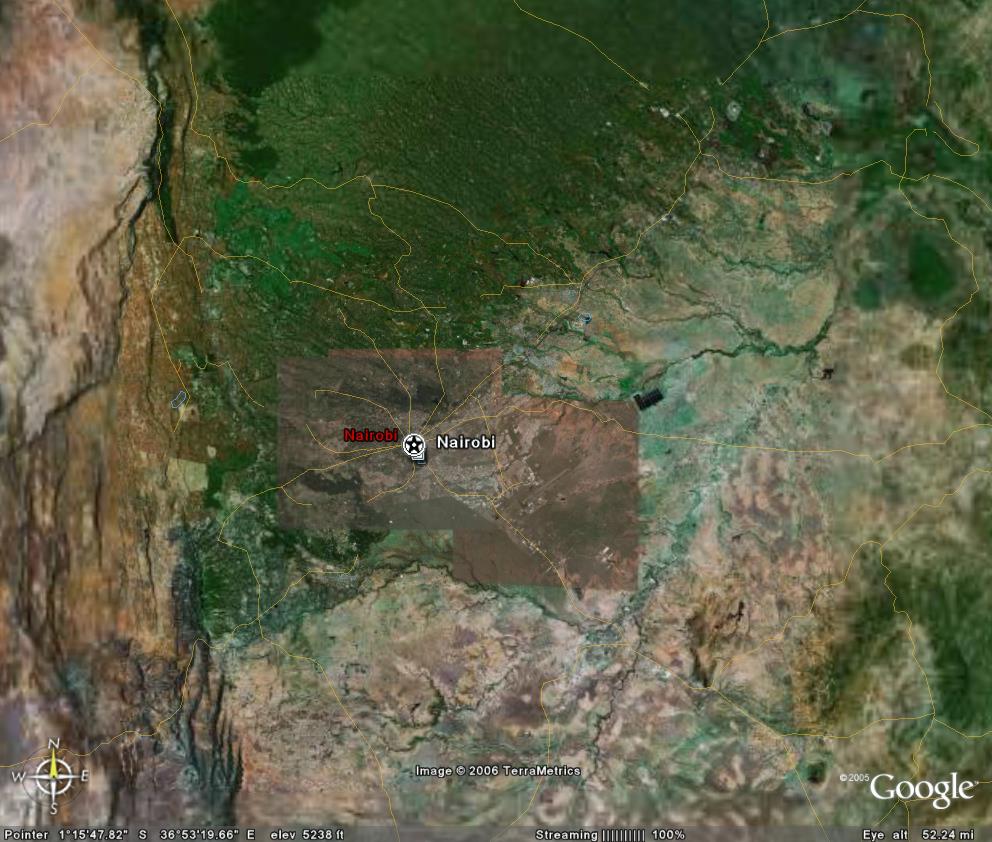
I read a story on a german IT website about GoogleEarth doing this for Germany, and so I thought I better check Kenya as well. Et voilà, our new Nairobi map:
naiorobiearth.jpg
Cool! (dito Eldoret Airport, Kisumu, Mombasa Airport (MIA), etc. :-))

As for Germany, some maps improved, some were edited or even worsened while others are just horribly detailed.
tempobremen.jpg

That red object is my ‘89 VW Golf II in front of the house….go figure…


ajaxWrite

I received this newsletter from Michael Robertson, founder of mp3.com & Linspire, today and there’s something to this typical & sometimes also strange personal marketing approach ("hey buddy, look what I’ve made for you" etc) we are also used to from guys like Steve Gibson of grc.com or even Steve Jobs of Apple Computer – something were you would go: "oh, okaaaaay, now that’s cool". An approach that these guys have brought to perfection whereas a lonely ranger like Bill Gates still needed to learn that consumers want to be approached from this "look, I’ll explain this to you in simple terms" level instead of "my company is SO great and we have this high-tech blablabla" level. Keep it simple.

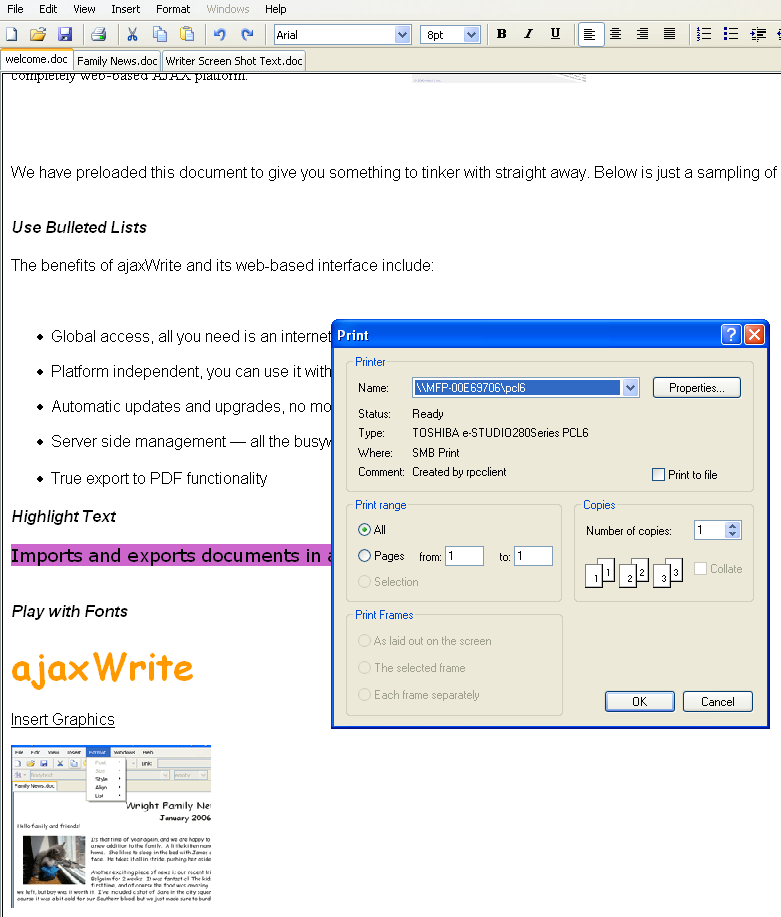
So the cool news of the day is that Robertson & "a guy named Hishem" have come up with something called ajaxWrite.com – which is an online word processor for your instant needs. The advantage? Well, instead of buying word processor software or even just downloading free office packages like the OpenOffice suite, what we get here is an online word processor based on AJAX technology for instant use. And this is what it looks like:

shot3.png

Bookmark this in your del.icio.us account and when you’re in a cybercafé with limited resources at your hands, point a browser window to ajaxWrite.com and you can still have access to basic word processor functions, write some text, format it and then save it or even print it out! I think this gets us one step closer to a more independent IT environment. No more need to buy software or the hassle of installing it, but instead the convenience of using technology whenever you need it – free of charge and at reasonable size. And Robertson goes on saying: "It’s a slim 400K. You read that right – its size is less than one megabyte, which means it runs equally well on a low-powered laptop as well as a high-powered desktop."

Low-powered Laptops? Huuuu….doesn’t that make us think of the US-$100 OLPC initiative?

And yes, there have been other ajax & web-based programs out there – however, this one gives us the feel & look of Word & OpenOffice, so there’s less adjustment to a new user interface. After all, all we want is to get things done. Also, there will be more ajax-based applications to be launched on ajaxLaunch.com in the coming weeks, so let’s stay tuned for more goodies. Enjoy :-)

P.S.: Yes, I know that there are a lot of computers out there that don’t have 24/7/365 access to the internet – however, I think this is a good start in the right direction anyways. As for the OLPC initiative – I can well imagine a scenario where these laptops are connected to a local server via wlan which could be running the ajax application…

switching environments

vmwareplayerubuntu.jpg

There are those moments in life when you just want to switch operating systems for various reasons. Be it that you want to check your website’s layout under a different OS & browser; maybe you just want to access a few pages on the internet from a much more secure plattform; maybe you need to share a computer via a remote access connection; or maybe you’ve just always wanted to use a fancy Linux distribution such as Ubuntu and you are such a lazy bone that you don’t want to install it or even only use the live cd which would enable a complete Ubuntu environment running directly from your system’s RAM & CD-ROM drive. Yani, the computer would be required to restart and we don’t want that. All we want to have is instant access to another plattform/system/operating system – another "virtual" machine.

VMWare Inc., the makers of VMWare®, provided the player you see in the screenshot above – and all I am doing here is running a special Linux distribution of Ubuntu right from my WinXP environment. Imagine, two operating systems running on my (rather old) AMD XP 2000+ desktop pc at the same time! I think that’s pretty cool, also, the argument of "niiaaa…this xyz piece of software doesn’t run on Linux ‘nway so I’ll stick to WinXP" doesn’t count anymore because why worry if you can switch systems at the touch of a button?

Want to try it out? You’ll need the VMWare player and (e.g.) this Ubuntu distribution. Enjoy :-)

national frequency table in 5Z4

The public version of Kenya’s “table of radio frequency allocations” (PDF, 2,4 MB) as issued by the Communications Commissions of Kenya in 2002.

I was longing for such an overview chart for a long long time – and now I just had a short glimpse at their (CCoK) website and found it. Haiiiaaaaa! :-)

(…someone should run a list of GoK websites that work and of those that are “temporarily” offline or “under construction”.)

Update: How do you succesfully take a website OFFLINE for a relaunch?

Well, according to the webmasters in charge of the GoK websites you apparently just have to remove the index.html (main / home / root / etc.) file and leave the rest of it ONLINE.

The Ministry of Water and Irrigation
The Parliament of Kenya
etc.

The launching of the all-important Parliament website is long overdue says George Gopal who believes such an enterprise should not be held to ransom because some 40 errant MPs have not submitted their CVs. George suggests that Bunge should just publish whatever is available. Says he with a hint a of sarcasm: “After all, we have seen that even some of the MPs in the august House with impressive CVs still perform far below par.”
(source: The Cutting Edge, DN, 3/22/2006)

Aren’t Kenyans reading their blogosphere? The unofficial link to the remaining info on that Parliament website has been posted a few times on the blogosphere…

sanitation is dignity

gto2.jpgThe german print media recently covered the interesting initial public start of an international organization – the German Toilet Organization (GTO) – here in Germany which main objective is to lobby for more (public) toilets and improve access to clean sanitary needs worldwide (the pic to the left shows the recent “sanitation is dignity” exhibition on Potsdamer Platz in Berlin, Germany as organized by the GTO – pls click to enlarge).

Toilets, choo, restrooms, latrine, lavatory – you name it.

Well, you name it? What kind of words do people use when they try to express their need to “take a natures call” or have to relieve themselves? The problem starts with the fact that we – we as in people world-wide – don’t even like to talk about these issues. It’s a taboo that keeps on being ignored, yet going to toilet is just as natural as eating or sleeping. And in order to improve the sanitary situation worldwide, first thing we need to do is to start talking about this issue.

The shocking truth is that, according to the WHO and UNICEF, roughly 2,6 billion people (around 42% of the worlds population) don’t have access to a working (read: adequate) sanitary system – and with an ever growing population and a clear need for an improvement, something has to be done. Soon.

“Proper sanitation protects water resources, increases health, provides dignity, increases agricultural production, can be an energy resource”….wait! It increases agricultural production? How come?

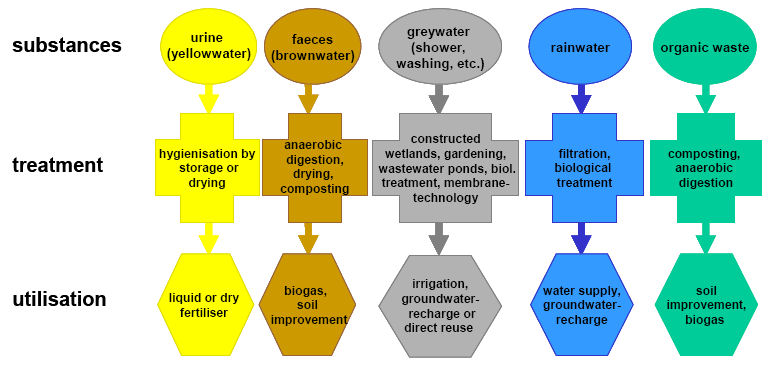
The problem with waste water treatment in huge treatment plants starts with the initial problem that we – the users – flush down virtually anything down the toilet. Out of sight, out of mind? Maybe… However, the results of these daily actions are that we get to have this huge mixture of waste and nutrients that require a lot of process engineering and energy to be separated.

==> We are using electrical energy to treat our waste. How crazy is that?

Now, what’s with that argument that an improved treatment could increase agricultural production? Let me please (try to) explain:
Instead of re-thinking complicated and expensive ways on how to separate this horrible mixture, let’s directly go to the root of the problem and separate the urine from faeces and greywater where they are being mixed up: at the toilet. There are some toilet designs out there that come with a built-in separation system – just think of a bowl that has an extra outlet for the urine and you get the idea.
By doing this, we receive an almost homogeneous, separated material out of which we can then recover nutrients, trace elements and even energy. Think of phosphor, this fertiliser stuff we put on our fields & gardens: the world-wide resources are limited, yet some countries (like Nepal) still invest a lot of money to import it although we could just recover up to ~40% of that phosphour from our urine.

gto3.jpg

In fact, the German Agency for Technical Co-operation (GTZ) started (among others) an initiative to promote this idea of closing nutrient loops some years ago and have shown great progress in promoting this much needed approach to fulfill the Millenium Development Goals set by the UN. They call it ecological sanitation (ecosan) and to emphasize a systematical approach to this paradigm shift, they have published a source-book (PDF, 9 MB) as well as other useful information material that will help to promote this great idea of ecological sanitation.
Mind you – ecosan isn’t just a technology or a technical approach to bugging issues. It’s a philosophy and understanding for the challenge which we’ll have to face in the 21st century: closing biological cycles/loops. Among the key issues of ecosan as documented in the so-called Bellagio Principles, we find the following definition:

Waste should be considered a resource, and its management should be holistic and form part of integrated water resources, nutrient flow and waste management.

• inputs should be reduced so as to promote efficiency and water and environmental security
• exports of waste should be minimised to promote efficiency and reduce the spread of pollution
• wastewater should be recycled and added to the water budget

And yes, I am very passionate about this subject and as I’ve mentioned earlier, the challenge I see for us in the 21st century will be to re-design the products and technologies we’re using on a daily basis so that every material remains in a biological or technical loop / cycle. No more end-of-pipe technologies but cradle-to-cradle designs with materials that remain as nutrients to future generations. There is so much technology out there and it starts with generating an awareness for the biological cylce – something our forefathers already knew and we apparently forgot with todays products. Also, this isn’t just one of those ideas for the drawers of development aid – this is an approach on a global basis that sees various implementations in e.g. Europe as well as in Asia or Africa. The technology is already applied – even in Kenya – and in fact, I am planing to promote this even more when I am back in Kenya.
(@GTZ: I AM YOUR MAN ON THIS…hint, hint ;-)

Coming back to the toilet issue, please have a look at the website of the World Toilet Organization to find out what YOUR options are to make a change – now. Thank you!

el mejor amigo del hombre es el libro…

I am looking forward to buying a notebook (laptop) with the following criteria:

  • CPU Pentium M Centrino 1,7 GHz or better
  • HDD min 80 GB (100 GB)
  • 1024 MB RAM
  • decent graphics card (ATI & Co.)
  • WLAN b/g, Bluetooth, IR, modem, 10/100 NIC
  • built-in WEBCAM (!)
  • double-layer DVD burner
  • USB, (COM), PP, Firewire
  • battery runtime of at least 4hrs
  • decent keyboard with a normal RETURN key
  • built-in SD/MMCard drive
  • disengageable trackpad
  • max. weight ~ 3kg
  • …and a built-in MIC!

There are so many notebooks on the market, however, most of the good ones (read: good deals) lack a built-in ~50 cents microphone. Can you imagine? Even my old Acer Travelmate 513T of 1999 had a built-in mic…

Any recommendations? I thought of a Samsung X20, but these ASUS A6V/A7V notebooks are also nice…hmm…