solarbuzz

The sun eventually decided to start (the) spring season (in May!) and blessed us with this kind of weather today:

sky.jpg
(…while Nairobi is blessed with rain, rain, rain, rain and rain? Haiiyaaa..)

Which reminded me of a solar panel my mzee bought for me way back in 1989. Back in those days, there was a shop on solar and other alternative energies next to his place of work – so whenever I visited him @work, I spent hours in this shop admiring all these “new” technologies.
My father, knowing that I would one day end up doing something fundi-styled, put his hands deep into his pocket and coughed up this really high-tech (=> 1989!) monocrystaline solar panel for me which delivers 8V and a current of 165mA.

solarpanel8v.jpg

And yes, children LOVE “solar models” :-)

trashtoys ‘r’ us

Earlier in Januar 2006, the ecoblog Treehugger covered an interesting story on Arvind Gupta who is well known for developing toys out of trash / waste material and publishing books on various subjects. The “tinkerer and toy-maker”, as he is quoted in this article by India Together, has dedicated his life to demystifying the abstruse world of science for the comprehension of children”.
Looking at his toys, one understands his interesting approach on combining toys & with science and it also reminds me of this little scientific book I had as a child that featured similar ideas. No wonder I’ve become a geek :-)

“The best thing a child can do with a toy is break it !”
(quote on Arvind Gupta‘s website)

This morning I received a challenging short message by my dear friend Mbuzimoja, who asked me about creative toys that could be built with 4 to 9 years old children in an orphanage. Since I’d forwarded the above mentioned article to her earlier in January, she told me to have a closer look at do-able ideas – toys that could be produced in Kenya. Oh yeah – I DO like this idea!
Here’s what I had in mind (all links open in a new window):

crowncap01.jpg
Crown-Cap “Tik-Tiki”

abacus01.jpg
Abacus

balloonpump01.jpg
Ballon Pump

captop05.jpg
can top

clapinair08.jpg
clap in the air (oh, i love this! :-)

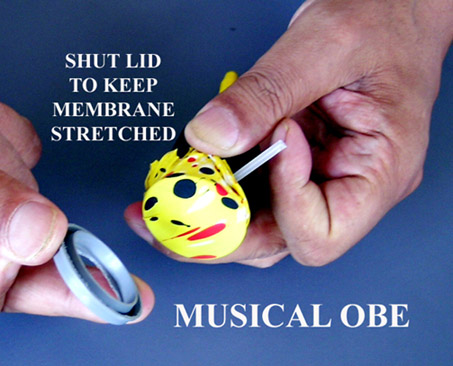
musicalobe03.jpg
musical oboe

generator02.jpg
Or for the older kids a simple generator (motor) that powers an LED (these parts are available on 2nd hand electronic markets or even from other old electronical gadgets).

…the list goes on and on and it becomes obvious that creativity knows no boundaries while at the same time the children learn something about building their own toys (like those wire cars we already know) and getting an understanding for technology. In case this triggered your interest, make sure to check out Arvind Guptas publications as well. A man who clearly enjoys the joy of sharing. Thank you!

P.S.: and here’s a special solar link for you, afroM :-)

ecomoney?

“There is no doubt that the market has spoken in a big way.
This leaves no doubt in the capacity of our economy to finance well-structured viable ventures”

Esther Koimett, Investment Secretary, as quoted in today’s DN on KenGen’s IPO.
I am not such an expert on private investment like Bankelele and his commentators, who are btw doing a great job in reporting stories from the monetary world in Kenya. What triggered my attention on the KenGen IPO, though, was that Kenyans apparently come out in great masses when it comes to investing money in (hopefully) profitable markets.

I was also going through an interesting advertisment (published in April 11th edition of the DN) on the launch of the Kisumu Water and Sanitation Project which is partly funded by the French Government through AFD – an investment to the tune of 20 million Euro.
Now, bearing in mind that people are willing to spend their savings on shares – an investment that promises a healthy divident in future, what if we take this kind of investment spirit onto different levels? So far, it seems, ppl are willing to invest their money into anything profitable – so why does the Governemnt have to look for funding if Kenyans actually do have the money needed to …repair Kisumu’s water supply and sanitation services?
All four speeches on the launch of the above mentioned project agreement held by the Minister of Water and Irrigation, his P.S., the chairman of Kisumu Water and Sewerage Company Ltd. and the Mayor of Kisumu contained a phrase in which they encouraged all involved parties to “embrace good corporate governance” or even a straight-forward challenge to the Water Services Board & – Provider “to live up to the expectations”. And, according to the P.S., “the support has attracted the Global Partnership on Output Based Aid (GPOBA) funding which if used properly should solve the problem of water and sanitation in low income areas”.
It is great to see this kind of progress since the implementation of the Water Act 2000, and a Ministry that is actively encouraging the people to greater achievements.

And as much as these new funding approaches (like GPOBA, Infraco or Guarantco) are interesting, what I would like to ask instead is: Are ppl ready to accept a completely different approach on the way we see water and sanitary needs under a financial context? What (for instance) if we can find ways to succesfully implement even more EcoSan projects in Kenya where human excreta and waste water become nutrients that could then be sold for agricultural use (~fertilizers)?

Or in other words: our waste => money.

The technology is already available, the understading for closing environmental loops is currently being thaught to future generations and the monetary incentive is given. So, what do you think? Would it be possible to attract ppl in investing their money into such unorthodox businesses that do not only fill the pocket but also help closing some much needed environmental loops?

binary worlds

“There are only 10 types of people in the world:
Those who understand binary, and those who don’t*

Fellow blogger Mzeecedric recently bought himself a new DELL notebook and if I remember well, the first thing he did after starting his new computer toy was to format the main partition in order to install his own software and preferences.

Having mentioned that, I today came across an older fellow student (born in 1962!) who desperately tried to get her CV and job application letter she’d compiled in MS Works format (*.wps) emailed to a future employer.
Now, that very same woman recently bought a brand new AMD Turion64 notebook (100 GB HDD; 512 MB RAM) with LOTS of additional accessory like this really cool hybrid (digital + analogue) tv tuner + remote control from a supermarket sale for the sum of EUR 999,- …and actually, the only thing she really knows about this machine is how to start it.
I helped her to install the OpenOffice 2.0 suite and showed her how to convert her files into PDFs as well as how to email them via her yahoo account, etc….

bbcomp.jpg

During all these years of free computer consultation for others, I’ve often come across typical user statements such as “Oh, maybe I should buy a new computer because the old one has (software) problems” or “Oh, I don’t understand this, it doesn’t work, but I’ve invested a lot of money in it so it should work….”. I am sure a lot of geeks out there have experienced similar stories, and one is often tempted to mention that it isn’t the computer or faulty software to blame, but instead incapable users who on one hand invest a lot of money but on the other hand expect these machines to function with the ease of a simple tv remote control.

And it is not that “we” know computers that much better – there are also a lot of software questions I am having and which I’ve often tried to ignore (like doing comparatively simple stuff in Office suites). It’s just a matter of approaching technical issues, and having an interest to spend some time in front of these machines figuring out how to solve certain problems.
We are having the year 2006 now, computers and their operating systems have come a long way, things may have improved over the years, but at the same time these machines have become more and more complex – and users have often given up trying to understand how things work. Mind you – I am talking about engineers, that is, about people who are supposed to have an analytical approach on technical issues. That above mentioned fellow student is a fully certified civil engineer who has also been working as a carpenter for more than 20 years.

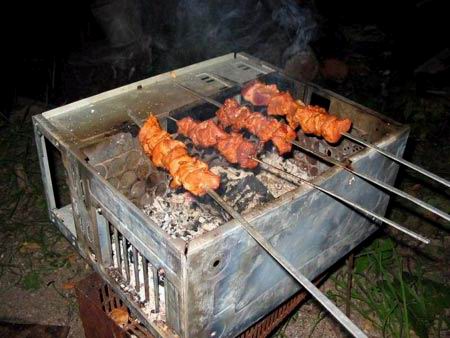
pcgrill.jpg
the perfect case mod: computer case BBQ

The reason I am mentioning all this is because I am still flabbergasted at the fact that the industry apparently tries to make computers, cars, mobile phones, PDAs, etc. more and more complex – but at the same time often neglects the fact that users just want to use their systems without worrying about technical details. Sure, there ARE interesting developments on the market – even Windows XP isn’t that bad and simple to use. Cars (except of course for BMWs :-) have simple menu-driven user interfaces on their navi systems, and it won’t take much for future generations for getting used to such systems as they are growing up with mobile phones and other gadgets. BUT! – marketing tells us to get our hands on better & faster machines, to invest again into complex systems that take us one step further away from the initial idea of just using technology for simple needs. In other words: it sort of brakes my IT-shaped heart when I come across such lost users like this fellow student who invested a lot of money in a brand new computer whose full potential she is never going to use.
Is this the progress we’ve been working on?

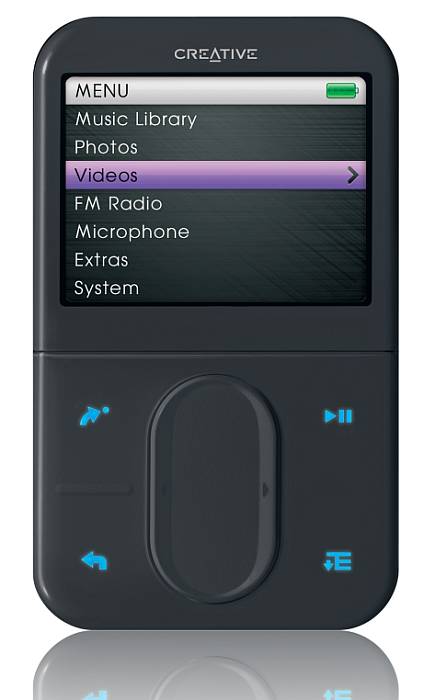
Creative Zen Vision:M

Just a small review/comment from my side on this portable media player (PMP) Creative Zen Vision:M (ZVM) which was given to me (for use) two days ago. Whereas there are few good and detailed reviews out there on the internet here and here, let me just mention some points that I think are important to highlight for anyone who wants to buy such a player:

SANY6320.JPG
The picture on the screen is sized to scale…
…the actual screen is a bit bigger as you can see here

For adding media content such as audio, video or picture files, the player relies on Microsoft’s Media Transfer Protocol (MTP). So, contrary to what you might be used to from other players or USB sticks, it does not support Universal Mass Storage (UMS) for adding media content. In other words: this little nice machine only works under MS Windows® XP SP1 + later!
However, since Creative’s engineers apparently aren’t THAT mean, they included a function where you can asign a partition of the internal 1,8″ Toshiba HDD at fixed sizes (512 MB / 1 / 1,5 / 2 / 4 / 8 / 16 GB) to work as an external harddrive. The problem, though: data that’s uploaded to that partition can not be played. This might change with future firmware releases, but in the meantime, this is just a major drawback, as I was expecting this little player to have one partition only where you can add any data from any USB-supporting operating system in a drag-and-drop style.
Who’s responsible for such decisions over @ Creative? Stupid!

There is no folder structure you might be used to from other players. All audio files are identified by their ID tags, such as the popular ID3 tag as found on mp3 files. That is, IF you managed to rip your CDs while using ID3 tags, you are on the save side.
Else, like in my case – as I started ripping my CDs / converting music files into mp3 format as early as 1998 or so when I was still too dumb to realize that there might a feature use for ID3 tags on mp3 files – you’ll have to edit these tags. Whereas this might be a one-time procedure only, you can well imagine how time consuming this task is once your music collection exceeds 160 GB….On the other hand, though, this is an inevitable necessity for any future use of mp3 files, so you’re better of starting today with this procedure. Fortunately, there are few nice programs out there that will help you retagging your files (keywords: mp3 tagger).

Battery runtime is limited to 11-14 hrs (depending on usage & played file types) – which of course is nice, but it only has a fixed Lithium-Ion battery pack inside that can only be exchanged once the player is opened. Since this gadget here is rather new to the market, spare parts and accessories are still to become more and more available in future.

As I haven’t been using any other modern player like these iPods before, the user interface with this vertical scroll/touch pad is just brilliant to me. In fact, it is such a joy to play around with it. While it is a bit too sensitive of course, it doesn’t take long to get a feeling for it. Actually, I had plans of exchanging this player for a (cheaper) monochrome Archos Gmini XS 202S 20 GB audio-player-only because of Archos’ UMS ability and folder structure support. The ZVM’s user interface though made me fall for this neat player in the long run.
It’s just a sexy machine. Holaaaaaa! ;-)

zvm12.jpg

Like many other players, this one comes with a proprietary dock connection. For connecting it to your computer via USB, to recharge it via USB / an external power supply (included! – these things have to be bought seperately with iPods!) or to connect it to your tv / stereo / car audio system (A/V-Out = LineOut), the player comes shipped with a little white dongle that connects to the bottom of the player. It has been designed in such a bad way that one ultimately assumes Creative’s engineers must have had a bad day or weren’t payed for being really “creative”. It’s just a cheap little plastic connector that doesn’t look good in any way and presumably is the first thing that will get lost once the player is in heavy use. Again, who comes up with such uncreative creations over @ Creative? I was expecting this dongle – if at all, as ppl on Creative’s forum said they would rather like to have the player be a bit longer and include all these sockets – to be shapped like the rest of the player.
Needless to mention, of course, that the connector itself isn’t available from any specialized electronic spare part dealers (btw, is this RS Electronics shop still on Moi Avenue? I’ll need to check this out asap), so there won’t be any way of making your own connector/docking station. Anyways, the A/V cable is also said to be “special” – the wiring inside has been changed so that customers are forced to buy a special one. I will built my own, yani, this page suggests that Apple’s iPod Video caboooools also work. Either way, maintenance / spare parts / accessory costs are, as usual, the biggest revenue on these devices..

As with many other modern players, the surface is scratch sensitive, so make sure to apply some additional screen protector films which are available all over the internet to avoid further scratches. Also, some components used on this player are very “soft”: there’s this RESET pinhole at the bottom of the player which is already worn out after only resetting the player once. Again, no spare parts in sight for this optical/reselling problem.

Fortunately, the player connects to my stereo system or even the car audio system through a normal 3way 3,5mm jack – which is the most important thing for me (you’ll still need the above mentioned A/V / camcorder-cable for video output in PAL or NTSC). I just want to have a portable storage system that plays (parts of) my music collection the moment I need it whenever, wherever. I would have sticked to the mp3 player in my mobile phone – but that one only has this 256 MB MMCard which is of course nothing compared to these (formatted) 28 GB of data on the player. The more harddisk space, the better it is. The day there are 200+ GB data players available at this pocket size, I will eventually drift away into a self-chosen world of musical pleasure. Battery runtime would be an issue though, but that’s another topic I’ve mentioned earlier.

Speaking of connectivity (did I alread mention the missing UMS support? No? :-), the player starts recharging the battery whenever the USB connector is inserted. Whereas this is a nice feature, it also means that you can not recharge the player via USB and output any a/v data at the same time. However, simultaneous a/v output and recharging works with the external power supply. Interesting point to remember when you connect this thing to a tv set or even a beamer (cool!).

Since this PMP device plays even cpu intensive videos like XviD encoded files, there’s much more code expected to be implemented in feature firmware releases. Also, as Creative seems to be having plans for bigger models up in their drawers (60 GB?), further improvements on the firmware can be expected. You know, with today’s fast product cycles, it isn’t always clear how long developers will be working on a specific model before they skip it for another better, but also completly different model. Let’s hope there’s still a lot of features they’ll include on this gadgetimoja (UMS support, pliiiiiiiiizzzz, Creative, tafadhali, we’ll need this!).

Another useful information might be that my ZVM came shipped with a european firmware version whereas there’s another firmware edition designated for the US market. The difference between both versions is that the US version – similar to the iPod – has a higher headphone jack output level. So to increase the overall output level on your headphones, an upgrade to the US firmware is recommended.

As for the hdd partition for use as an external hdd: I’ve set mine to 8 GB, uploaded a few ebooks for references while on safari, a Knoppix + Ultimate Boot CD image as well as other useful programs / utilities / private data.
This all sums up to one small portable player & storage device that I’ll be carrying around with me. And in the end that’s all I wanted to have. Less stuff to carry around while having (maximum) connectivity and the ability to play & listen to my media files wherever I want to. The missing UMS support is still a major drawback for me, but then, most of us grew up in Africa, so we kinda know how to handle “bottleneck conditions” :-)

Inspired by this awesome disassembly manual, I of course had to open this little player just after two days:
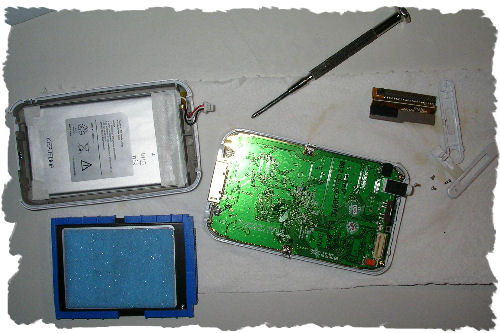
zvmopen.jpg
This is what happens if you give such toys in the hands of a geek :-)

And yes, it still works. ^^

Once again, A BIG THANK YOU to the generous person who gave this little toy to me!

the acceptance

Last evening, I saw a documentary on tv that portrayed Germans whose fathers had been British soldiers stationed in Germany right after the end of WWII. One of these ex-soldiers – now living in a nursing home in Canada – has children from romances all over the world who regularly visit him. “Being loved by all my children and knowing that they take care of me”, he said, “is what’s worth living for”. True.

Now, I don’t have children yet – and I hope there aren’t too many women out there whose hearts I’ve broken in the past.
What I do have, though, are really good friends – people from different corners of the world who have a very big heart and whose friendship and love I really appreciate.

One of those close friends decided to order a CREATIVE ZEN VISION:M from Amazon and have it send to me. JUST LIKE THAT! It isn’t my Bday or anything like that. Ok, maybe because of Easter, but the point is: the person told me: “You might want this for use on your journeys…”. Hola!

vision02.jpg

This Creative Zen Vision:M is a mobile audio/video player (like an Ipod Video) with 30 GB of hard disk space and battery runtime of up to 11hrs. It plays audio files such as mp3s, videos such as AVIs, shows photos, has a built-in FM radio, a microphone and extras like a calendar or a contact & tasks manager for synchronization with my computer. And the best part: it connects to the computer like an external harddrive, so I won’t have to search for another external hdd solution.

Apart from the fact that the person who has given this to me isn’t too rich to give “just like that”, I am having problems accepting this as a present. It is so nice and such a joy to give to others – but it is very hard to accept such blessings in the same way. While I am very grateful for the honour given me through this gift, I think the easiest way to accept it is by sharing it. So, my dear friend – i know you’re reading this – thengiu muno for this lovely joy and rest assured: I’ll use it now and give it to you later on this year. Sawa? :-)

Demotech

For all you DIY-freaks & makezine readers out there, check out this interesting “construction manual for a Bathroom Toilet unit” provided by Demotech. It is an online DIY manual that shows how to build a shower-toilet-combination for use in villages…Their website isn’t about toilets only, so there might be something else of interest to you.
The idea behind blogging this is to show that the technology and creative imagineering are already available – what we need to do is to actually build these projects and see if ppl are ready to accept such technologies.
ME I WANT, I WANT, I WANT… :-)

Solo Computer, the details (part II)

AfroM of AfroMusing asked me to compile the feedback on the technical questions she received from ExpLAN Computers Ltd. on their SOLO computer project. I also tossed in some questions to inquire what this is all about, and – apart from all those juicy details that we are now supposed to blog – Paul Richardson of ExpLAN Computers Ltd. not only answered these questions but also presented us with a very comprehensive understanding of how things work out in field. In other words: the man knows what’s needed and has spent an enormous amount of time trying to understand what works and what doesn’t. This is about hardware and software playing together, understanding what ppl out there really need in terms of basic computing and having an understanding for the context under which these developments are to be seen.

So let’s just have a look at Paul’s answers:

Rechargeable Batteries: The Solo computer (Solo) will be run using a separate power-supply in a box with high-temperature rechargeable cells, capable of receiving charge up to 70degC. Also in this box is a processor and charge-switching system. The power supply monitors what is needed to run the computer and will make up any deficiency in direct solar-power by mixing in some charge stored in a battery. Hence, you would typically have enough energy in a completely full unit to run a Solo computer for about 2.5 hours.

Variety of Power Supplies: The Power Supply can receive input from any source of electrical power, either constant-current or constant-voltage (between 6v – 30v DC). Think of generators which are connected to static bicycles…

CPU: We are no longer expecting to use the ARM-7500 processor in the production units. ARM processors are mostly used in portable devices like mobile phones, and consume less than 0.5 watts. Frankly a USB port uses more power than our processor! A pentium processor consumes typically 70watts or more. The AMD Turion processor was designed for use in low-energy laptops and is available in versions using 35w or 25w.

Touch Panel: There are three main technologies used for touch-sensitive screens and the choice of touch-screen type will be made later:

  • resistive (4-wire or 5-wire). These have the active surface on top and can be scratched by dirt on a finger or stylus.
  • capacitive.These have the active layer underneath, but can only use a finger because it needs the human body to drain the capactive charge. The problem with this is that genetics has dictated that the average African finger is 50% wider than the average European one! So Africans using capactive screens often complain that they can’t see the pointer!
  • Surface Acoustic Wave. There is no touch-sensitive surface. Instead there are sensors at the edges of the screen which detect where a finger, stylus or stick is pointing. SAW screens are about twice the price of a 4-wire resistive.


Maintenance costs: will there be any local dealers that could repair these computers when they brake?
We do not expect Solo computers will be sold by the usual concept of a “dealer”. No existing dealer could yet handle the sort of technology inside a Solo, and most will be based in cities or towns that have some mains electricity. So they have the wrong skills in the wrong place!
The Solo design incorporates a number of redundancy features. So if the keyboard breaks then you can use the mouse with an onscreen keyboard or a touch-screen to send a message asking for a new keyboard.

Since there are no internal moving parts and very few connections, it is difficult to think what a service-engineer could repair “in the field”. If there is a catestrophic failure caused by (for example) dropping the screen on a rock, then only a Manufacturing Base or a designated field-agent could possibly be able to install a new screen.
A Solo isn’t built from the same sort of parts that are found in PC’s

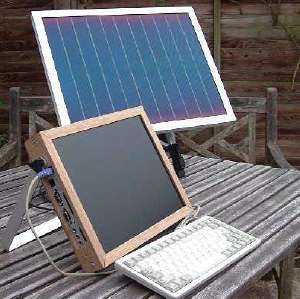
SoloComputer MkII Prototype

Operating Systems: Currently our prototypes are running *both* Debian Linux and RISC OS. They are both standard operating systems with the usual 7-layer model of network protocols, and based on the Berkley network stack.
If the computer is running Linux, then the user environment would look no different to any other PC or laptop running the same version of Linux. The Solo is a “full” computer, not a palmtop with a cut-down functionality and reduced user-interface.
The same would be true if it ran RISC OS.


Hardware Upgrades?
The Solo design does not have the usual concepts of a single hard-disc and a single block of RAM. We have a 5-layer memory system wich has different types of solid-state memory, which use different levels of power. Hence we have no concept of the computer being “off”. It simply transfers data into an appropriate type of memory and shuts off all user-processes.

We expect that most Solo computers will be manufactured with two or more externally-available memory slots capable of taking a Compact Flash card, microdrive or other type of solid-state device. If the user wants more storage, then they can insert a larger media-card.


the invention?: Hopefully the average user will be totally unaware of “what theinvention is”! They should just regard it as a standard computer in a slightly unusual wooden case. We’ve spent the last 8 months with one programmer working on the code to drive the video-output stages. Low energy CPUs are usually designed to drive a screen the size of that on a mobile phone. They have neither the resolution nor the data bandwidth to address a full-size computer screen. So this is an extensive amount of development work.

What else could be made of wood or sustainable materials despite the computer case?The case of the Solo power-supply can also be wood. And we’re working on a solid-state light which might use wood too.
However, a more important environmental issue is the use of lead and tantalum in the manufacture of circuit boards. There are no restrictionson this in countries of the Developing World. But in Europe it is now illegal to throw away such computers into a land-fill site.

That’s why companies give old PCs to charities who pack them into containers and send them out for use in African primary schools.
(!!!) When they fail, the African school digs a pit behind the classroom and throws them in. So in 10 year’s time, it will be the African teenagers who are suffering from brain damage because such “heavy metals” can’t be removed from the
drinking water. Compared with that problem, the use of environmentally-friendly wood in the case of the Solo is very much a side issue.


==> that was my initial question, not the use of environmentally-friendly wood but getting this cradle-to-cradle design to the PCB level and finding a solution to this bugging issue of heavy metals pollution in the developing countries which needs to be addressed much more. Surely, finding a solution to this situation isn’t the duty of engineers that are trying to build a computer for these countries, but still, it’s the most interesting part for me. I think we’ll need a free Wiki on the inet for intelligent materials pooling – an overview of materials, availabilities and pricing that could provide some solutions to the lead, tantalum & Co. material flow management.

I like their approach and their down-to-earth understanding for what’s needed. The bottom line seems to be that although the technology is already available, it takes time, money and definitely a lot of passion and a healthy business plan to get this from the prototype level into production. On the other hand, as marketing requires a lot of funding, let us continue promoting this good initiative and do some viral marketing through the blogosphere. Or as Paul puts it: “We are a Design Team, not a sales outlet. So we have no admin staff to handle sales and marketing. Every hour we spend answering questions to individuals is an hour less in actual design-work.”