Hooligendammit

I have just taken a 3hrs ride by train only to realize that no one is around. The ladies at the administration office are on holiday – both of them. Well, what a coincidence.

Which gives me some time to read and comment on a few articles. You know there’s this G8 summit taking place on June 6-8 2007 in Heiligendamm, which is Germany’s oldest seaside resort.

I read an interesting comment in Germany’s (left-wing) daily “die tageszeitung” this morning about the summit – heck, there are so many stories on this G8 event alone, and while it remains interesting to ask whether the leaders of 8 economic powers should meet and discuss various topics of interest, the actual debate seems to be on how the State actually excludes it’s citizens, and how democratic rights are waived for dubious security reasons.

This isn’t about a meeting of economic powers anymore, but about democracy and how we are supposed to do something for others if we can’t even demonstrate against such an event. The quality of a democracy clearly shows during such events.

This whole event is one big ******* lie to me.

Africa!

Pan-Africanism is… when you save & share your bookmarks via del.icio.us and come across recommended tags by other users who have already saved that page, tagging it with the word “Africa” when it comes to describing websites from e.g. Kenya.

Africa, nothing else but Africa.

(to be continued…)

Nivio

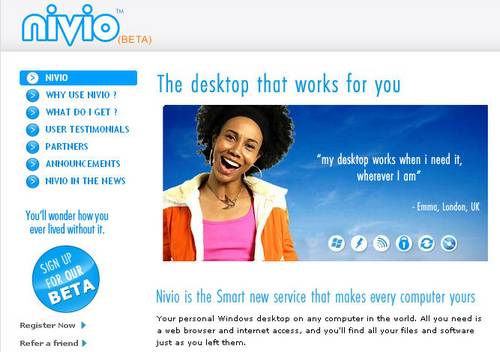
A friend of mine forwarded this article from Der Spiegel Online to me which talks about Nivio.com, a new start-up that offers a remote, virtual Windows Desktop to its users.
I haven’t tested this so far, but according to the website, there’s a trial periode of 30 days and then it costs US-$ 12,99 / month. The virtual desktop is supposed to come with Windows XP, 5 GB space and a bunch of commercial and open free software.

nivio

While I appreciate any efforts towards this direction and since I believe that software should be independent from hardware issues, there’s still one thing that bugs me about this: in order to use this kind of technology, you’ll need to have a broadband connection. How fast? AT LEAST 128 kbit/s.

Sorry guys, but I think you’ve missed the target. While many users definitely appreciate the Windows desktop, what we – the users around the world who aren’t on broadband – need are secure Windows-styled GUIs that offer the same services but don’t require so much bandwidth.

Maybe something like the already mentioned Jahazi package that comes bundled with portableapps.com on a pre-configured USB stick or LiveCDs such as the (still alpha) ReactOS which is a WinXP clone. Something that just works and doesn’t require any virus scanners, extra firewall software and multiple installations because someone accidentally deleted a Dynamik Link Library (dll) or other horror scenarios any admin fears.

So, what’s the alternative? Simple: get a LiveCD of your favourite OS, plug it in any computer (LiveCD on a USB stick!), restart it (ok, this may not always be possible), load your favourite OS and just start working. Inet access may still be a problem though, but maybe there’s a DHCP server runing somewhere.

I would just like to see more and more ppl using their own (virtual) desktops, stored on their own USB sticks with their own preferences. This of course isn’t the best solution, but it could help having better desktop environments at internet cafés or other places where a single computer is often shared by many users.

soup, baby!

The following post on cooking goes out to all my friends out there who hardly ever cook. Yes, those very same ppl who enjoy watching Jamie Oliver creating some culinary miracorrrrs, but prefer to opt for the quick & dirty solution when it comes to organizing dinner.

Ok now, this is Germany, which means lots of people eating bread. Healthy wholemeal bread and not that kind of white bread the Brits (who can’t cook! yes, I said it!) presumably introduced to a country like Kenya. If there’s one good thing about Germany, then it’s the beer, a wide variety of whole-meal breads and different kinds of sausages.

As for the bread, there are ready mixtures available for as low as EUR 0,35 that just require 320ml of warm water, 2h hours of resting and about 45 minutes of baking in the oven @ ~ 200°C. A simple and quick solution for your own bread that doesn’t come with any preservatives and other fake ingredients. Since you’re the one who bakes it, you know what’s inside. Pefect.

soup
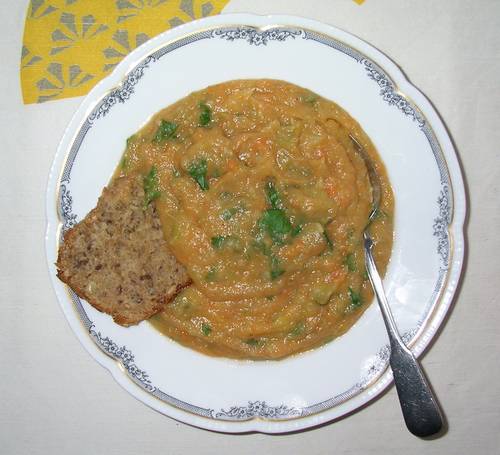
vegetable soup with fresh parsley and home-baked whole-meal bread

And then there’s the vegetaboooool.

The vegetable they are selling here in Germany often comes from some articifial plantations in Spain or the Netherlands – and while it looks great, it often tastes like…nothing. The potatoes I bought, for instance, have come from Israel.

Israel! Now that reminds me of the apples from China we had the other day

So I went shopping and came across a bunch of more or less cheap vegetables: potatoes, onions, carrots and celery. I added a bunch of parsley and headed home.

“No, I don’t want to eat any carbohydrates in the evening”, I heard this friend of mine complaining the other day. – “Yeah, sure…how about a light soup then?”.

Yes, how about a nice vegetable soup? My initial plan was to slightly cook the vegetable and eat it with some curd cheers, but then I just chopped everything, threw it onto the stove with some (very) salty water and let it boil until the vegetable had this particular “al dente” firmness: ready to bite.
I then pureed everything with my favourite kitchen gadgetimoja and added some nutmeg and fresh parsley and a bit of milk.

This recipe is just so simple and yet healthy as it contains no oils or other evil stuff that makes you think twice about the evening beer. Also, you may want to freeze any extra soup that you can’t finish in one day, which just makes it perfect for those many many singles out there who eat nothing at all in the evenings just because they are too tired to cook a single menu.

(this article is part of the “cooking with Juergen Kamau” series :-)

Wahlhelfer, part 2

There was an article in the local newspaper the other day where the State of Bremen asked its readers to volunteer for today’s election day. I quickly downloaded the application form from the inet and applied for that position as I always wanted to do that kind of work.

Such a one-day job actually includes arriving at the polling station as early as 7.30 am and supporting the election official until all votes are registered, which means you’re home at about 9 pm.

Despite of being interested in that kind of work, I also wanted to see WHO actually lives in this area which had been my interim home during 1983-1990 – and since I had just returned to a familiar place for the first time in my life, a place I am sometimes ready to accept as my “base station”, I thought it would be great to see some familiar faces from the past.
Besides, there’s EUR 30,- incentive at the end of the day, and in my Kenyanesque brainstructures, this equals to around Kshs. 2700/= for a day of just sitting on a desk and making sure that ppl drop their votes. Dude, could I ask for more? Simple!

07-05b-014

So what’s the difference?

Besides of different procedures (voters get their electoral card sent through normal snail mail and have to deliver either this card or their ID card in order to vote), one thing remains as an amusing fact.

Well, can u see that long bench in the middle of the floor? We used it to divide the room into two areas for each electoral district, but ppl here – for some peculiar reason – apparently saw this as a challenge to change lines a.k.a. districts and consequently line up for another district. They just jumped over the bench as if they were back in school (the building is a primary school).

==> Whereas you’d probably see an askari with a rungu in Kenya, making sure that ppl keep order, there was no order here, just unbelievably “smart” people (~ 5% of them having a PhD) who apparently thought to be smarter than the rest by jumping over the bench the line. Idiots.

Needles to mention that the majority of the electorate in this district voted for a very conservative party. I guess this goes to show the actual meaning of permanent head damages (phd). ^^

The problem with many ppl is their inability to think in juristic terms – putting your vote on a piece of paper isn’t voting but instead dropping that vote into a sealed box and getting your name registered as having voted. The consequence of this misunderstanding is that they put every emphasis on marking their cross on that piece of paper, but when it comes to the actual process of registering your vote, many voters today just wondered about this extra hassle.

And yes, it was a nice experience today and I would do it again any other day. It’s a good feeling to be living in a society where ppl actually care about each other, and despite of these somewhat peculiar relicts of German history, I appreciate being part of the system, even if its just for one day.

Of course I just had to close the day with Bremen’s best product: Beck’s Gold! :-)

attention, Eurosphere!

Is there anything such as a European blogosphere? A Eurosphere? Maybe a EUROspehre.

“I don’t read your blog”, some of my German friends told me, “coz you’re blogging in English”. English isn’t my mothertongue, but hey, we have to start somewhere, and there are a lot of people around the world who write in English although it isn’t their mothertongue.

With the recent elections in France that saw a very conservative candidate becoming the next President, one thing remains certain: national interest are still more important than European ones.

There may be different historical and political reasons for this behaviour, however, the outside sees us – the Europeans – as a unit. More than we actually are.

Something similar may apply to the African continent: whereas someone from Egypt or Morocco wouldn’t like to be called “an African”, the rest of the continent is still regarded as one big dark continent – by those who are not well informed.

It’s those messages such as the recent crashing of a Kenyan airplane where newspapers list all nationalities of the passengers and mention that “the remainder are Africans“. As if there is anything such as “the African”. Because those ppl hail from the same continent? Yeah, right…

The European blogosphere, if there is anything like that, the European media, all those fancy Web 2.0 websites are orientated towards the USA. This isn’t bad. In fact, most Inet startups in Europe are 1:1 copies of succesful sites from the US. However, there’s the Atlantic Ocean between the USA and Europe. And between Europe and the African continent? A rather small Mediterranean Sea.

Imperialists from European countries had conquered the African continent in the past and subdivided it into different countries, regardless of ethnical boundaries. Some of the main languages there are English and French, however, this European connection doesn’t seem to matter when it comes to intellectual stuff from the continent.

So much about background information for those who still need to check the world map to see where Ghana or Tanzania are located on the continent.

Having said this, let me pls introduce you to some fine African websites that have come up in the past. African, yes, as in Pan-Africanism.
I don’t know if there’s anything like Pan-Africanism apart from political institutions, but if it takes the digital age to connect different ethnical groups into one big unit – hey, why not? Now let’s see what this is all about:

1. Muti
muti screen

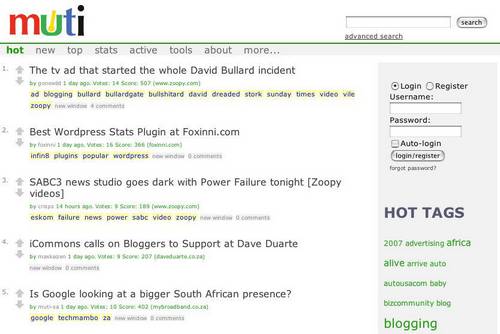
“Muti is a social bookmarking site inspired by reddit and Digg but dedicated to content of interest to Africans or those interested in Africa”.

Muti is a perfect resource for the African content – and the obvious advantage of social bookmarking and why you would want to use it (and there are still a lot of friends who haven’t understood this): don’t waste your time combing the internet for interesting content but instead rely on that what others have already filtered for you. It’s like using Google with a human filter. That’s quality!

2. Afrigator

afrigator screen

“Afrigator is a social media aggregator and directory built especially for African digital citizens who publish and consume content on the Web. (…) You can use Afrigator to index your blog, podcast, videocast or news site (i.e. any site that publishes an RSS feed) and market it to the rest of Africa and the world. You can also use it to discover new sites in the Afrosphere.”

The Afrosphere!

3. BlogAfrica
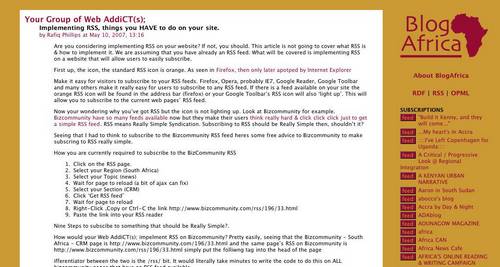
blogafrica screen

“BlogAfrica is intended as a collection of weblogs by Africans, both living on the continent and in the diaspora, and of non-Africans writing about Africa.”

BlogAfrica also is part of Globalvoices, “a non-profit global citizens’ media project”.

4. African Signals
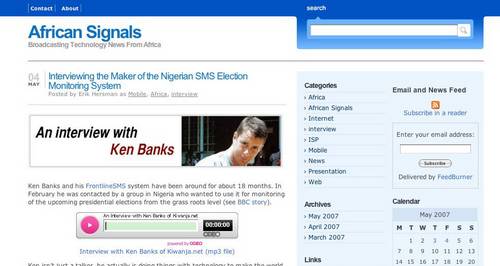
africansignals screen

AfricanSignals is a new, blog-styled website that aims to “broadcast technology news from Africa”. AfricanSignals was created by fellow blogger Hash, who also blessed us with:

5. AfriGadget
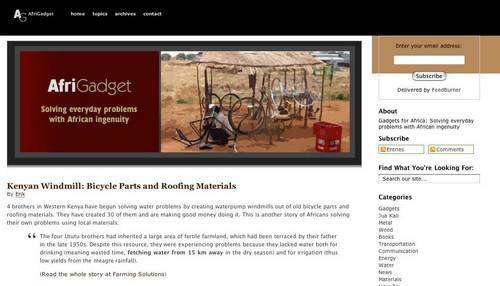
afrigadget screen

“Gadgets for Africa: Solving everyday problems with African ingenuity”

AfriGadget is another blog-styled website that tries to portray some neat technical solutions. Or as I would call it: the MacGyver solutions that come up in situations when your tools and materials are limited. If you think of solutions, and not problems – this is your site.
(disclaimer: I am part of the team that contributes articles – want to join us?).

6. African Path
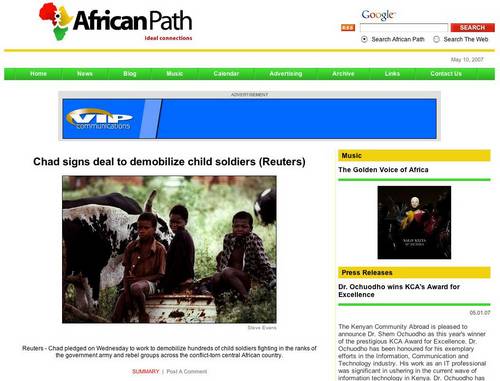
africanpath screen

African Path is the premier online destination for Africans online providing daily breaking news and discussions on issues affecting Africans and Africa.”

7. AllAfrica

allafrica screen

“AllAfrica Global Media is a multi-media content service provider, systems technology developer and the largest electronic distributor of African news and information worldwide.” (…) it…”is among the Internet’s largest content sites, posting over 1000 stories daily in English and French and offering a diversity of multi-lingual streaming programming as well as over 900,000 articles..”.

8. TimbuktuChronicles
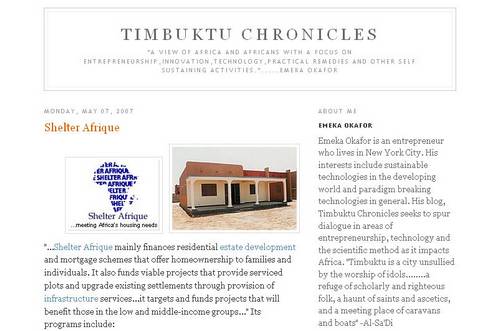
timbuktu screen

TimbuktuChronicles, a blog by Emeka Okafor on “sustainable technologies in the developing world and paradigm breaking technologies in general”.

This blog is particularly interesting as it tries to highlight some sustainable technologies and business ideas which, I believe, have in the past and will also remain the driving forces for development in Africa.
This isnt’t about some well-meant development aid by industrial countries, but about working solutions that put food on the table at the end of the day.

There are of course many other interesting websites (this listing will never be complete), and while most of them are focused on a national level, we must not forget that I only mentioned those in English. How about the Francoblogosphere?

As for Kenya – my 50% home – there are interesting sites like Mzalendo (a pretty interesting database on the Parliament of Kenya and its members and their outputs), Mashada (a community platform with a blog aggregator, forum, market place, etc.), KenyaUnlimited (KBW, the Kenyan Blogs Webring with an interesting 400+ blog feed) as well as new start-ups such as Jahazi (an online application based on XML that enables its users to configure their applications, something like portableapps.com for the many users who are bound to internet cafés) and I just received an email from the brand-new Kenyan startup Nivipi, which claims to be a “Full Community Website” like MySpace for Kenyans.

ALL of these aforementioned websites are a perfect example that WE EUROPEANS shouldn’t forget about that huge continent in the south of the globe, so close to Europe, which already provides many interesting and smart projects as well as intellecual property that shouldn’t be left out.