“…approximately 8 million (plastic) bags are given out by the supermarkets alone every month and two times as much in the informal sector in Kenya.”
(source)

“…approximately 8 million (plastic) bags are given out by the supermarkets alone every month and two times as much in the informal sector in Kenya.”
(source)
It’s almost like as if they are already keeping the thumb on the phone’s red button.
Trying to call someone in Nairobi from abroad is easy and cheap, lakini most jamaas there – it seems – are used to 10 seconds conversation: no long greetings, a very short smalltalk and then an abrupt ending.
“Hellooo?”
– “Eh, hello, this is JKE calling.”
“Oh, r u in Nairobi?”
– “No, I am calling from Germany…so, how are you?”
“Oh, here everything is just fine.”
… (~ 20 seconds)
“Ok, goodbye & thx for calling.”
– “Ah…?”
-click-
Irritating, especially since I am the one who is calling and paying for the call.
AOB: came across this textbook on “Swahili for Starters” yesterday while strolling through our local (university) library.
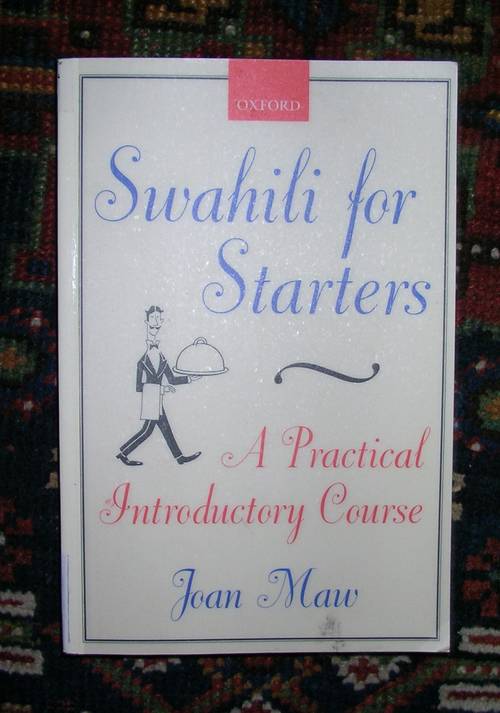
I just had to borrow something as all the books I went there for were already taken by someone else and since the really interesting stuff (as pictured below) wasn’t available for lending.

Kikuyu-English Dictionary, by T.G.Benson, Oxford @ Clarendon Press, 1964
(and the best thing I saw there was a Lingala-English dictionary…*sigh*)


Steve already received his copy the other day, and since I found a perfect deal to secure mine for only 10,- EUR, I just couldn’t resist…
For more literature on contemporary music from the continent, here’s an interesting PDF (~0,2 MB) from the Depatment of Anthropolgy and African Studies @ the University of Mainz in Germany.
Next book on my wishlist is Gerhard Kubik’s “Africa and the Blues”.
Being extremely bored by writing a paper on water quality assessment guidelines, which btw is something I’d rater leave to those who get a kick out of interpreting the European Water Framework Directive and it’s applicability in order to classify water bodies in Germany, I chose something else that I had been procrastinating for the last…uhmm….20 years?
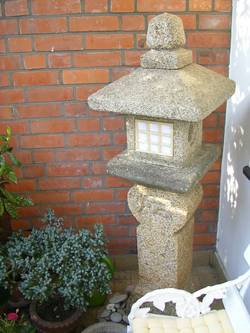
Fixing a wooden cover on a Japanese stone lantern .
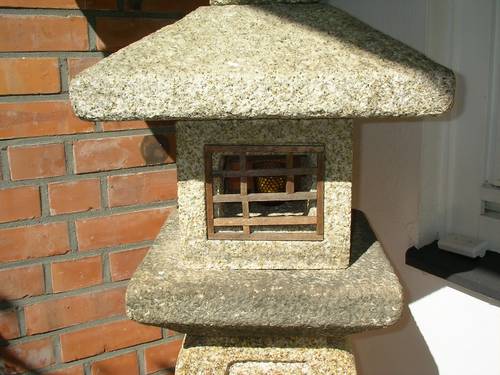
These Japanese lanterns actually come without such covers, but it somehow looks better and also reminds us of the shoji, a traditional “room divider or door consisting of translucent washi paper over a wooden frame” as found in traditional Japanese architecture.
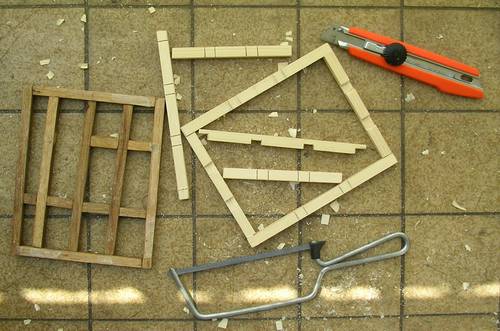
I love working with natural materials, and I sometimes think I should have chosen another path in my life. Doing an apprenticeship on carpentry, for instance, instead of learning to become an industrial manager & studies in water and soil management. Everyone can sell and work as a broker, but not everyone enjoys working with his hands. These manual jobs are a perfect retreat for those who are forced to work in an office environment, and, sad but true – I’ve seen quite a few comrades in civil engineering who could perfectly calculate the static equilibrium of a fixed end beam, but were hopelessly swamped with the simple task of hammering a nail in a perpendicular way into a wall. Obviously, such specimens of the academic world never enjoyed building their own toys during childhood .
The last time I built this wooden cover some 20 years ago, I actually didn’t give a damn about philosophy. That is: I was apparently using some fancy glue and nails. The result was and still is a horrible *thing* that used to work as the interim solution.
And now, after the Stone lantern travelled with us from Japan to Germany to Kenya and back to Germany, I thought it would be nice to eventually substitute this with something more adequately fitting the Japanese philosophy of perfectionism. Just as the Stone lantern is a piece of art, perfected into every detail, any additional cover should be made out of natural materials and proper joints such as the T halving and Cross halving as seen in the pictures.
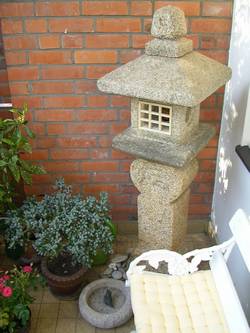
the wooden frame + covered with paper
When darkness sets in, the candle behind the shoji (let me just call it a shoji, ok?) begins to illuminate everything and that’s exactly when the lantern is in perfect harmony with… looks good.
I sometimes wish to have a small Japanese garden somewhere.
While there are t-shirts available in Nairobi these days, portraying the picture of Kenya’s freedom fighter Dedan Kimathi & a “Mau Mau University” slogan for ppl like me who like to show off with this in the Diaspora…

…there are also shoes available with a portrait of Ernesto Rafael Guevara de la Serna for those who apparently think that Che was the only “hero” out there.
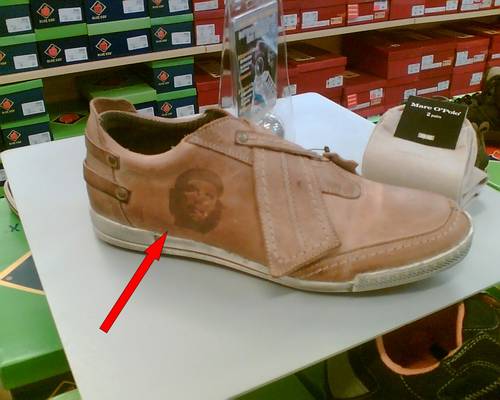
I wouldn’t wear both.
As for the MauMau shirt – I *needed* to buy it, although I instantly had the feeling it would shrink after washing it – what it did, from XXL (!) to L. I am more the polo shirt guy anyways, so wth…
There must be a market out there for those kids who are buying these shoes!
(oh oh, the Kiuk in me suggests I should have bought a dozen of these shoes and sell them on WSF2007 earlier this year…damn… :-)
It almost broke my heart today when I saw a relatively modern Nokia 6230i (series40) phone selling for EUR 99,- EUR in a bundle together with a prepaid sim card in Germany.
Buy that phone, take it to Kenya and remove the simlock.
EUR 99,- is how many Kshs.? ~ 9100 Kshs? And afaik those refurbished ones for sale in Nbo sell for at least 12.500 Kshs or even more.
Why can’t they have Nokia phones with Series60 OS on such deals? Damn…
(The Nokia 6230i has become a very popular phone on the european market since it’s release two years ago and currently retails at around EUR 159,-, without branding or any other software restrictions.)
On the other hand, though, since I already dropped my Vodafone contract (= no subsidized phone every 24 month), I shall get my next phone @ Moi Avenue in beloved Nairobi.
Read an excellent, 41 years old (offline) article on Obafemi Awolowo yesterday evening and was somehow reminded of Hon. Raila Odinga the mandazi vendor in Kibera.
Politics suck, but biographies and achievements of great leaders in opposition are interesting, indeed.