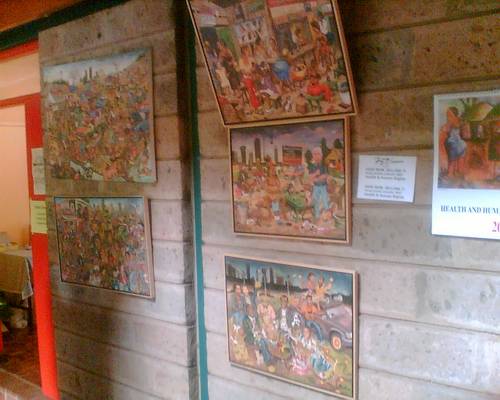
sasa?

A workshop.

A workshop on the formulation of a Catchment Management Strategy for the Water Resources Management Authority which shall be gazetted in ~May 2007.

The second workshop on this matter I’ve been attending, and this time it included some brainstorming on the sub-catchment management strategy. A workshop with lots of interesting discussions, some good ownership through the HQs, and a workshop which really produced some output. Something that shall regulate the water resources by establishing an effective mechanism and in the end really have an impact on water resource management problems. Something that the People of Kenya can actually benefit from.

06-12d004
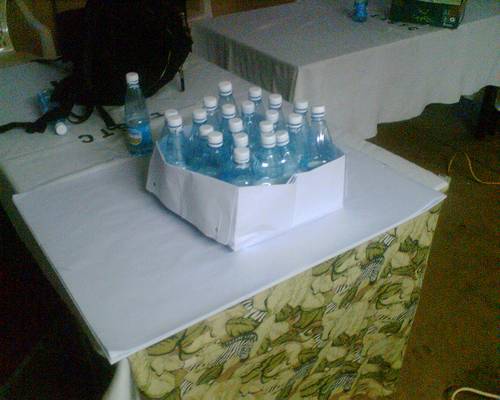
Things you do after the workshop: folding some flipchart paper into baskets so that people own up the rubbish they’ve produced during those 3 days…

A workshop that drained my brain of any blogging attempts in the past few days and left me wondering about the following observations instead:

1. These traffic police officers at your favourite road block – does the GoK provide them with batteries that power their torches during the nights?
(Kwasababu: ~makes me think the first minibus / lorry stopped has to “add value” to these people in public service.)

2. Important people in Kenya have a very…parrrrticulaaaar way of getting their messages across. The most notable rhetoric instruments of course are the implementation of pauses as well as something I call “left out words”.

speaker: “So….this is whereby we are looking FOOOOHHA (for)………..??
audience: “…..”
speaker: “right..”

Judging from the way these people speak, one can instantly assume where they normally spent their sunday mornings.

3. Toooooooothpicks! The toothpick alone deserves it’s own post. There’s NO meal in Kenya without toothpicks. No nyama choma feast without a package of toothpicks.
Ok, sure, some vegetaboool eaters are players and chewing on a toothpick all day long to maybe pretend a higher meat consumption or can’t afford any chewing gums. In fact, the other day I saw a smoker lighting his cigarette and the next thing he did with the half burned match was to stick it in his mouth.
So, next time you’re @ Java House – look out for any toothpicks on the taboool. Are there any? JH isn’t yet kawaida

4. I pity those office folks – especially those in their red number plated cars – who have to sit in meetings and workshops most of the time. Those who hardly ever get out of their office world and sometimes even lose any sense for the wananchi out there. Workshops are exhausting. I am tired. Haiiiaaaaa……

5. Life is beautiful. @Everyone: have a nice weekend!

Dear Safaricom…

I’ve been successfully using your GPRS service on my (branded Vodafone!) Nokia 6230i in the past three months, and also took the opportunity to blog about this fine service (here and here) so that other users benefit from this technical progress which really makes a difference for wireless internet access in Kenya.

I am located in a rural area and it just adds lots of convenience to access my emails and surfing the net via my mobile and/or my computer. I wouldn’t want to miss it anymore, and I think wireless telco solutions are the future in Kenya in terms of reliability and accessibility. Thx!

However, there are still some open questions regarding your service which have come in as comments on my blog – and I would like to kindly ask you, or whoever is authorized to give an official statement on GPRS support on Safaricom.

Here are our questions:

  1. How much does it actually cost per Megabyte + V.A.T.? And how much is a megaybte? 1000 kb or 1.024 kb?
  2. How do you enable your customers to use GPRS? Is it just an activation for the SIM card / line?
  3. Are customers required to buy special GPRS phones which are supported by the network, or are the GPRS settings universal and only a few phones may receive automatic settings sent out by your service?
  4. How long does it take to activate customers on GPRS? I know there have been some users in the past months who are still waiting for their GPRS settings and/or line activation.
  5. How come the customer care line (100) is almost never available? Or is it just bad luck that I never got through so far?
  6. When will you update your (mobile office) website on GPRS usage? When I google for “safaricom gprs kenya settings” (and similar keywords), I first of all get to my own blog. Hmm. You know I am just a user who wants to share his joy with others. The blogging approach though might add to the Google ranking.
    In other words: update your website more often, and potential customers/users will figure it out themselves on how to use GPRS with Safaricom. Just like we did.
    (Please correct me if I am wrong on this one, but my assumption is that most GPRS users in Kenya are still above the kawaida level – geeks, to be precise, who first of all google for their informations needed before they try out the busy #100 helpline.)
  7. What can customers do to speed up the process of getting their GPRS settings? Can we walk in your Westlands office on Waiyaki Way in Nairobi and ask for the settings? I went to Sarit Centre’s Safaricom retailer the other day and asked for details, but the guy there just didn’t even know that GPRS also works for prepaid customers.
    UPDATES:
  8. aegeus asks: “I have been unable to use the GPRS service beyond 10 pm weekdays, is this interruption scheduled or part of the limits of the service?”
  9. and: “And can they provide a discounted price preference like the competitors whose postpaid customers are charged at 8 bob per 1mb, down from 10 bob if their usage exceeds a certain level?”
  10. AfroM asks: “…those of us in US have been having issues with their SMS services, our counterparts in Kenya receive the messages we send them but we do not receive their replies, yet they get charged for the SMS they sent to us?”
  11. 60/\/\ asks: “Why don’t the GMail app and some other applications like MJabber work.” (yeah, why not?!?!)

Any constructive comments on those questions will be highly appreciated by me and the various readers of this blog. Thx!

@everyone: if you know more or have further questions, pls put them as a comment and I’ll add them to the list…

the access point

06-12b013

“You can call it: the cheap solution to an expensive problem”, my colleague Zakayo told me. A very cheap solution, yes, indeed.

Some time ago, our offices were provided with some nice HP desktop computers as well as an access point for a wireless local area network (WLAN). Except for the usual problems (e.g. ppl transmitting computer viruses (not virii!) via USB flash sticks), the wireless network had been left switched off as the previous setup could only reach 2 or 3 offices.

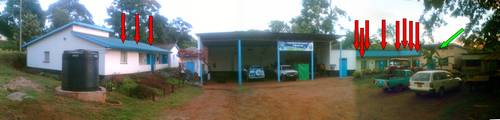
To give you an idea of what our compound looks like, pls feel free to check out this panorama view:
wrmatana2
(click click => opens in flickr)

The red arrows indicate the number and position of computers, the small green arrow at this former workshop building to the very right is the position of our access point as from today. The access point (AP) used to be in the building to the left – which is why the signals never reached these offices on the other side of the compound.

The access point we are using is a simple D-LINK DWL-2100AP with a small rubber duck antenna that connects via the typical reverse SMA connector. There are in fact external antennas for such accesss points and wireless routers available on the market – even in Nairobi. External antennas come as indoor and outdoor versions. However, these cost between Ksh. 5.000 and 15.000 /= – which of course is a lot money for a simple (repeater) antenna.
I even thought about extending the antenna by using a coaxial cable and the existing antenna or even an additional reverse sma connector (I even thought about building my own antenna using this manual). Yani, the best improvement for any wireless setup (tv, radio, wlan, etc.) is to get a good antenna. Any coaxial cable in between might extenuate the already weak signal, and besides, this is Embu. There’s no 50 Ohm coaxial caboool, neither any reverse sma connector available. And I am just sick of being stopped by unable shopkeppers who don’t even know what they are selling. These gals (!) don’t even have simpoool battely horrdaaass, as mentioned earlier.

I wanted this thing to eventually work. And I didn’t want to spend too much money on this. This is a public service office that survives on donors support, revenue from water permits and salaries through the government @ job groups J & K.

Think of solutions, not problems. (Dan Eldon)
06-12b010

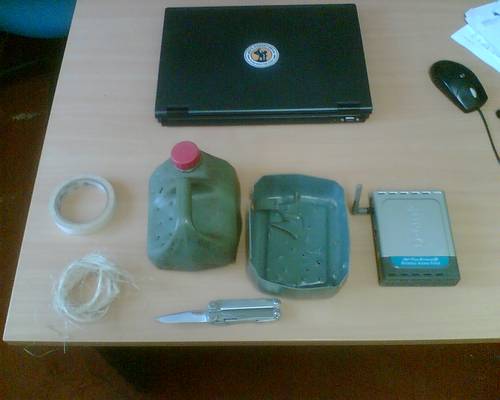
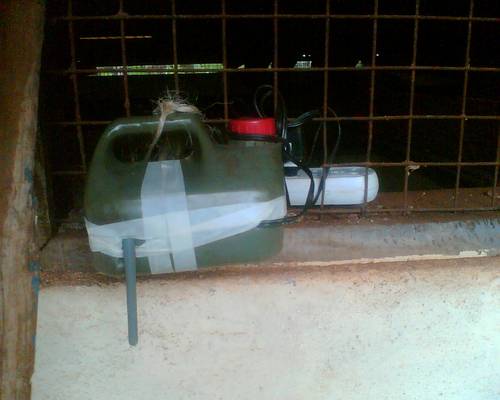
And this is what you’ll need for the outdoor protection of an access point: an old jerrycan rescued from the garbage, some sisal rope, some tape, a sharp knife and, of course, the AP.

I also invested Ksh. 249 /= for a 5m extensiooon cabooool and ….nothing else, actually. These things just do the job.
06-12b014

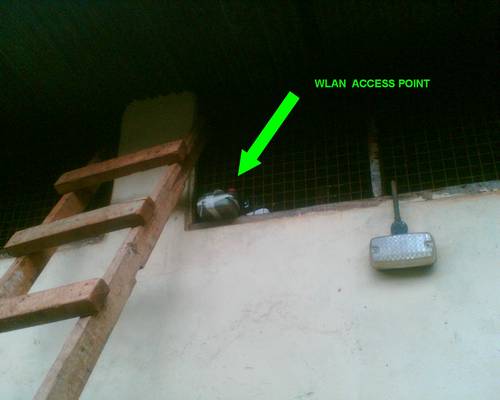
I’ve cut the jerrycan into pieces (just like the salt shaker :-), put the AP inside, connected it to the extended power supply and fixed it to the ventilation windows on this old workshop building (ex provincial water office workshop).

Well, what can I say? It works. It just works. The signal is now strong enough to reach the whole compound, all computers are hooked up, are secured via the typical WLAN security measures and we only spent an additional sum of Ksh. 249 /= which could have been even less by using a simpoool powaaa caboool which sells for Ksh. 45/= /m.

The reason for blogging this is because in the past, I’ve seen a lot of money spent on expensive high-tech whereas simple and cost-effective solutions also do the job. And as long as we’re talking about public funds, the money issue is important, I think.

(funny thing: the wooden ladder as seen in the pictures was made to be heavy so that it doesn’t “walk away” (~ get’s stolen by someone). welcome to the public service! :-)

roadside artists

The roadside is where the action is. There are some things out there you never get to see while travelling in a car. This especially applies to those Wazungu folks in their posh & red number plated 4WD cars who spend some years here and then say they’ve stayed in Aaaafrikaaaaa. Yeah, right.

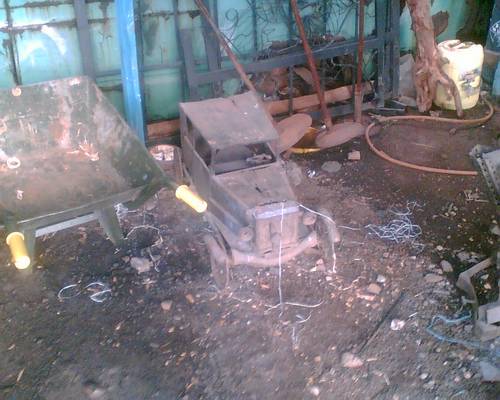
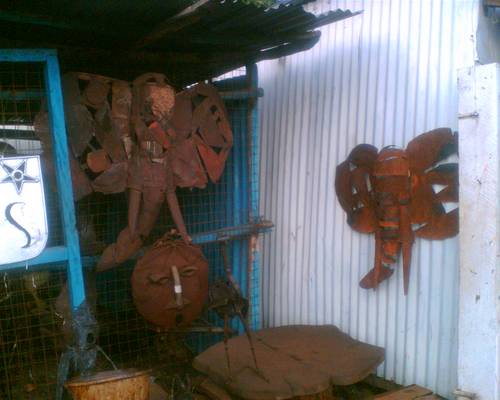
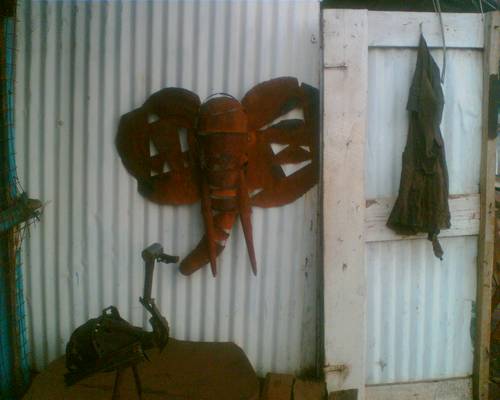
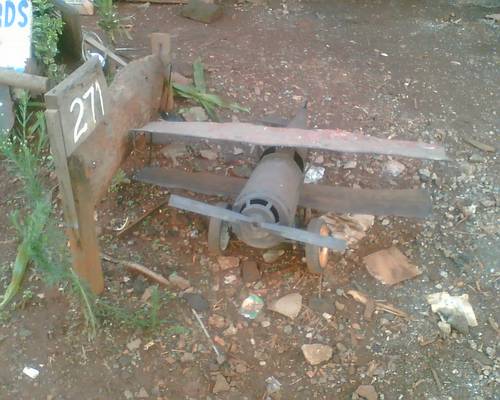
Something like this (scrap metal art):

06-12a015

the car

06-12a017

the musician

06-12a020

the kichwa tembo

06-12a021

the kichwa again, this time with a flamingo and an old jacket

06-12a022

a stalled eroplani

06-12a026

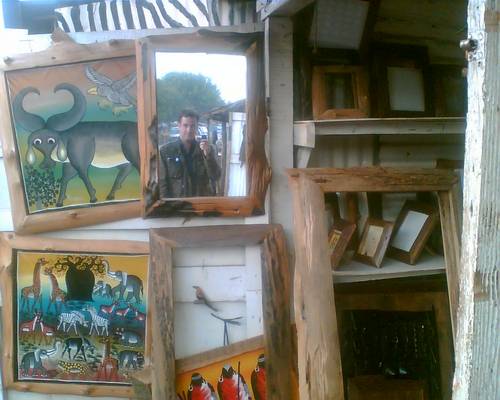
TingaTinga paintings within nice wooden frames made out of driftwood – something where the Kenyan part in me argues that these frames can’t be good kwani they are already broken and the styler-part in me thinks: woah, yeah, great safari design, these guys have nice & inspiring catalogues.

06-12a027

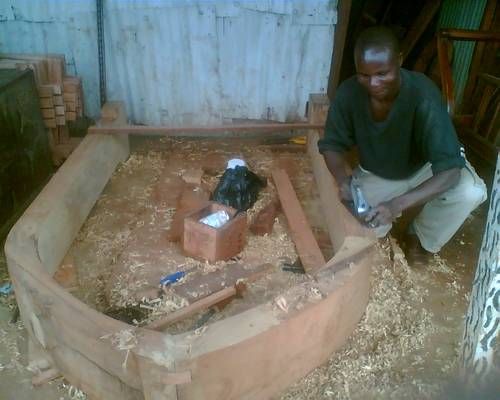
And then of course Bwana fundi seremala who takes 2 weeks to complete the door frame for this Lamu-door. Whoever ordered this door will receive some piece of really nice work. Think of something like Ksh 25.000/= and we’re in business. Now that’s even more than what my colleagues in Embu earn every month. Jobgroup J & K in the public service, you know?

There’s something about this City of Nairobi that always makes me come back.

painting cats

I thought about renaming my blog from “Kikuyumoja’s Realm” into “JKE’s photo safari blog” for a moment, but then…

Harrycane, the kids & I went to the christmas bazar at the German Embassy/Church place on Riverside Drive in Nbo today, and despite of meeting some old friends I hadn’t seen for a long long time, I also had a chance of meeting one of Kenya’s finest artists: Bertiers.

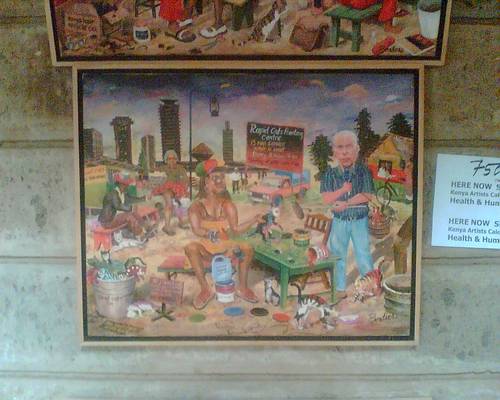
Joseph Bertiers, this humble sign writer from Dagoretti who has actually won some prestigious awards in the past, is no stranger to me. I had this really funny poster on “toilet use” in my bathroom he made for the GTZ some 12 (?) years ago, I remember he made a painting of our graduation class in 1996 (Mathias, where is it? in Frankfurt?) and even fellow blogger / videojournalist Ruud Elmendorp made a short documentary on him some time ago. Bertiers’ name was on my “things to do” list earlier this year when I came to apply for that internship in Embu. I urgently wanted to meet him and see his atelier.

Now, I gave him my card and wrote “Kikuyumoja” on it – and Bertiers instantly told me “yeah, Kikuyumoja’s Realm, I know that site on the internet…”.

Atereere…. :-)))))))))))

06-12a002

Kibs painting cats while Agwambo enjoys an orange drive.

06-12a001

WDR-Wim reporting live from the “rapids cats painting centre”.

06-12a008

These paintings sell for about Ksh. 20.000 /= each, which of course is a proud amount of money. Yani, Bertiers ever-returning theme of “painting cats” is something we’ll continue observing in Kenya’s political scene – which still delivers free-of-charge daily templates for perfectly placed satire. Just imagine the Arthurs saga and their bling bling styles – that’s free entertainment which needs to be turned into art.

06-12a007

Now, despite of the true political observations painted in oil, there are a lot of small and interesting details one discovers by closely looking at these paintings. And I think there’s no better compliment for an artists if a crowd of young kids interestingly inspects these paintings for about 15 minutes. And even after some years, these paintings don’t lose any of their energy.
Trust me: if you’re interested in contemporary Kenyan art, and would like to get something unique – Joseph Bertiers is the man to ask.

@Bertiers: see I don’t have transport at the moment and need to get back to Embu kesho, lakini asap there’s more time, let’s pls arrange for a visit at your studio, ok?