St.Louis Spéciale

“Documentary about Orchestra Baobab that was made for their comeback album, 2002’s “Specialist in all styles”. It documents Baobab’s story, music and band members.”

L’Orchestre Baobab may not be my favourite band, but these documentaries are just fine. Abdoulaye, Mischel – Nan nga def?

[via]

just another multitool

The only reason I am posting the following is because I get terribly excited about multitools. Think of Apple fanboyz and you’ll know what I mean. I think it’s the EveryDay-Carry (EDC) syndrome – the need to have the perfect tool in your pocket.

EDC also reflects a lifestyle of preparedness, where the individual wants to be prepared for the majority of situations ….(…) People who carry EDC items have a mindset of planning ahead for emergency situations. (src)

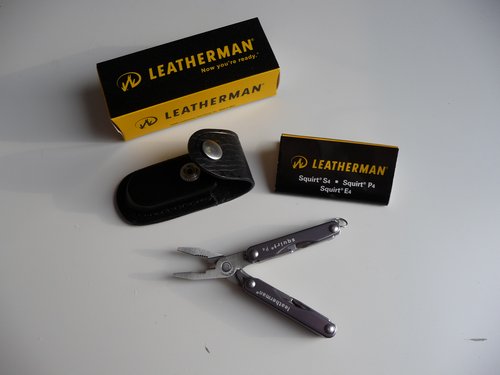
Fortunately, I am not alone on this and there are others who not only visit EDC-forums, but also come up with detailed reviews on my latest purchase: the Leatherman Squirt PS4 (e.g. 1, 2 & 3) and even their own (and very smart) modifications (& here). Unfortunately though, my new Leatherman PS4 does not have screws but rivets, so modifications are very limited. The perfect tool does not seem to exist yet, but we’re getting closer with every iteration.

Leatherman P4
A Leatherman Squirt P4 I bought some time ago forwarded as a gift to her father. He really loves this one and prefers it to his older pocket knife.

Leatherman PS4

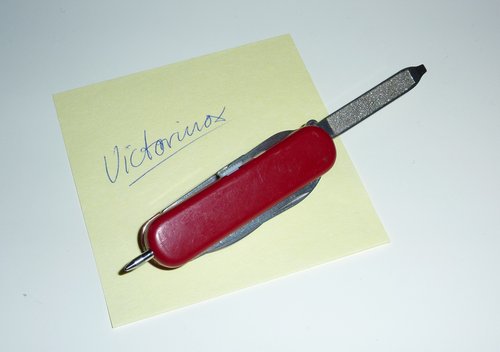
The Victorinox Manager 0.6365 I got instead of the LM Squirt P4. A very nice & slim pocket knife that comes with a pair of tweezers and ballpoint pen. Mentioned here because I think the perfect tool should also come with such a handy ballpoint pen and tiny screwdrivers. Also, Torx 5, 6 and 7 would be great!

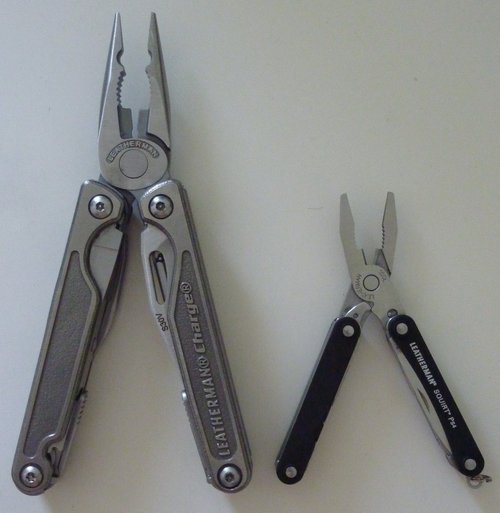
I bought the LM Squirt PS4 (not P4) because it comes with pliers and isn’t that much bigger than the Victorinox. The tools I need the most are a) knife, b) screwdrivers and c) pliers. When I switched to the Victorinox in 2009, I also stopped carrying my LM Charge TTi – so I always missed the pliers. Hence this recent purchase of the PS4 which is a successor to the P4.

Leatherman PS4
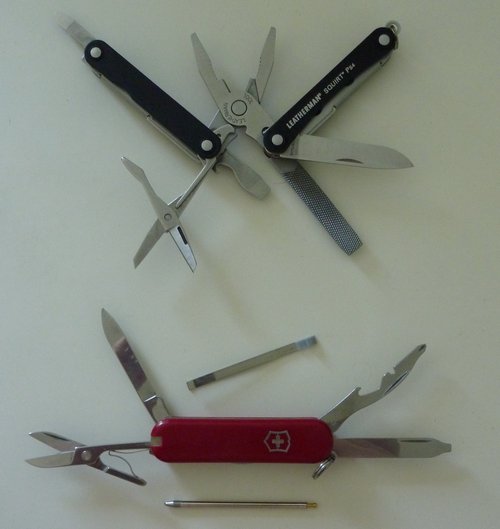
LM Squirt PS4 vs. Victorinox Manager

The quality on the LM could be a bit better. This also applies to the Charge TTi below. There’s a clear difference between the tools Leatherman produced some years ago and the ones they are selling these days. Victorinox clearly wins here, even though steel quality is equally bad. Sufficient for my needs, though.

Leatherman PS4
LM Charge TTi vs. LM Squirt PS4

Leatherman PS4

I’ve paid about EUR 20 for this LM PS4 and it arrived within only 7 days from the US. The cheap EUR-USD exchange rate probably is another reason for my love affair with multitools :-)

Leatherman PS4

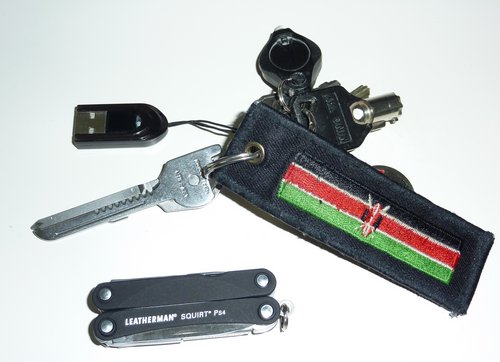
The real winner of my EDC concept is the Swiss+Tech Utili-Key 6-in-1 – because it looks like a key and is on my keychain. A great little helper that even passes through TSA while all other tools have to be stored in the luggage.

Are you also infected with the EDC virus? What’s your favourite EDC gadget?

P.S.: There’s a Wiki on MultiTools. God, I love the internet! 1!11

eggbotlicious

“Do you have a nice vector logo for me?”, Simon asked me via Twitter today. Not knowing what to expect and since I missed this particular tweet earlier today due to still missing push notifications on Android, I failed to answer in time. But Simon just picked the Kikuyumoja-Tusker logo from my site, converted it into a vector image via Inkscape, distorted it to fit on an egg and switched on his latest toy: an Egg-Bot.

P1030755

What’s the Eggbot?
The Eggbot is an open-source art robot that can draw on spherical or egg-shaped objects…(…). [more]

This certainly has to be the GREATEST Easter present – ever. I am so lost for words, dear Simon. Asante sana!

on money


If money has been around on this planet for so many centuries, how come we (humans) are still at a very basic level to define the monetary value of things you can’t buy in shops?

Am asking this since I just read this short article on future mobile (billing) technology and wondered if money as we know it in its various forms will be the right record to define a value.

Taken to my special level of interest – public toilets and the provision of sustainable sanitation with an understanding for closed loops among its users – what needs to happen until users are ready to accept these new ecosystems where the positive impact on society & environment isn’t (primarily) measured in EUR, USD or CNY?

ReverbMag

Ein kurzer Hinweis auf meine Artikel beim reverb magazine – einem neuen Online Magazin, für das ich derzeit schreibe.

do epic shit

(Facebook | Twitter)

Do epic shit. Das ist natürlich eine gewagte Ansage, steht aber auch stellvertretend für den Anspruch und die Geisteshaltung, den Leser mit interessanten Themen zu unterhalten und einen wirklichen Mehrwert zu bieten.

Für mich ist es auch eine neue Erfahrung, weil ich meine Texte auf Deutsch verfasse und zur Veröffentlichung freigebe – statt auf Englisch wie bisher (hier und anderswo). Betreut werden wir Autoren übrigens von jungen Online-Journalisten, die sich u.a. mit diesem hübschen Bildband schon einen Namen gemacht haben.

Kurz: das reverb magazine ist ein gut gemachtes Blog mit spannenden Themen, kurzweiligen Artikeln und freut sich auf Euren Besuch! :-)

my vision of a perfect laptop

Recent news about an updated range of HP EliteBook (laptop / notebook) computers made me realize that I should compile a list of things I’d like to see on future laptops.

My list, or should I say: wishful thinking (but not utopia), does not include things that I don’t want to see on a laptop, and isn’t limited to material issues. Instead, it’s my own realistic approach to that “good-guy”-thing they’ve been talking about in IT since the very beginning.

Also, most of my observations are based on the business ranges from Dell, IBM/Lenovo, HP and also Acer. Some, if not all desired changes are already possible and available in some parts, others probably limited due to licensing or marketing reasons.

First: I’d like to see a leasing approach on most laptops so that they can be recycled and be made out of better materials.

You as a user / customer only pay for the use of these computers. The manufacturer shall use this relationship and consequently use materials of higher value which can be recycled (not downcycled). This c2c closing-the-loop concept is the basis for me on any product I like to purchase. I am not asking for “biodegradable” materials on my computer, but a good mixture of pollution-free materials that also won’t be toxic to any creature. This is important. There’s already so much toxic waste out there and we spend a great amount of time in front of a computer every day. So the computer should be made of non-toxic, recycable/reusable materials.

Having said that, the following is my list. I consider the display and the keyboard/touchpad the most important interfaces on a laptop.

  • Display: very bright, should be readable in direct sunlight without problems, high contrast, energy consumption should be very low, very good vertical and horizontal viewing angles, matte (not glossy) cover, ratio 16:10, ~ WXGA+ is ok. Probably also with a touchscreen option, which includes that it can be turned 180° around and flipped over (~ tablet computers).
    If this tablet option isn’t included, it should be possible to open all displays up to 180° (or similar).
  • Keyboard: manufacturer should offer the choice between chiclet and traditional keyboards. Keys should have a unique pressure point, enough width and no stupid layout “specials”. But since opinions on keyboards differ a lot – some ppl still prefer the ThinkPad layout – there should be different keyboard designs for the same machine. So those who prefer the “FN” key in lower left corner (instead of “Ctrl”), should be able to change it. Either via a hardware swap, or by using illuminated icons on the keys – similar to Art Lebedev’s Optimus Maximus keyboard.
    The keyboard should also be illuminated. But not via an external keyboard light like the one found on Lenovo ThinkPads or HP EliteBooks, but instead an illumination from beneath the keys – backlit keyboards. See DELL Latitude and Apple MacBookPro keyboard illumination – that’s the style I prefer.
  • Touchpad and / or Touchstick: users should have the flexibility to pick what they like best. I personally never use the touchstick, others love it. Also, the availibity of three buttons for those who need it (Linux users) is important – either virtual within pre-defined areas of the touchpad or physical. And not only on 15″+ laptops.
    It’s so easy to include another, third button, so I am wondering why not all laptops already have three mouse buttons.
  • Size: I like the 13″-14″ form factor best! This way they are often light enough to be carried around, accomodate a full qwertz/y keyboard and can still be balanced on your knees. 15″ is also ok with me for programmers who need the space on the screen.
    I used to believe that smaller computers are better and easier to carry, but in the end it doesn’t make a big difference if you have a 12″ or 14″ laptop to carry around. It’s the extras that matter here.
    I also believe that A LOT of people prefer a solution like the Mac Book Air where they’ll have the comfort of an OSX computer in a very light bundle with an attached keyboard. Also because more computing power often isn’t required. This may apply to those who do their conference hopping. Others who need their laptop as their “main machine” certainly require a real laptop (hence my post here).
  • Body: the “HP Duracase magnesium alloy chassis” on my current HP EliteBook is very nice and imo better than most ThinkPads or Latitudes. I would not want to compare it with the unibody aluminium chassis of recent Apple Mac Books because that’s a different approach to manufacturing, not worse or better. I think the ideal chassis stability depends on all other requirements. It may appear that the unibody structure is the best (as recent EliteBooks also come with a unibody-styled top cover).
    The aim for a durable laptop frame/chassis also includes details like the clam shell design introduced with ThinkPads back in the days where the display cover would not only sit on top of the keyboard (when closed), but also close the gap between the mainboard and the display, thus preventing any obstacles from entering into this area. I’ve seen that modern Elitebooks (i.e. 8640p) have some sort of rubber lip that’s supposed to do that. Interesting design.
    Some smarter engineering should also be applied on the display lock. I had to repair the one on my EliteBook – twice. After the second repair, the lock now works very fine. This is so basic yet HP messed it up on my machine.
    Likewise, all hinges on all laptops should be as stiff as the ones found on all recent business laptops. No complains here.
  • CPU & GFX: any Dual CPU is fine with me. I’d like to have an option where I can either choose between the internal or a dedicated gfx chip (both on the same machine, like some ThinkPads T400 had with hybrid gfx chips) OR a modern solution that already does that for me automatically so that I can play the occasional game on my laptop but will not complain about this battery drainer for the rest of the year.
    RAM and HDD can be swapped, so I won’t mention them any further.
  • Connectivity: This is a big one. Of course, USB 3.0 ports. Three or four would be nice (my current laptop has three USB 2.0 ports). Firewire? Never needed it. Express/54 cards? Why? Who needs them? How many business users actually need it? Fingerprint reader. Yes. SecureChip thingy for business users? Yes. Audio-OUT, Audio-IN _AND_ LINE-IN? Yes, so you can use these audio ports on a professional basis and don’t have to add another external audio card (e.g. I use Line-In for Software Defined Radio audio sampling). Oh, and the sound from the internal speakers should also be loud enough for most users. Some professional laptops that cost more than 1500€ are still sold with horrible speakers. Microphones? Of course, stereo. Webcam? Yes, but with a simple hardware cover.
    CD/DVD/BlueRay….hmm… yes, but always make it swapable so that those who don’t need it can insert a 2nd HDD instead. Card-Reader: yes, of course, and not only SD/MMC. RJ-11? :-) RJ-45? of course! Display ports: if possible – all of them. If not, VGA & HDMI? Bluetooth? Min. 2.1, if not higher. Wifi? Yes, a/b/g/n. InfraRed? No, outdated.
    WWAN, yes, all antennas and a modem that will work with all operating systems (i.e. not this Qualcomm Gobi thing). GPS? Is included with modern Gobi modems. GPS should be accessible. All components should be lockable and unlockable on BIOS level from all operating systems (= you won’t have to boot into Windows just to unlock your disabled WiFi to be used in GNU/Linux).
  • Docking station: all laptops should have a connector for a docking station (not just USB dockings, but real ones). This is so basic but still my main reason why I am not using an Apple MacBook. No docking station, no fun. And please, this “docking” is a bad joke.
  • Battery: Minimum battery runtime on the default battery with surfing and wifi on should be 6h. Period.
    Batteries should also be removable/serviceable by the user, also because they don’t last as long as the machine.
    I don’t know if battery technology will change that much during the next 3-4 years, and my hope is that we find a technology which would enable the production of energy the moment we need it – which would then elliminate the need for high capacity batteries. But as long as we haven’t achieved this, I’d like to see less heat on computers. The generated heat is where all that wasted energy goes to. Imo, optimize the energy consumption and you’ll also fix the heat problem. Regulate much more components, make them use only as much energy as they need. Use more sensors to double check that. Really, there are ways of achieving this and it’s not that hard. But it’s a buying decision. And it’s not about buying spare batteries. If you think the average customer spends around 150€ on spare batteries, just improve your energy management and add this as a surplus charge on your product. Any customer will pay more (see Apple!!) if runtime is improved. I will depend my next buying decision on a) display quality and b) battery runtime.
  • Heat: as mentioned above, heat is a problem with most laptops. I like the fan intake on ThinkPads (my main reason for ThinkPads) which is located at the side of the chassis. On Dell and HP, it’s both at the bottom. This is stupid. And on MacBooks? You don’t get to hear the vents most of the time but ask any MBP owner on heat problems. Yes.
    I would also like to have a computer I can take to work in a dry, hot and sunny African country without having to worry about any components. Cooling, as a start, should be excellent. Again, there’s so much potential on the heat dissipation thing.
  • Power Supply: Power supplies shouldn’t weigh more than 300gr, should be as small as possible, should NOT come with these really thick 230V cables even if the law still says so (ha! – but the cable weighs more than the transformer…), they all should have magnetic plugs as found on MacBooks (Apple, PLEASE licence this to others) and they should all have an LED indicator light (yes, some still don’t have this!). An LED on both the transformer and the plug.
  • Operating Systems: I like Windows. I like Windows because it works fine on my laptop. I like OSX because it works fine on MacBooks. I like GNU/Linux on desktop PC because it doesn’t give a damn about battery runtime. Honestly, I don’t care about the used OS as long as it is adjusted to the hardware I am using.
    It’s the details. Hardware that will only work on Windows, not in GNU/Linux even though the machine is certified to be compatible with SUSE Linux. Yeah, right. Software that will *know* how to address my hardware and will make proper use of it. This actually is one of those 1:0 situations for Apple. I prefer their approach (but they don’t have serious docking stations, etc. etc.).Instant-On-OS: a second, simple OS that may be switched on when the computer is offline. Many tasks are web based these days, some just require a quick check on computer data. It would be nice to have this on my “good laptop” (my EliteBook has this where it’s called “QuickLook” and “QuickWeb”…. but HP, well…., HP is a big bureaucratic company with no clear vision on things, it seems. It still does not work as beautiful as it should probably do).Also, as this often depends on the OS the laptop came shipped with: a clear policy on user data. Create a second partition, find a way to easily backup your home directory. Give users more flexibility in securing their data. After all, the hardware may die but your data should survive. It’s almost like asking manufacturers to have an extra HDD just for the static user data, and an SSD for the OS and programs only.

I think that a lot of the mentioned details above will still not be possible because of:

  1. marketing reasons (because they want to sell more, because their product managers are salespersons and not end users)
  2. technical limitations (the heat problem, smaller power supplies)
  3. licensing issues (patents on technologies such as the magnetic plug, and maybe also the fan intake on the side?)
  4. companies, who are the main customers of business laptops, don’t have such requirements and prefer machines that provide a controllable IT environment instead of any desired flexibility
  5. there’s still no such good + open + secure operating system that will play very well with the attached hardware.
  6. The design is done with a short product cycle, planned obsolescence, no dedicated C2C policy and in regions where quick wins are more important than overall achievements and happy customers (that’s why I suggested the leasing model, btw, because it would help a company to extend the product cycle and so much more).
    You can see this with the Qualcomm Gobi WWAN (UMTS/EVDO) modem which is a very nice piece of hardware, but was designed only once and all manufacturers then adopted this design to their needs. Probably licensing issues and the lack of human resources that limit the availibility of proper GNU/Linux drivers for this modem. Not good.
  7. Who designs these laptops? Engineers in the US, in Europe or China? Does each company have their own engineers? I don’t think so. Are these engineers paid to define what users/customers need and want? Who sets these targets? And what kind of relationship do these companies want to have with their customers? Are they interested in a relationship that goes beyond selling hardware and spare parts?

If there’s any serious manufacturer out there who would like to build THE perfect laptop: I am available. :-)