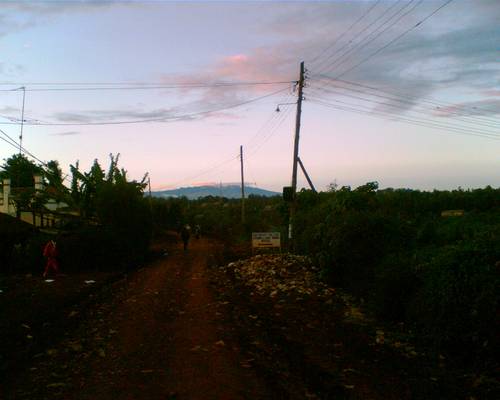
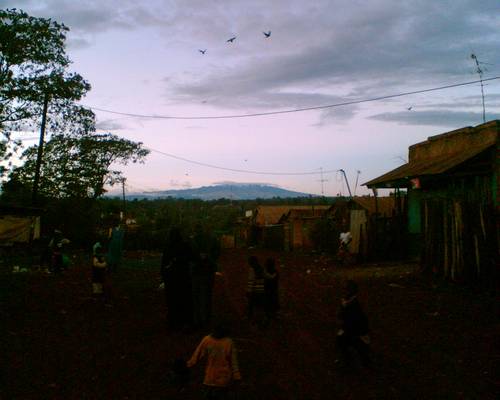
Mt. Kenya (Kirinyaga) as viewed from “Dallas”, Embu.
Such a splendid view redeems (for) all the matope (mud) infested places in rural areas.

Mt. Kenya (Kirinyaga) as viewed from “Dallas”, Embu.
Such a splendid view redeems (for) all the matope (mud) infested places in rural areas.
A relatively short visit @ nyumbani over the weekend proved once again how much this “City in the Sun” differs from shaggz, which I’ve btw already started to appreciate. After all, there are some things you’ll never find in Embu:
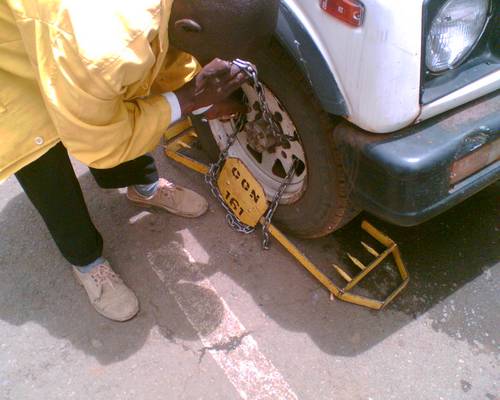
1. City Council thugs that hide behind other cars and wait just until you’ve left your car. This happened to a friends car on Sato asubuhi in downtown – we had just left the place for 2 minutes and the front wheel was already clamped. And there was no one in sight to whom we could pay the 70 bob parking fee.
Fortunately, it just took a little bit of the “JKE-going-really-mad”-show (aka kelele mingi) to persuade these yellow folks to promptly unclamp the car. He even didn’t want to be paid: “No, it is ok, me I don’t even have a receipt book”. But clamping is ok or what? What a ******* *********.
@CityCouncil: IMAGINE I COULD BE A TOURIST VISITING NAIROBI AND I DON’T KNOW ABOUT THIS PROCEEEEDJAAAH. How do I know what to do next? To whom do I have to speak to? Where is the office(r) that takes responsibility for such actions? Who will pay me for the time I’ve lost to clear this problem? ==> Customer Service??
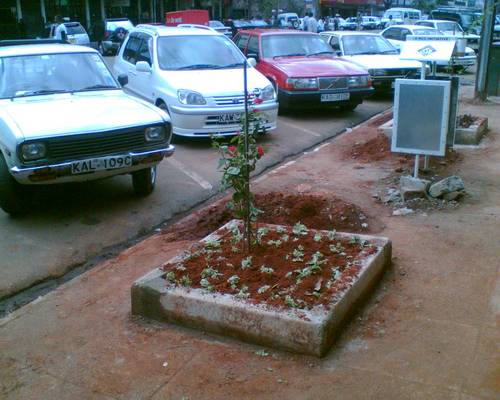
2. The Tree Planting & Beautification Programme, if I may remind you. I really like this word…“Beautification”.
I saw an older woman planting little seedlings next to the young trees on Moi Avenue and congratulated her on her important work. I really appreciate what these people are doing for the city. For us. ASANTE SANA!
(And you might well imagine what kind of job groups they are having….A?, B?)
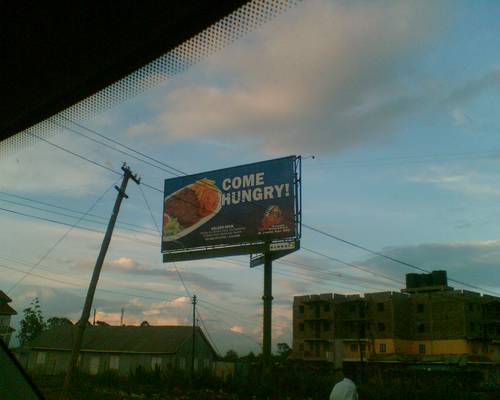
3. Oh boy, we were SOOOOO hungry today. And besides, I really wanted to eat a real + a really gooood steak – just as pictured on this typically oversized billboard.
Nairobi is the only city, I guess, where they don’t feel irritated by putting such mouth-watering advertisments next to low income areas. I feel a bit irritated by this add.
(btw, anyone knows a good place in Embu where I’ll get a medium done steak which chips and salads that doesn’t feel like eating old rubber and tastes like Omo? thx!)
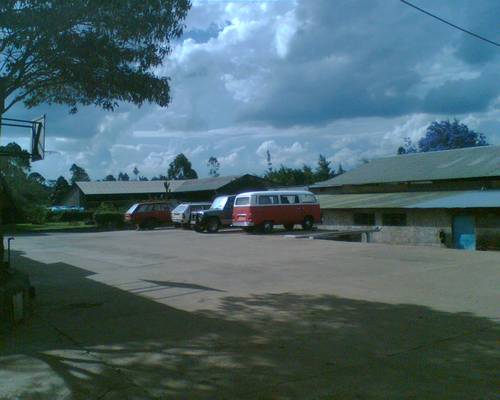
(@CG: kuja, bwana, your car is already here! :-)
4. Bwana Harrycane and I went to see Mzeecedric‘s parents in Mbagathi to show them GPRS via Safaricom – and we even managed to chat with Mzeecedric in Europe via Skype (VoIP!).
Sitting on the veranda, watching over Nairobi National Park and being able to actually chat with someone who is ~ 6600kms away over a wireless gprs + voip telephone connection still fascinates me. This GPRS thing really is a step forward from the awful 951 dial-in procedure, and I am very curious to see how reliable and fast UMTS (WCDMA) will be once it is fully deloyed nationwide.
Still, the best place to surf the net for free is JavaHouse. Yani, the one at Junction didn’t have Inet as “we switch it off during peak-hours (= till 8 pm)”. Why?? The one at Adams “Oh, it just doesn’t work…but only today…”. Yeah, right.
Gigiri was open though, and next to downloading some software for the office, I even chatted for a short moment with our sista Kui in Abuja. Nice!
Nairobi really is this city of different worlds.
And now from all this luxury back to the rural comfort…aterere..
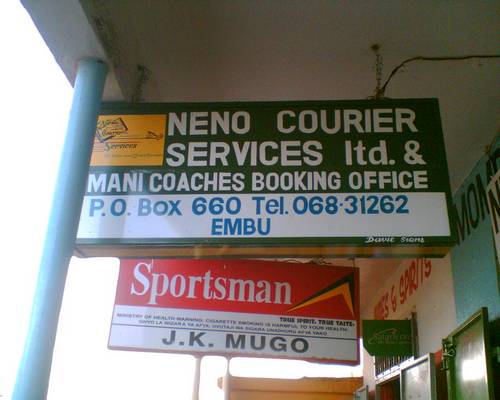
I haven’t worn my watch for a long time now. And why should I?
Travelling in Kenya (Africa) isn’t fixed to specific times or dates. You just look for transport, wait, wait even longer, eat something, wait, talk to someone, wait, play with your mobile, wait…and then eventually transport arrives – only to realize that it actually goes to another direction.
While growing up in Nairobi, I never rearlly cared about this time factor. Things just happened this way and it was ok. Now I am older and time becomes more precious. It’s like waiting in front of the computer for pages to load from the internet: An annoying waste of time – but there’s nothing you can do about it.
(although, as for travelling, I’ve come to the conclusion that instead of paying 300 bob in advance for a 10pax shuttle bus to Nbo and waiting for more than two hours for the ******* bus to arrive, I should instead just walk by the roadside and take the next matatu coming along. this way, it should just work.)
…the municipal council of Embu to open its eyes and start using public funds for public benefit:
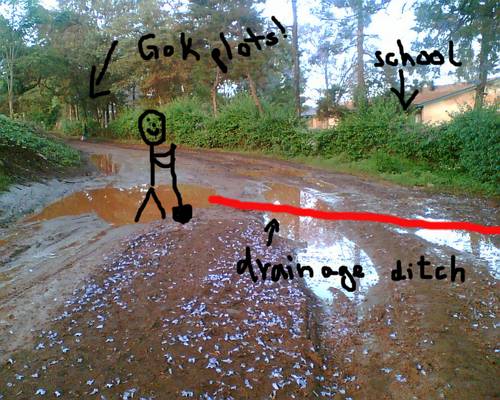
There is this really muddy road next to Mama Ngina Street in Embu which could just use a simple drainage ditch system to remove these articifial lakes on the middle of the road. After all, the road leads to other GoK plots and even a school. And everyone (including me) is forced to wade through this muddy **** every day.
Ok. Let’s do this deal. If they can’t make it within the next two weeks, we’ll start a Harambee at the office and hire a jobless farmer to do the job. Sawa?
p.s.: this is a wonderful example to demonstrate the meaning of the often used (kenyan?) phrase “they are supposed to…”.
..out of an old bottle (when there’s a power failure and only candles to illuminate the room):
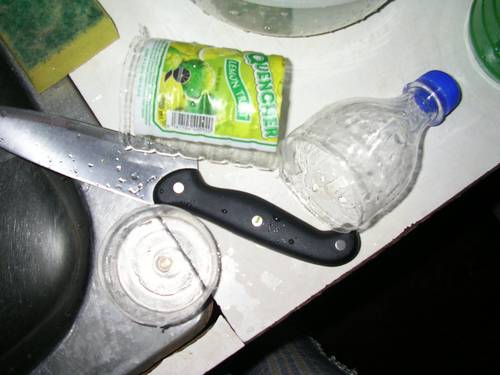
1. take a used bottle & cut it into three pieces. throw away the middle part.

2. drill some holes into the lid with the knife of your choice
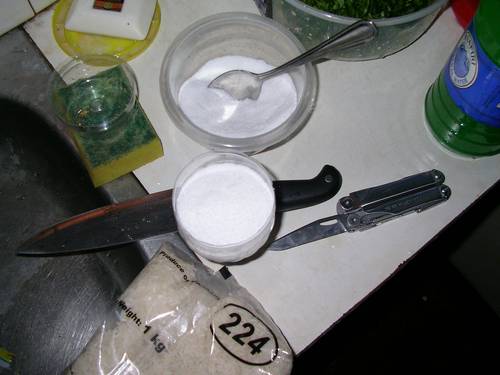
3. fill it up with some salt…
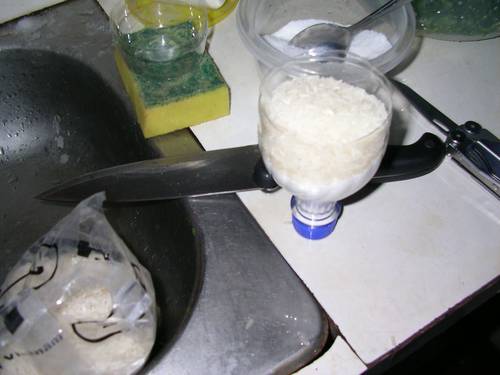
4. add rice to avoid moisture within the salt…
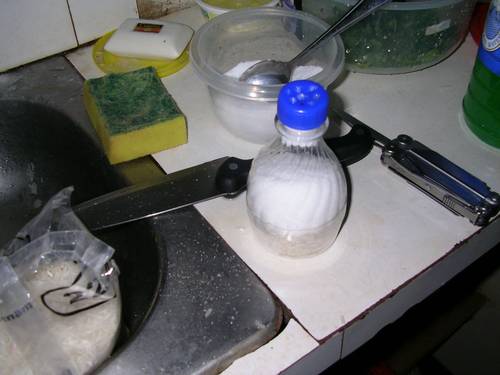
5. close the shaker by fixing the bottom piece of the bottle
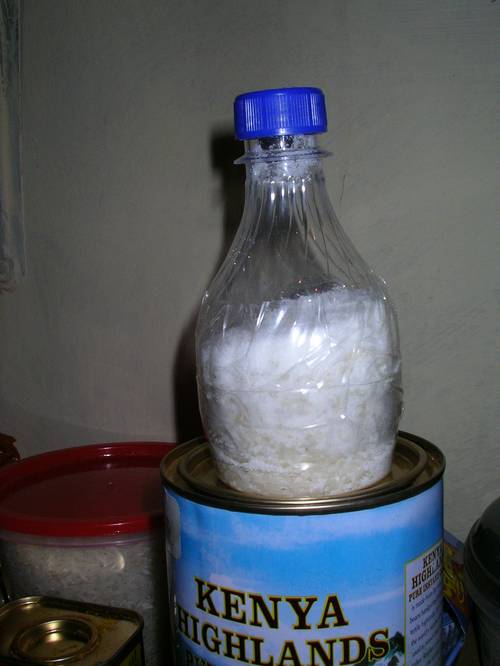
6. ready! (you may want to add some adhesive tape to enhance stability)
Ok, let’s do some viral marketing for GPRS in Kenya…
The other day, I already blogged on GPRS (General Packet Radio Service) in Kenya and complained about Safaricom’s strange GPRS settings which were previously sent to my mobile phone. Of course I am way too complicated from time to time, hence the service never worked – for me – as I had put way too many settings. The whole installation process is quite simple though, hence this little “how to…” round-up on GPRS with Safaricom in Kenya as I also see lots of traffic on my blog on the Safaricom + GPRS issue.
First, let’s look at the current situation and conditions that made me look for an alternative way of accessing the internet: I am currently working at a GoK institution and helping these guys on some technical issues among scientific work (~ working on my final thesis in the water sector). Today we tried to upload an annual report to the HQ in Nairobi which was about 4 MB in size. Knowing that their Winnet webmail service (local ISP) only allows attachments of max. 2 MB, we spilt the file into two pieces and zipped both.
Now, going online from the rural side isn’t that easy – the traditional modem speed depends on the quality of the line (=> attenuation) and with our modern V.90 modem we only got speeds of 16,2 kBit/s – which is nothing of course. A frustrating speed and connection, as you’re charged about 7 Ksh. / minute – and being online doesn’t mean that you’re actually downloading or uploading anything. It just says you’re connected.
In Nairobi, there are many interesting and working alternatives. The cheapest and best alternative of course is the wireless lan at Nairobi’s Java Houses (+ really good food!) and, if you are lucky enough, an AccessKenya.com line via WLAN in your office. Then there are these upcoming CDMA (~UMTS) local networks which currently only work in Nbo and Telekom’s DSL line, although the latter ones raised their prices in August this year and also DSL isn’t as speedy as it used to be. Someone at the Telekom office in Westlands told me that their prices might change again in near future, but until then….you’ll still need a fixed telephone line, and I understand that those are still hard to come by in Kenya due to differenct technical, historical and vandalism reasons.
Which leaves us with the GSM mobile phones that many in Kenya have these days. The best part about these phones – I think – is the prepaid system: a perfect way for the service providers to receive money in advance and no one needs to worry about unpaid receipts. It will only be a matter of time until other sectors jump on the same wagon (Kenya power, water sector, etc).
Now, in order to go online with your phone, all you need is a wap browser which enables you to surf special (wap-enabled) websites. WAP is a rather old service which never really succeeded except for Japan (i-mode) where lots of services are based on this technology (but they are using a different frequency range and technology anyways so let’s ignore them).
In order to actually SURF the internet like my blog or google, yahoo, the BBC news, etc – you’ll need a GSM mobile phone with a (X)HTML enabled browser. Many modern telephones already have this. You can actually access your email by using the browser (“internet”) in your phone. A very convenient way of going online from whereever you are in Kenya with network coverage. GPRS isn’t really needed for this service, but it helps limiting the costs (as you are charged by MB downloaded) + increasing the speed (?).
And then of course there is GPRS for use with computers. This is the sexy part of it. As far as I am informed, there are three different ways of connecting phones to a computer:
a) via InfraRed
b) via Data Cables
c) via Bluetooth
If you are an owner/user of a notebook/laptop computer and also have Bluetooth and a phone that has this Bluetooth functionality, use this! It’s the most convenient way of putting it – also because there can be a distance of up to 10m (sometimes also more) between the computer and the phone. So if the network coverage is bad, just put your phone next to the window (where the receiption is better) and access it via Bluetooth from your computer.
InfraRed is very slow although it works (direct line of sight needed to hook it up with the computer) and then of course there are data cables.
You see, there are some GPRS enabled phones – but without any means to connect a data cable (unless you remove the battery, like on the older Nokia 6510, 8210 series, etc.). And data cables are sometimes hard to come by. Not every shop in Nbo (and of course not even Wachira Electronics here in Embu) sell those cables, even not those posh Nokia Shops @ Sarit Centre & Village Market. Or? Update: the data cable @ Nokia Sarit Centre costs Ksh 5500/=! A fake chinese copy goes for around 1200 /=….
Anyways. if you’re about to buy a new phone, make sure it comes with a data cable. Such a cable is also needed for downloading data content from the phone (pictuers, videos, etc.). I remember that e.g. Sony Ericsson phones already come with such a cable. I personally have all three connection types – the cable (from Ebay Germany @ EUR 4,-), an infrared port on my notebook and Bluetooth on both sides. Bluetooth USB dongles sell for about 10,- EUR in Europe – sijui about their prices here Update: Ksh. 1600/= in downtown, presumably less @ Mitsumi in Parklands. But then, the very popular Nokia 6020 phone here in Kenya does not have Bluetooth, so a cable is the best choice (called “CA-42” (serial) or “DKU-5” (serial-to-USB) for this particular Nokia 6020 – the one for 6230(i) is called “DKU-2” (100% pure USB)).
Another alternative are these data cards (pc cards/pcmcia) that offer GPRS/EDGE technology and are used on laptop computers.
Ok, enough about the technical background, let’s start with the actual service:
In order to use GPRS with Safaricom, all you have to do (as a prepaid customer!!!) is to send an empty short message (SMS) to 4777. That’s it!
They will then shortly afterwards send you a confirmation sms and the settings for your GPRS capable (!) phone which you will be asked to save and activate using the following PIN: “1234“. Simple as that.
If the settings can’t be received for whatever reason, but your phone is able to do GPRS, then try the following settings for Safaricom:
APN: safaricom
username: saf
password: data
(hope i didn’t forget anything here..) UPDATE: kindly check the comments for more details, thx!
PLEASE NOTE:
@Safaricom: how about some air time for this free-promo? My number is +254723436609 – Asante sana! :-)
p.s.: remember, I’ll work for bandwidth :-)
Ati? Safaricom? What’s this and this? Cooooooooooooooooooooooool. Really. M-Pesa? Like Hawala? Now THAT’s even more important than stable inet access. M-Banking is the next big thing.
@Mzeecedric: pole, I know it’s a long text although access is so simple. I just wanted to write down a few things that had been up in my mind. I so often meet ppl who spend a lot of money on fancy phones (~ going crazy for that video function for whatever dumb reason although they can’t even download the content from their phones) and then all they actually need is to access some things online and/or do online banking.
…like these mikebe I came across while shopping for my furnitures:
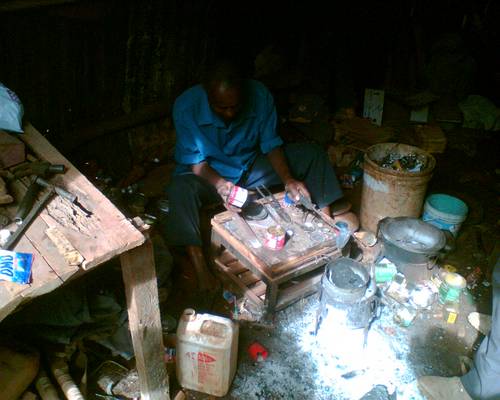
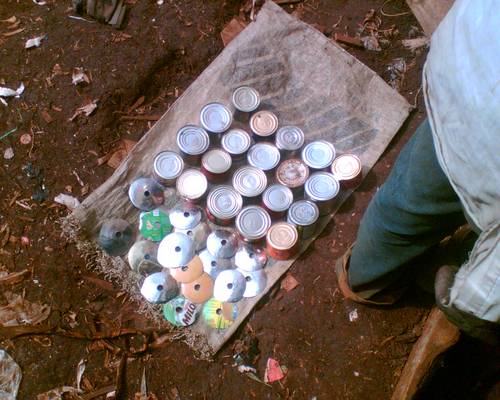
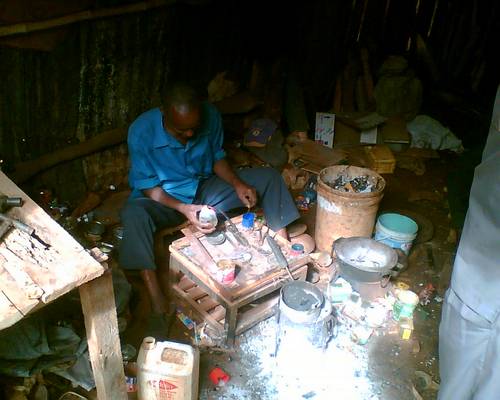
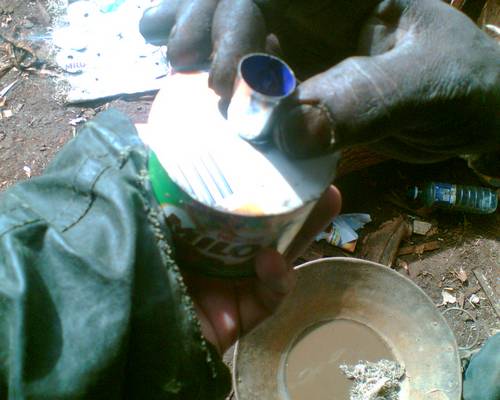
The beauty of living upcountry is that you see things which have almost vanished from Nairobi. And everyone here keeps on telling me how much they prefer Embu (read: “the rural life”) to the chaos in Nairobi. True! Remember what it takes to get from A to B in Nbo? And here I won’t even need a car. Nice.
I think I should stay here.
And with this GPRS thingy now which enables me to even blog, surf, chat and email for hours there’s no need to worry. In fact, now with Safaricom and Celtel offering GPRS services on their networks, one can actually take the notebook out on Safari and Skype from the National Park (yesss, VOIP over GPRS, it works!).
p.s.: the upside of living next to a night club is that you fall asleep to Franco Luambo Makiadi, Les Wanjika, Daudi Kabaka, etc…smooth :-)
My colleague called me from Kakamega and told me to go online and download a new binary file for the software we are currently using (the programmer compiled a new binary and had it sent to us – 1,3 MB, which is a lot for the average modem connection).
So I went out at 8 p.m., in the search of a decent inet/cybercafé for kesho asubuhi that would enable such a download. I think they were already closed by that time as I couldn’t find any and also some descriptions aren’t that reliable (“somewhere there down the road behind this building” (waving his hand into that direction). Somewhere can be anywhere.
“Mori turi te salutant” is what I first thought upon catching this scene with my cam:
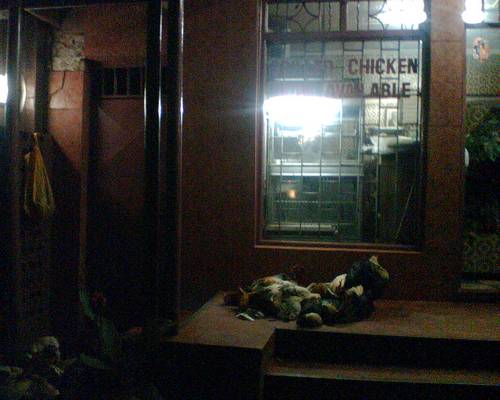
The bad news: these poor little (fat) kukus were sitting in front of “Morning Glory Hotel” here in Embu, with their feet tied together and awaiting their death “Furahiday” morning.
“Don’t you have any mercy with me?”, I asked the nearby waiter.
Waiter: “Me? Nooo..you see, they can already see their friends being grilled in the oven so they know what will happpen. We will cut their throats tomorrow morning.”
No wonder the place is called Morning Glory…
The good news: Safaricom GPRS works perfectly well. I just made the mistake of using a mixup of sent & own settings so it never worked. But then I thought about deleting all settings and trying it again with a clean installation et voil? : GPRS in Embu, the mobile phone connected via Bluetooth, everything at full speed and no need to look at the clock as the rates are charged per MB downloaded. It really works! Amazing….