attention, Eurosphere!

Is there anything such as a European blogosphere? A Eurosphere? Maybe a EUROspehre.

“I don’t read your blog”, some of my German friends told me, “coz you’re blogging in English”. English isn’t my mothertongue, but hey, we have to start somewhere, and there are a lot of people around the world who write in English although it isn’t their mothertongue.

With the recent elections in France that saw a very conservative candidate becoming the next President, one thing remains certain: national interest are still more important than European ones.

There may be different historical and political reasons for this behaviour, however, the outside sees us – the Europeans – as a unit. More than we actually are.

Something similar may apply to the African continent: whereas someone from Egypt or Morocco wouldn’t like to be called “an African”, the rest of the continent is still regarded as one big dark continent – by those who are not well informed.

It’s those messages such as the recent crashing of a Kenyan airplane where newspapers list all nationalities of the passengers and mention that “the remainder are Africans“. As if there is anything such as “the African”. Because those ppl hail from the same continent? Yeah, right…

The European blogosphere, if there is anything like that, the European media, all those fancy Web 2.0 websites are orientated towards the USA. This isn’t bad. In fact, most Inet startups in Europe are 1:1 copies of succesful sites from the US. However, there’s the Atlantic Ocean between the USA and Europe. And between Europe and the African continent? A rather small Mediterranean Sea.

Imperialists from European countries had conquered the African continent in the past and subdivided it into different countries, regardless of ethnical boundaries. Some of the main languages there are English and French, however, this European connection doesn’t seem to matter when it comes to intellectual stuff from the continent.

So much about background information for those who still need to check the world map to see where Ghana or Tanzania are located on the continent.

Having said this, let me pls introduce you to some fine African websites that have come up in the past. African, yes, as in Pan-Africanism.
I don’t know if there’s anything like Pan-Africanism apart from political institutions, but if it takes the digital age to connect different ethnical groups into one big unit – hey, why not? Now let’s see what this is all about:

1. Muti
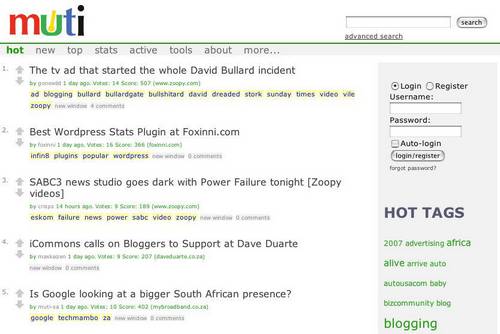
muti screen

“Muti is a social bookmarking site inspired by reddit and Digg but dedicated to content of interest to Africans or those interested in Africa”.

Muti is a perfect resource for the African content – and the obvious advantage of social bookmarking and why you would want to use it (and there are still a lot of friends who haven’t understood this): don’t waste your time combing the internet for interesting content but instead rely on that what others have already filtered for you. It’s like using Google with a human filter. That’s quality!

2. Afrigator

afrigator screen

“Afrigator is a social media aggregator and directory built especially for African digital citizens who publish and consume content on the Web. (…) You can use Afrigator to index your blog, podcast, videocast or news site (i.e. any site that publishes an RSS feed) and market it to the rest of Africa and the world. You can also use it to discover new sites in the Afrosphere.”

The Afrosphere!

3. BlogAfrica
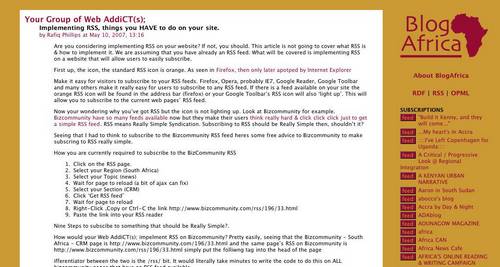
blogafrica screen

“BlogAfrica is intended as a collection of weblogs by Africans, both living on the continent and in the diaspora, and of non-Africans writing about Africa.”

BlogAfrica also is part of Globalvoices, “a non-profit global citizens’ media project”.
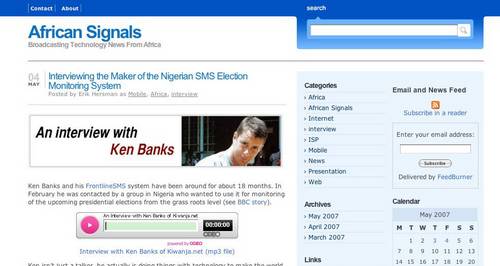
4. African Signals

africansignals screen

AfricanSignals is a new, blog-styled website that aims to “broadcast technology news from Africa”. AfricanSignals was created by fellow blogger Hash, who also blessed us with:

5. AfriGadget
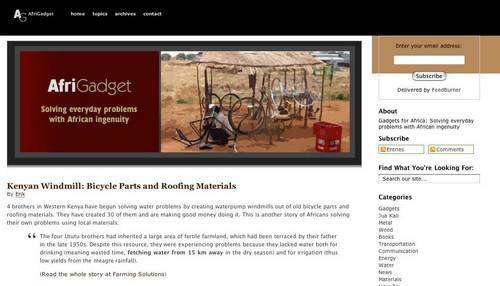
afrigadget screen

“Gadgets for Africa: Solving everyday problems with African ingenuity”

AfriGadget is another blog-styled website that tries to portray some neat technical solutions. Or as I would call it: the MacGyver solutions that come up in situations when your tools and materials are limited. If you think of solutions, and not problems – this is your site.
(disclaimer: I am part of the team that contributes articles – want to join us?).

6. African Path
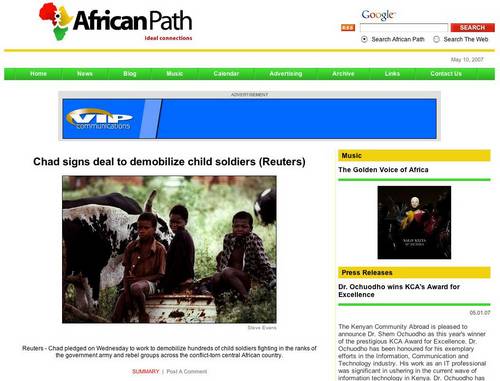
africanpath screen

African Path is the premier online destination for Africans online providing daily breaking news and discussions on issues affecting Africans and Africa.”

7. AllAfrica

allafrica screen

“AllAfrica Global Media is a multi-media content service provider, systems technology developer and the largest electronic distributor of African news and information worldwide.” (…) it…”is among the Internet’s largest content sites, posting over 1000 stories daily in English and French and offering a diversity of multi-lingual streaming programming as well as over 900,000 articles..”.
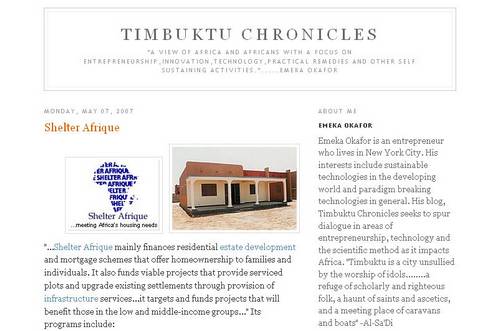
8. TimbuktuChronicles

timbuktu screen

TimbuktuChronicles, a blog by Emeka Okafor on “sustainable technologies in the developing world and paradigm breaking technologies in general”.

This blog is particularly interesting as it tries to highlight some sustainable technologies and business ideas which, I believe, have in the past and will also remain the driving forces for development in Africa.
This isnt’t about some well-meant development aid by industrial countries, but about working solutions that put food on the table at the end of the day.

There are of course many other interesting websites (this listing will never be complete), and while most of them are focused on a national level, we must not forget that I only mentioned those in English. How about the Francoblogosphere?

As for Kenya – my 50% home – there are interesting sites like Mzalendo (a pretty interesting database on the Parliament of Kenya and its members and their outputs), Mashada (a community platform with a blog aggregator, forum, market place, etc.), KenyaUnlimited (KBW, the Kenyan Blogs Webring with an interesting 400+ blog feed) as well as new start-ups such as Jahazi (an online application based on XML that enables its users to configure their applications, something like portableapps.com for the many users who are bound to internet cafés) and I just received an email from the brand-new Kenyan startup Nivipi, which claims to be a “Full Community Website” like MySpace for Kenyans.

ALL of these aforementioned websites are a perfect example that WE EUROPEANS shouldn’t forget about that huge continent in the south of the globe, so close to Europe, which already provides many interesting and smart projects as well as intellecual property that shouldn’t be left out.

Entdecke die Möglichkeiten

“Das Web ist ein Werkzeug, mit dem Millionen Menschen eine regelmäßige und sinnvolle Tätigkeit simulieren. Die von der Bundesregierung ermittelte, durch das Web verlorene echte Arbeitszeit von zwei Jahren pro Person wurde kürzlich hinten drangehängt.

Weblogs (auch: Blogs) sind einfache elektronische Publikationssysteme, die von der CIA entwickelt wurden. Weblogs geben Bürgern das Gefühl etwas zu sagen zu haben und verhindern dadurch möglicherweise störende, tatsächliche Aktivitäten. Weblogs sind das digitale Equivalent zum Demonstrationsrecht. (Quelle)”

…so heißt es ironischerweise beim Johnny in einem Artikel, der die schöne bunte 2.0 Welt im Web dem interessierten Leser näherbringen will.

Man kann sich das ruhig mehrmals durchlesen.

Viele Blogs im deutschsprachigen Internet, so erscheint es mir zumindest, haben sich auf das Zusammentragen von Online Informationen spezialisiert. Informationen, die nur in dieser virtuellen Online Welt existieren und von Interesse sind.
Als Beispiel sei hier die Berichterstattung über neue Web 2.0 Dienste genannt – z.B. über neue Plugins für WordPress (s.u.), wenn Flickr mal wieder nen Schluckauf hat oder dass SonyEricsson in Second Life einen Cebit Stand eröffnet.

Für Geeks ist das schon sehr sexy.

Nur: es hat in der realen Welt da draußen eine eher geringe Bedeutung.

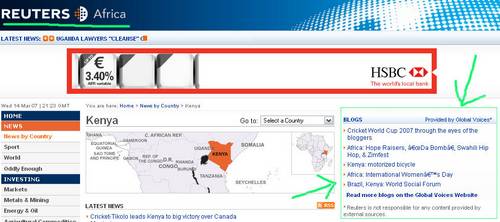
Dass es auch anders geht, zeigt Reuters auf seiner überarbeiteten Website.

reuters

Mein Kumpel Mentalacrobatics aus Nairobi erwähnte es bereits letzte Woche: Reuters setzt ab sofort auf seinen Länderseiten im neu überarbeiteten Afrika-Portal auf Bloginhalte, die bei GlobalVoicesOnline zusammengetragen und von Autoren freiwillig aufbereitet werden. Bloginhalte von lokalen Blogs, wie sie z.B. hier auch im Kenianischen Blogwebring zu finden sind.

Freilich, Kenia ist nicht Deutschland, es gibt dort nur zwei bedeutende und einige unbedeutende Tageszeitungen; in Kenia gibt es keine taz und Meldungen, die in Dland wohl eher von Praktikanten zusammengeschustert werden, müssen dort vom Agenturticker 1:1 übernommen werden. Insofern ist man dort auf die Berichterstattung durch Blogger viel mehr angewiesen als hierzulande, wo Blogs wohl eher der Unterhaltung dienen.

Kenia an dieser Stelle auch nur als Beispiel – es gibt sicherlich noch viele andere Länder, in denen es mit der Presse- und Meinungsfreiheit nicht so rosig ausschaut, und in denen Blogs als eine der wenigen repräsentative(re)n Quellen angesehen werden können.

Reuters hat dies verstanden, und nutzt seitdem Blogs als zusätzliche Infoquelle.

Beim Hash von WhiteAfrican wird zur Zeit wieder über ein Mobilfunk Community Projekt in Afrika nachgedacht, bei dem über SMS als möglichen Kommunikationskanal die Menschen auf einem lokalen Weg erreicht und angesprochen werden können.

Hash trat mit dieser an sich sehr interessanten Idee vor einigen Monaten an die Öffentlichkeit und warf es so in die Blogosphere – wobei auch er (wie ich) in dem kenianischen Blogwebring verlinkt ist. Die Verlinkung bedeutet übrigens auch die Einbindung von Bloginhalten in Feeds, so daß täglich eine recht breite Masse von Lesern mit den Inhalten der kenianischen Blogosphere rein visuell konfrontiert wird.

Das interessante an dieser Diskussion, und wieso ich es überhaupt erwähne, ist die Tatsache, dass auf einmal so richtig deutlich wird, wie sehr dieses Bild von “Afrika” fälschlicherweise in den Köpfen der Leute steckt – und wie sehr von außen von einer Einheit ausgegangen wird.

Gut, wir kennen das von der USAmerikanern, die uns hier in Deutschland auch als Teil von Europa sehen, als Teil einer Einheit die wir selber gar nicht so aktiv wahrnehmen.
Im Vergleich zu den afrikanischen Ländern sind wir aber in Europa auch einheitlicher organisiert – alleine wegen des Euros und der Gesetzgebungsrichtlinien durch die europäische Kommission. Gibt es ja alles nicht bei der noch recht jungen Afrikanischen Union.

Das ist dann mitunter einer der Gründe, wieso interessante Web 2.0 Projekte wie Muti aus Südafrika in einigen westafrikanischen, frankophonen Ländern überhaupt nicht bekannt sind: nicht nur wegen der sprachlichen Unterschiede (wenn man von nationalen Sprachen ausgeht, sind wir im vereinigten Europa schon mehrsprachiger, oder?) oder technischer Zugangsschwierigkeiten, sondern weil es unterschiedliche Welten sind, die einander vorbeileben.

Dabei hat sich in den letzten Jahren das Handy als Endgerät in den meisten afrikanischen Ländern als DIE Kommunikationsplattform entwickelt. Das ist ein Prozess und eine Geschwindigkeit, wie sie keiner so schnell erahnt hätte.
Der Unterschied zu einem anderen schnell wachsenden Markt wie Indien oder China besteht dann darin, dass diese beiden Länder, gleichwohl sie als Subkontinente betrachtet werden dürfen, vergleichsweise homogener auftreten.

Es muss also an dieser Stelle die Frage gestellt werden, ob der Mobilfunksektor in Zukunft eine DER neuen Völkerverbindenden Möglichkeiten darstellt, mit dessen Hilfe einzelne Länder, oder auch Völkergruppen innerhalb einzelner Länder zu einer größeren Einheit zusammengeführt werden können.
Ich nehme an, dass der Mobilfunk jetzt schon dort Brücken schlägt, wo es bis vor einiger Zeit noch keine Kommunikation gab, und so auch keinen gesellschaftlichen Fortschritt hin zu mehr Einheit.

Und das – diese Völkerverständigung durch neue Technologien – finde ich dann wieder gut an Web 2.0 & all dem Schnickschnack.

pick one

SANY0074

“The most beautiful women on earth, the beauty that no amount of money can buy, the most powerful hair in Africa, the most wanted hair styles now in Africa, our business is to make ladies look beautiful. If you want to look beautiful, come to us now. The magic in weaving styles for beautiful women.”

I just had to buy this poster on River Road today. That is, where else do you get African beauty for 60 bob? :-)

Buschpilot

mafbild

Wenn ich das am Donnerstag morgen im Presseladen am Flughafen richtig gesehen habe, scheint es in der aerokurier Ausgabe einen Artikel über MAF Germany zu geben. Das ist doch genau Dein Ding, Christoph, oder?

trashtoys ‘r’ us

Earlier in Januar 2006, the ecoblog Treehugger covered an interesting story on Arvind Gupta who is well known for developing toys out of trash / waste material and publishing books on various subjects. The “tinkerer and toy-maker”, as he is quoted in this article by India Together, has dedicated his life to demystifying the abstruse world of science for the comprehension of children”.
Looking at his toys, one understands his interesting approach on combining toys & with science and it also reminds me of this little scientific book I had as a child that featured similar ideas. No wonder I’ve become a geek :-)

“The best thing a child can do with a toy is break it !”
(quote on Arvind Gupta‘s website)

This morning I received a challenging short message by my dear friend Mbuzimoja, who asked me about creative toys that could be built with 4 to 9 years old children in an orphanage. Since I’d forwarded the above mentioned article to her earlier in January, she told me to have a closer look at do-able ideas – toys that could be produced in Kenya. Oh yeah – I DO like this idea!
Here’s what I had in mind (all links open in a new window):

crowncap01.jpg
Crown-Cap “Tik-Tiki”

abacus01.jpg
Abacus

balloonpump01.jpg
Ballon Pump

captop05.jpg
can top

clapinair08.jpg
clap in the air (oh, i love this! :-)

musicalobe03.jpg
musical oboe

generator02.jpg
Or for the older kids a simple generator (motor) that powers an LED (these parts are available on 2nd hand electronic markets or even from other old electronical gadgets).

…the list goes on and on and it becomes obvious that creativity knows no boundaries while at the same time the children learn something about building their own toys (like those wire cars we already know) and getting an understanding for technology. In case this triggered your interest, make sure to check out Arvind Guptas publications as well. A man who clearly enjoys the joy of sharing. Thank you!

P.S.: and here’s a special solar link for you, afroM :-)

New African

Fellow ex-blogger Irena recently forwarded a paper copy of the NEW AFRICAN April ’06 edition to me (thx!!) and while going through their articles, it somehow surprised me that a magazine of such broadness (the last time I bought this zine was in February 2000) still seems to battle, to justify the self-worth of the African continent and their people in the 21st century. A battle for anknowledgement?

That is, the lasting impression is that they are constantly trying to portray this modern picture of the continent – the focus, it seems, is on showing the rest of the world what’s so new on Africa and how diverse it actually is.
Please don’t get me wrong – I like this approach, and I also like to read positive news and being informed on different background stories. The magazine itself is very interesting, and I take it that compiling such a magazine every month isn’t an easy task as its readers world-wide sure are some of the most critical.
On the other hand, though, I am of course tempted to compare this sort of journalism with the local, monthly media – if possible. And this leads me to the assumption that our local (european) journalism is much more foccused on reporting contemporary stories and thus focusses on the story itself – whereas the New African editors try to catch the bigger picture, often trying to combine the present with the past. It’s like introducing readers to a new world, trying to get their understanding for the various microcosms by adding the historical context. It’s like reading le monde diplomatique in the format of TIME magazine.
The reason I am mentioning all this is because I did not intend to write a review on the New African, but instead, I was wondering about the impact this kind of journalism / publishing / writing style has, and the message that tries to be conveyed with such approaches.
Or in other words: the African continent with it’s relatively young countries shaped by the colonial heritage, which still has more relevance to today’s politics compared to the also known history and cultural values found on the continent long before any white (wo)man set a foot on it, has something unique, something very important I think: a burning desire to advance and an undying thirst for knowledge.
Let’s take Germany, for instance, and the various debates going on in this democracy on a national level. Any bugging issues? Think of falling birthrates (resulting in unhealthy pension sheme), the european and global competition next door (= unemployment & frustration) or just excessive taxes. While politicians & others are debating the problem and trying to find possible solutions, only a few people really go back to this point where they ask the fundamental question of how we – as a society – want to live in future and what kind of target we are heading to.

And this is exactly where I would like to make the connection to this New African magazine: what we need over here in Europe is another type of journalism, something that just not reports facts, but instead shows us how all these little problems, microsms and societies mix up and deliver the bigger picture. There are (of course) a few such new styled magazines (~Brandeins) that try to catch the atmosphere, but I would like to see this kind of spirit swap over from the paper form into the heads of my people. Something that gives them an understanding for the global context and how new developments are to be seen with respect for the past.

The New African does exactly that in its April edition by publishing excerpts of Ayi Kwei Armah‘s new boook titled “The Eloquence of the Scribes”. Taking us back into history to get an understanding for where we are heading to in future – conscious and unconscious.

Solo Computer, the details (part II)

AfroM of AfroMusing asked me to compile the feedback on the technical questions she received from ExpLAN Computers Ltd. on their SOLO computer project. I also tossed in some questions to inquire what this is all about, and – apart from all those juicy details that we are now supposed to blog – Paul Richardson of ExpLAN Computers Ltd. not only answered these questions but also presented us with a very comprehensive understanding of how things work out in field. In other words: the man knows what’s needed and has spent an enormous amount of time trying to understand what works and what doesn’t. This is about hardware and software playing together, understanding what ppl out there really need in terms of basic computing and having an understanding for the context under which these developments are to be seen.

So let’s just have a look at Paul’s answers:

Rechargeable Batteries: The Solo computer (Solo) will be run using a separate power-supply in a box with high-temperature rechargeable cells, capable of receiving charge up to 70degC. Also in this box is a processor and charge-switching system. The power supply monitors what is needed to run the computer and will make up any deficiency in direct solar-power by mixing in some charge stored in a battery. Hence, you would typically have enough energy in a completely full unit to run a Solo computer for about 2.5 hours.

Variety of Power Supplies: The Power Supply can receive input from any source of electrical power, either constant-current or constant-voltage (between 6v – 30v DC). Think of generators which are connected to static bicycles…

CPU: We are no longer expecting to use the ARM-7500 processor in the production units. ARM processors are mostly used in portable devices like mobile phones, and consume less than 0.5 watts. Frankly a USB port uses more power than our processor! A pentium processor consumes typically 70watts or more. The AMD Turion processor was designed for use in low-energy laptops and is available in versions using 35w or 25w.

Touch Panel: There are three main technologies used for touch-sensitive screens and the choice of touch-screen type will be made later:

  • resistive (4-wire or 5-wire). These have the active surface on top and can be scratched by dirt on a finger or stylus.
  • capacitive.These have the active layer underneath, but can only use a finger because it needs the human body to drain the capactive charge. The problem with this is that genetics has dictated that the average African finger is 50% wider than the average European one! So Africans using capactive screens often complain that they can’t see the pointer!
  • Surface Acoustic Wave. There is no touch-sensitive surface. Instead there are sensors at the edges of the screen which detect where a finger, stylus or stick is pointing. SAW screens are about twice the price of a 4-wire resistive.


Maintenance costs: will there be any local dealers that could repair these computers when they brake?
We do not expect Solo computers will be sold by the usual concept of a “dealer”. No existing dealer could yet handle the sort of technology inside a Solo, and most will be based in cities or towns that have some mains electricity. So they have the wrong skills in the wrong place!
The Solo design incorporates a number of redundancy features. So if the keyboard breaks then you can use the mouse with an onscreen keyboard or a touch-screen to send a message asking for a new keyboard.

Since there are no internal moving parts and very few connections, it is difficult to think what a service-engineer could repair “in the field”. If there is a catestrophic failure caused by (for example) dropping the screen on a rock, then only a Manufacturing Base or a designated field-agent could possibly be able to install a new screen.
A Solo isn’t built from the same sort of parts that are found in PC’s

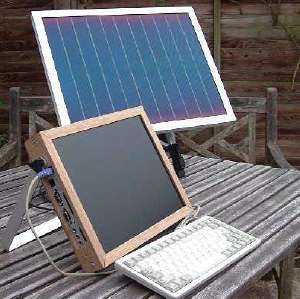
SoloComputer MkII Prototype

Operating Systems: Currently our prototypes are running *both* Debian Linux and RISC OS. They are both standard operating systems with the usual 7-layer model of network protocols, and based on the Berkley network stack.
If the computer is running Linux, then the user environment would look no different to any other PC or laptop running the same version of Linux. The Solo is a “full” computer, not a palmtop with a cut-down functionality and reduced user-interface.
The same would be true if it ran RISC OS.


Hardware Upgrades?
The Solo design does not have the usual concepts of a single hard-disc and a single block of RAM. We have a 5-layer memory system wich has different types of solid-state memory, which use different levels of power. Hence we have no concept of the computer being “off”. It simply transfers data into an appropriate type of memory and shuts off all user-processes.

We expect that most Solo computers will be manufactured with two or more externally-available memory slots capable of taking a Compact Flash card, microdrive or other type of solid-state device. If the user wants more storage, then they can insert a larger media-card.


the invention?: Hopefully the average user will be totally unaware of “what theinvention is”! They should just regard it as a standard computer in a slightly unusual wooden case. We’ve spent the last 8 months with one programmer working on the code to drive the video-output stages. Low energy CPUs are usually designed to drive a screen the size of that on a mobile phone. They have neither the resolution nor the data bandwidth to address a full-size computer screen. So this is an extensive amount of development work.

What else could be made of wood or sustainable materials despite the computer case?The case of the Solo power-supply can also be wood. And we’re working on a solid-state light which might use wood too.
However, a more important environmental issue is the use of lead and tantalum in the manufacture of circuit boards. There are no restrictionson this in countries of the Developing World. But in Europe it is now illegal to throw away such computers into a land-fill site.

That’s why companies give old PCs to charities who pack them into containers and send them out for use in African primary schools.
(!!!) When they fail, the African school digs a pit behind the classroom and throws them in. So in 10 year’s time, it will be the African teenagers who are suffering from brain damage because such “heavy metals” can’t be removed from the
drinking water. Compared with that problem, the use of environmentally-friendly wood in the case of the Solo is very much a side issue.


==> that was my initial question, not the use of environmentally-friendly wood but getting this cradle-to-cradle design to the PCB level and finding a solution to this bugging issue of heavy metals pollution in the developing countries which needs to be addressed much more. Surely, finding a solution to this situation isn’t the duty of engineers that are trying to build a computer for these countries, but still, it’s the most interesting part for me. I think we’ll need a free Wiki on the inet for intelligent materials pooling – an overview of materials, availabilities and pricing that could provide some solutions to the lead, tantalum & Co. material flow management.

I like their approach and their down-to-earth understanding for what’s needed. The bottom line seems to be that although the technology is already available, it takes time, money and definitely a lot of passion and a healthy business plan to get this from the prototype level into production. On the other hand, as marketing requires a lot of funding, let us continue promoting this good initiative and do some viral marketing through the blogosphere. Or as Paul puts it: “We are a Design Team, not a sales outlet. So we have no admin staff to handle sales and marketing. Every hour we spend answering questions to individuals is an hour less in actual design-work.”