K?r?ro k?r? it??ra g?ting?reka m?nd? akome*

Dear President Kibaki,

On March 2, 2006 armed police raided the headquarters and printing plant of the East African Standard Group. In addition to destroying equipment including the printing presses and burning newspapers, they shut down the Kenyan Television Network television station.

This latest attack follows the jailing of three journalists from the East African Standard newspaper, attacks on the Citizen Weekly, and ongoing harassment of journalists by government-sponsored forces.

I urge you to:

  1. wake up!
  2. Condemn these attacks in the strongest terms possible.
  3. Dismiss any member of your government who played a role in the attacks.
  4. Live up to your promise to support freedom of the press.

Please copy and paste a copy of this letter on your blog. You may alter the wording to suit your needs. Campaign started by Keguro.
[via Mentalacrobatics]

*One person weeping prevents all in a village from sleeping.

UPDATE: the story gets BoingBoinged & make sure not to miss Ruud’s video coverage

so jung kommen wir nicht mehr zusammen

priceless.JPG

  • sausages (€0,65) and feta cheese (€0,89) in filo dough (€0,75), covered with one liquid egg (~ € 0,08) = € 2,37
  • RIOJA,  Paternina Banda Azul, Crianza 2001,
    a gift from a good friend (thx Gün :-) = € 0,00
  • Kikoi from Kenya, used as a tablecloth
    ("never travel without YOUR kikoi" (JKE)) = ~ €8,-
  • music
    Tocotronic "so jung kommen wir nicht mehr zusammen" = €  8,97
  • time to enjoy life with friends = priceless 

a proposal…

Without any proper scientific proof at my hands right now, I would still like to focus your attention to an urgent problem that keeps on arising and needs to be tackled soon: Africa, I think, has become the landfill for the West. And East!

Remember China’s interest in various African countries? Not that they only exploit the continent of natural resources – in return the markets are flooded with cheap products that end up somewhere on a landfill. All these plastic items, be it useful buckets or just toys, eventually end up as rubbish and need to disposed of (one way products). Recycling is an option, yes, yet in most cases it’s a downcycling process (material quality deteriorates) and just a delay on its way to the landfill. In the end it’s still waste.
And of course it isn’t China only. I’ve just watched this youtube video of an NGO that helps schools in Uganda going online. Nice! However, to look at backgrounds – isn’t it that most of those computers are 2nd hand and thus disposed of to countries like Uganda?
Or Kenya: ever wondered why there are so many plastic bags flying around? People grew up with organic products, they were used to goat bones and maize/corncob that would eventually decompose over the years. And with those plastic bags and batteries? No one told them that those items are polluting the environment (ok, except for schools). And no one wants to be responsible. People applauded Dr. Wangari Maathai for winning the nobel peace prize but it seems they never really got the message – which I think is taking fate into your own hands and starting to change something without waiting for others. No wonder Kenyans are more into political discussions than in identifying leadership. Dito Germans, btw, and in many other countries. People, it seems to me, are more into living a pleasant life and securing their amenity values. Business and maximization of profits is valued these days – whereas commendable professions like teaching or serving jobs like in the civil service aren’t really honoured. But I digress…
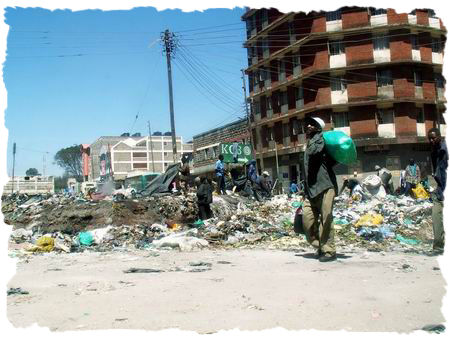

waste on the streets in Nairobi, Kenya // instead of better waste management, wouldn’t it be better to avoid all this waste in the first place by using more intelligent products?

Please don’t get me wrong – capitalism per se isn’t that bad and mandatory for progress. Only, what we’ll need to have are sustainable, eco-effective products that won’t have any negative effect on the environment and that only become better the more we buy/consume/produce. And we’ll need to design them in such a way that we don’t need to depend on the intelligence of people/users.
E.g. if 9 out of 10 people care for the environment and only 1 of them continually ignores all product handling directions by let’s say throwing batteries into a river, all others have to suffer. And since there will ALWAYS be someone violating guidelines (we can not change anyones behaviour), we have to change the products themselves.

Look for solutions, not problems. (Dan Eldon)

I’m not the typical theoretician that tries to lament on problems, writes reports on various subjects and has many different IF/WHEN/THEN-solutions to a problem. What I want is action, and I want it soon.

To make a start, I would like to tell you about this product idea I may have been talking about before and which I choose to blog instead of keeping it in a drawer somewhere. Besides, some companies may already be thinking about it, so anyways, here you go:

While working on this sewage treatment plant some time ago, I came across a huge pile of Q-TIPS® (cotton swabs) in the sewage sludge. The cotton part of them would dissolve in the wastewater whereas the plastic stick in the middle would remain and end on the sludge landfill. Those plastic components also contributed to a lot of mechanical problems on the treatment plant by destroying various pumps and other intergrated machinery.
The first question that arises of course asks for the dumb users that throw cotton swabs (among other things) in their toilets. According to what I’ve encounterded a lot of people do that. Out of sight – out of their mind(s)?
Whatever. You can not change them.

What I CAN do, or try at least, is changing the products they are using. I thought of re-designing those Q-TIPS®/cotton swabs in such a way that the plastic stick will be substituted by a material that is made of (corn) starch, chitosan, plant fibres or other biomaterials. This biological material could then dissolve in the wastewater or decompose on the landfill after use and people could continue throwing their waste into the sewage system without harming the environment that much.

I think some companies are already doing r&d on these products and it will only be a matter of time until customers are informed enough to ask for more and more sustainable products. The different approach, though, is that this shouldn’t be only focused on those that can afford to buy “good” products – the African continent with it’s still traditional and comprehensible view of nature and biological cycles should play a leading role in these (not so new) new technologies and I think it’s about time for more and more companies to start focusing on this instead of just copying various technologies/industries from the West.

This might just be small idea for progress, but at least it’s a start, or? What do you think?

simumania, part 2

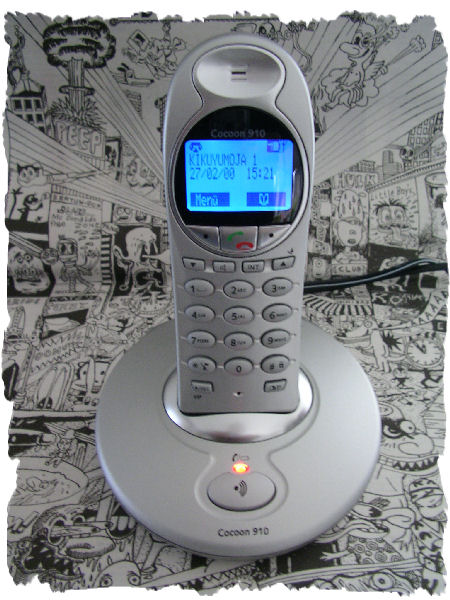
Talking about my cordless phone the other day – a friend of mine called me this morning from his almost broken cordless phone and, since I ‘ve been longing for a new phone for some months now, I came up with this idea to sell him my old cordless phone and buy a better one.
One with Calling Line Identification Presentation (CLIP) and a hands-free/speakerphone function. Everything else isn’t really required but nice to have…

simunew.jpg
So why would I blog on a normal cordless phone? Becooooos I am showing off there’s this special story that I’d almost forgotten until last Saturday when Mbuzimoja, her bro and me were strolling through Munich and came across one of those old Panasonic phones. You know, those huge white analogue ones with telescopic antennas that used to sell for ~9.000/= Kshs. back in those days (in the mid-90s).

Back in those days (~1988) when cordless phones came up in Europe, I always wanted to have one which, of course, I just couldn’t afford. Then, in 1992 or 1993, some local dealers in Nairobi had the first mobile phones for sale – most of them being those Panasonic ones with that huge telescopic antenna. One dealer, though, had this brand new Sanyo phone, operating at 46/49 MHz and the moment I saw it, I wanted to have it. Dearly. It took me half a year and selling some beloved items to eventually get my hands on this cordless phone.
Ndugu Mathias, remember how you used to laugh about this? Nairobi with its faulty telephone network – who really needed a cordless phone when most of the time, damage due to damp killed the line? Mimi! :-)

And nowadays, the market is overcrowded with digtial cordless phones with prices starting as low as 30,- EUR and Nairobians are meanwhile getting used to mobile phones (GSM). What’s next? A blackberry-styled network that will bring the internet to remote places such as Wajir? Stay tuned!

p.s.: the downside on this simu? Hakuna answering machine – but hey, why do I keep have this roommate who picks up the phone for me? ^^

Harambee, harambee, tuimbe pamoja…

"A German woman who is organising a fund-raising for a children’s home in Nairobi is frustrated about the lack of support from Kenyans. A friend of hers says the would-be benefactor has not found any Kenyan living in Germany, who is willing to volunteer his or her services for a few hours. Some have even asked to be paid a little something but the German finds this rather callous…" (source: The Cutting Edge, by Watchman, Daily Nation, Kenyan Newspaper)

Similar to Afromusing’s challenge earlier this week, in which she asks all keyboard/pyama/blogging activists out there if they could imagine donating US$ 5 for a tree planting project, I would like to ask the esteemed readers of my blog if they could imagine donating some of their income for social projects like a children’s home.

In fact, I was just chatting with Irena about this issue and she told me about the agony of organizing a fundraising evening in the US  that just generated US$ 10 for a good project whereas ppl were spending 50 bucks each on food & entertainment during that evening.
Sorry, but that’s just so sick.

Hence, the provoking allegation that I would like to make and on which I would like YOU to comment on is that there are a lot people out there – no matter what nationality – that don’t give a damn about others. And it’s not only that they don’t care, it’s also that they seem to think that OTHERS might be responsible for the fate of street/abandoned children, the environment,  politics / etc..
Charity begins at home? For them it ends at home.

And what’s with all those over-funded non profit organizations that have some money to share? What kind of overhead expenses are generated by local NGOs? Where are the jobless volunteers that would jump on the boat to work as trustworthy representatives?
So many questions…
And yet I am afraid that all this once again ends up in the same way it often happens: people are just talking all day long and nothing happens the moment REAL ACTION is required. It’s so easy to rant about these issues, but it’s hard to deal with bureaucraZy and other obstacles that prevent e.g. NGOs from working efficiently. While there are some officials that understand that most NGOs are doing a good job and need to be supported, others are just using the system for another rip-off. And the people? They leave it to the government a.k.a. corrupted civil service networks. Again, this attitude of surrendering responsibility  to others which just drives me nuts!
Wangari Maathai, I think, wasn’t only awarded the nobel peace prize for planting trees, raising awareness for environmental issues or because the nobel committee wanted to send a signal. I think she got that prize mainly because she kept on fighting and never gave up.
I wish some of her spirit could have an effect on the Blue Band/PS2/mobile phone Generation worldwide – the kids of this next generation who prefer being entertained by the media and trade in any quest to have a postive change on this world for an easy, hassle-free lifestyle that doesn’t include taking care of others. And it is us – me, you, everyone – we need to teach them and live good values.

Yani, I take it that those who have access to the internet and take their time to read blogs might think in a similar way and do not need any further briefing on this matter. However, since there are still so many ignorants out there, let’s make a start and generate some awareness. It might not change much, but we need to start somewhere at least.

n.b.: the interesting observation is that charity seems to be much more common with the poor.

redonculous

Ummmm….youtube again, sorry, but there’s something I still wanted to show you.

On my first visit to Munich last year, the capital of this strange empire also known as Bavaria, I came across an interesting spot – something that every Munich tourist apparently already knows but to me this was new. There’s this creek called Eisbach (Eis, as in icecold!) which flows through the Englische Garten and if you look at the map, you’ll see that it’s directly within the city centre.
Now, parts of this river are underground and the spot where it shoots out of the underground tunnel (system), the flow velocity and the underwater weir (just 40 cm beneath the bottom of the wave) produce a steady wave that can reach up to 1 m and higher in good conditions. Remember, all of this DOWNTOWN! (360° image of the scenery)

(youtube video offline)

Imagine me standing there for ages, watching crazy dudes jumping on their boards and riding the wave as if there’s nothing else in life than a good, steady wave. Munich, you rock – big times!

Ehrensenf

Endlich wird mein LieblingsVlog Internet TV Ehrensenf beim größten deutschsprachigen Blog a.k.a Spiegel Online (SPON) erwähnt.

Jetzt können die Gelegenheitssurfer aus der Generation Golf endlich ruhigen Gewissens verkünden, dass sie bei SPON was ganz großartiges gefunden haben. Womit sie ja auch absolut Recht haben.

mein Vorschlag
: BigBrother, DSDS & Co. mindestens 1x/Woche durch Dauerpenetration von Xtra3, Polylux, Toni Mahoni, Ehrensenf & Dittsche ersetzen. :-)