Beyond the Blue Band Generation

I wonder if this has ever been shared on the Kenyan blogosphere so far? I actually don’t like posting videos / not my own stuff, but the following is an interesting video that caught my attention while browsing Vimeo for quality content ex EAK.

Beyond the Nakumatt Generation

“Addressing the concerns of the poorest households and facilitating the inclusion of smallholders in modern distribution chains should be a priority in all East African countries.”
(“Beyond the Nakumatt Generation: Distribution Services in East Africa“, World Bank Policy Note No. 26, Oct 2011)

Talking about videos from Kenya, here is another – totally unrelated – one about a revolting teenager:

Do It Yourself, The Art Of Being Punk

Oh, and the art of browsing Vimeo & Co. for original Kenyan content is to exclude those vids produced by religious Wazungu Churches with their “Coming to Africa and doing good”-approaches that either show some slum dwellers or other poor groups in rural areas. It’s also the reason why I like this last video: even though it shows a household and protected childhood that probably only a small percentage of Kenyans have enjoyed, it’s the other side of Kenya that I have in mind when I talk about Kenya.

(“Blue Band Generation” is a play on the 1990s Kenya)

Bhoom Bhoom Africa

Long time readers of this blog may know that I have always been wondering why we’ve seen bands like “Matata” (with the then awesome Steele Beauttah) coming to success in East Africa during the 1970s – closely followed by a vacuum in the 1980s and early 90s that was only dominated by a) Congolese Soukous (Franco & Co), b) local Gospel, c) local tribal music and d) international Pop music (Michael Jackson & Co.).

At first, I tried to explain this seemingly sudden disappearance with the political situation(s) back then, but I guess it’s just an international thing as the music also changed in many other parts of the world.

Anyhow, it is against this background that I am always filled with great joy when I stumble upon really cool modern music videos (yes, videos – the visual age of YouTube, our beloved pop archive) – created in Africa, showing the world that Nairobi, Lagos or Luanda aren’t that much different from the rest of the world.

Heavy Metal band Ree-burth from Soweto South Africa

(see also this post on vice.com)

FALASTE O QUE
shot in the area of Sambizanga in Luanda, Angola with MC Sacerdote and his artist crew

Breakdance Project Uganda
(too tight!)

Anto & Paragasha – QWERTY LOVE (filmed in Nbo)

The Very Best – Yoshua Alikuti (also filmed in Nbo)

(which is a play on the clip for Lil Wayne’s “A Milli”)

Ma Bhoom Bhoom Bhoom
One of those vids from the BLNRB project

Liz Ogumbo “Maro pa more”
(filmed in Olepolos / Corner Baridi and in Nbo)

Muthoni “Mikono Kwenye Hewa”
(yup, a bit older, but reposted here because when her album went live on Bandcamp.com many month ago, I instantly bought it.)

…and then there’s (still) this:

Matasia Star “Life History”
(Ndombolo cruelty mix for those who still live in the 1990s)

(ati, the producer is some guy from Ujerumani? ;-)

Which IT setup would you buy if money wasn’t an issue?

In the age of tablet computers and the fact that I do spend about 80% of my computing needs on a stationary computer setup, it may sound a bit ironic that I am still wasting time on wondering about “the ideal mobile computer setup”. Whereas “ideal” stands for affordable and somehow powerful machines that do have that extra gimmick I think I need.

I am currently using an HP Elitebook 6930p (14,1″ Core Duo @ 2,26 GHz), an HP tc4400 (12,1″ convertible tablet laptop) and an Apple iPad2. When in Frankfurt, I use both laptops on an HP docking station which is connected to a 22″ TFT.

The iPad is the first machine I bought as new hardware – all other being 2nd hand or refurbished PCs for about half the price. The iPad is the best piece of hardware I’ve ever bought because it’s instantly online and because it’s good at what it is able to do.

I work with Win7 most of the time because my main client also does. My output needs to look fine on their machines. I have to use MS Outlook (even though I’d like to use something else). I have to use MS Office suites.

I want a laptop with a nice screen (IPS?!, no colour calibration needed, low energy consumption, not higher than 130 dpi). With a nice battery runtime (> 3h). With good and/or switchable gfx. With an illuminated keyboard. With a nice keyboard layout (CTRL + FN keys should be switchable). Touchpad that supports multitouch. 3 USB ports.

Screen and keyboard are my two interfaces that need to be rock solid. My current HPs only have average CCFL-screens – even though their color reproduction is kinda ok.

Going by the above mentioned criteria and the current lack of really cool machines, I’ll probably have to go for an Apple MacBookPro one day. But then – MacBooks? Me?? I grew up with an Atari 1040 STF, there’s the iPad and an iPhone4 – so there’s some sympathy, but else I dislike that there’s no real docking station available for most MacBooks (right?), that the display doesn’t fully open, that all current MacBooks come with a glare type display coating and probably also a few other things that aren’t that great. What I like about them are the magnetic power cord plugs, the illuminated keyboard, the display quality, the battery consumption and the integrated circuit that regulates battery recharging (right?? or is this on Lenovo ThinkPads only?).

So my WHAT-IF question to you is: if money wasn’t the issue, which IT setup would you currently go for and why? Thx!

(there’s a small site run by someone from a German laptop forum which regularly lists good laptop recommendations, but some of those selections are a bit strange. I am currently torn between a modern Lenovo, a MacBook(Pro) or even a business Acer – maybe also HP or Dell (e.g. Dell Latitude E6420), but only if their latest ones don’t have issues like that the internal 3G modem is only activated once the battery is inserted, which is so ridiculous…).

Pirates, revisited

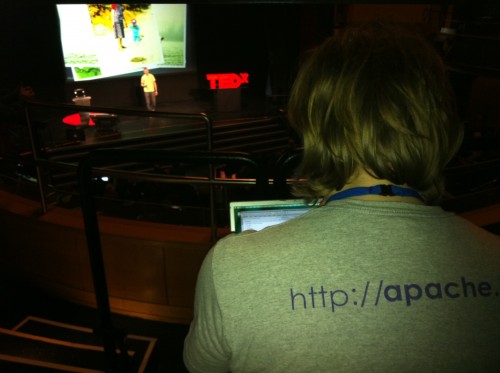
TEDxRM apacheAn unrelated, but still epic snapshot I took at a recent local TEDx event.

Coming back to my satirical he-said-she-said piece on Pirate Party Kenya, I think there’s 80% truth in it and that Kenya could also use such a modern political party. And this although I also believe that democracy as such still isn’t the best option for today’s Kenya, at least not when it comes to the way it has been implemented in the past and when we look at the historical structure of societies in East Africa.

I am not a member of the Pirate Party Germany because I am trying to be independent and have in the past also contributed to Germany’s first hyperlocal project frankfurt-gestalten.de (which is similar to Mzalendo.com, but for (the City of) Frankfurt am Main only and is more about republishing open data (e.g. hansards from the local parliament) and capturing citizen voices) and have as such tried to keep a neutral position.

I have, however, voted for Pirate Party during the last two local (German) elections because of the following reason(s).

I also voted for them because I am convinced of their concept. You’ll have to understand that about 95% of the German media are currently trying to brand us floating voters as “protest voters“, who voted for the Pirate Party out of protest. This is SO wrong and I am strongly opposed to this limited point of view! The problem is: most of the media didn’t get it. As much as they never understood the need to update their views on the law which regulates the use of (online) content. What’s a free and open media when they are too stupid to understand a completely different approach to politics? A new approach that also requires a different benchmarking system if we are to compare the new option with the traditional alternatives. And please remember: Germany already saw the introduction of the Greens Party (“Die Grünen”) in the early 1980s, so our society here is already familiar with new approaches.

I am calling the Pirate movement a modern party because I strongly believe that their structure is the logical consequence of what the internet has brought us so far. Such as an international and timely response on open issues that have in the past only been dealt with by a relatively small group. I see it as a response to the success of the internet – this world wide network that is as revolutionary as letterpress, radio and television combined. The understanding of the impact the internet has on all of us probably is something that many of the critics do not really want to acknowledge. As such, with new structures that introduced a completely new concept in communication, it’s also about time for a new and different system. Either way, it just happens, whether you like it or not. I also don’t like everything they put on Wikipedia, yet I often use it like many others.

What makes Pirates Party special to me is the integration of modern tools and a completely different understanding of grassroots democracy – something we already know from the internet. “Liquid feedback” is such a system and piece of software that collects voices and forwards votes to a person in the system that has more competence on a particular subject. Everyone can cast his vote on all issues or delegate his vote to someone else. It’s still a relatively new approach, but the one that makes the difference to me.  This alone – the different understanding of TRUE democracy – is reason enough for me to give them my vote.

It is also this understanding why I just laugh at critics who are asking me on “how can you vote for the Pirates – they don’t even have a political agenda next to their internet stuff??! 1!11”. Most critics just repeat what they read somewhere.

And the Pirate name? Well, both in Kenya and Germany, many if not all political parties seem to have names that don’t hold true to 95% of their daily business. Maybe the Anarchist Pogo Party of Germany (founded in 1981 by two punks) is one of the few that is as consequent in their approaches as the name dictates.  So either way you may want to interpret the name and how it qualifies for a better marketing strategy (given that it sounds a bit anarchic to most conservative voters), it probably only matters for marketing reasons and as such, it isn’t the worst.

In a recent election in two different states within Germany, the German Piratenpartei scored between 7 and almost 9%, thereby securing a few seats in local parliaments. They currently have over 23.000 (!) members in Germany, which is quite a lot for such a young party. Something tells me that a) they are doing it right, b) the interest to engage in local politics isn’t dead and as important as it has always been and c) not all of their members are the stereotypical IT folks with long hair who are into Terry Pratchett and/or have a paranoid fear of everything Google Inc. does. All these members, rich and poor, old and young certainly aren’t engaging for the protest only.

It is for these reasons alone, but also for many unmentioned more that I would to see politics adopting more structures that correspond to the technological framework we currently experience on our planet. New structures that enable crowdsourced project approaches, something that will hopefully also change the way we perceive to live in urban communities (e.g. a modernized infrastructure that plays along with our needs, not the other way round as it has been in the past). Pirate Party as such may not be the best option with all its typical start-up problems, but it’s the one that works and that’s all that matters to me at the moment. If we could have the same in Kenya, I’d be very happy!

Famous former Kenyan blogger to open Pirate Party branch

(Pirate Party Kenya logo courtesy of H.E. Kahenya Kamunyu, CC-BY-SA 2.0)

Famous former Kenyan blogger, techpreneur and writer Kahenya Kamunyu today announced the formation of Pirate Party Kenya.

In a festive event at Tribe Hotel, Mr. Kahenya said that Pirate Party Kenya has now been officially registered according to Chapter 7 (a) of the Political Parties Act as a Political Party in Kenya.

Pirate Party International

Pirate Party must not be mistaken for the Eastleigh-based Pirates Ransoms Association (PRA) or the Give Enough Money Association (GEMA), but is instead a Political Party which has of late been successful in different countries such as Scandinavia or German.

Mr. Kahenya today said that the motivation for the formation of the Kenyan branch of Pirate Party came from reading the late Wahome Mutahi’s “How to be Kenyan” which reminded him of the core values within the Kenyan society: good leadership, quick wins and a rich nation.

According to an Internet database, the Pirate Parties support civil rights, direct democracy and participation, reform of copyright and patent law, free sharing of knowledge (Open Content), data privacy, transparency, freedom of information, free education and universal healthcare.

Pirate Party Kenya will be the first Pirate Party branch in Sub Sahara Africa, with Morocco and Tunisia being the other two Up Sahara African countries where Pirate Parties exist, albeit unregistered. This will make Pirate Party Kenya unique on the continent and will underline the important role it will play for the region, Mr. Kamunyu said.

Interested members of the public and all members of Kenya’s famous tech incubator iHub are asked to join and register with Pirate Party Kenya as of today, Mr. Kahenya said.

Upcoming elections

Mr. Kahenya also said that he is going to run for the presidential seat in 2012.

After a quick enquiry via the Nation’s Social Media back channel Twitter, many Kenyan Twitter celebrities welcomed this announcement and said they will support Mr. Kahenya and even vote for him in the upcoming elections.

Twitter is an instant message service similar to SMS and has recently been announced as the official successor to SMS by Safaricom’s pleasant CEO Bob Collymore. In a press announcement via Twitter earlier this week, Mr. Collymore said that his company will offer special Twitter packages and is already in talks with Twitter Inc. in California for a zero costs access service.

Bandwidth, bandwidth, bandwidth

Pirate Party Kenya, Mr. Kamunyu said, will also focus on bandwidth problems which have of late been an issue in the upcoming ICT industry in Kenya’s striving capital Nairobi. “We will actually work for bandwidth“, Mr. Kamunyu said. “Interested IT companies will receive a reduced membership fee for their employees and are also encouraged to pay via stable bandwidth, airtime credits or local content“, he said.

“Pirate Party Kenya will also advocate for Free and Open Software in Kenya and ask the Government of Kenya to introduce a secure web-based email service for all public servants. This will also ensure productivity at various parastatal offices which are often affected by malware and other security issues.”, Mr. Kahenya said.

Mr Kahenya also said that “in a country where you can already pay your rent, your electricity, internet and water bills via mobile payment systems, it is about time to have a modern political party which addresses the needs of all stakeholders. Pirate Party Kenya will stand for these rights and will ensure that Kenyans are prepared for the global competition.
Furthermore, we encourage everyone who is fed up with the current political spectrum to give us his vote as we also provide democracy at a very basic level. All our members can directly vote for a candidate and it is this democratic basis that ensures stability in the long run”.

In a direct response via Facebook, famous Kenyan writer Binyavanga Wainaina said that he will name one of the characters in his upcoming novel “Kahenya”. Mr Wainaina is currently crowdsourcing fictional characters for a novel on a Kenyan who becomes a Swahili star in popular Nollywood movies. It is said to be the first true piece of pan-African fiction after the remains of Muammar al-Gaddafi’s diaries (“United States of Africa”) where found in a sewage pipe in Sirte, Libya in October 2011. Binya, as he is commonly known among his fans, said that “I support Kahenya Kamunyu’s introduction of the Pirate Party system in Kenya because Pirate Party Kenya will play an important role for the acknowledgement of Intellectual Property Rights which have always been an issue in most African societies due to historical reasons.”.

Meanwhile, the website of Pirate Party Kenya could not be reached at the time we went to press. “We are currently experiencing technical problems with the load balancer”, Mr Kahenya said in a telephone interview. “This, however, also is a good sign as it clearly shows the demand for a Pirate Party in Kenya”, he said.