“…the sudare is the thing handed down from their ancestor.” (src)
Found this nice quote on a website run by an artisan who crafts and repairs Sudare – Japanese screens. The same artist goes on explaining that:
“…the sudare is basically made from bamboo, but it can also be made from 3 to 4 other types of materials. The word “sudare” is characterized in Kanji by the combination of 2 kanjis: one meaning bamboo and the other meaning “in row.” So “sudare” means “lined-up bamboo.” Well actually, if we break the word “sudare” down, “su” stands for “lined-up bamboo,” and “dare” means “hanging down” because you hang sudare down from the ceiling when you use them. “
And that’s exactly what I am going to do with these screens: hang them up in our living room (in front of the window).
The interesting story and my reason for sharing this is that my parents found them on top of a rubbish container near our house in Tokyo some…30? years ago. An older house in the neighbourhood had been demolished and careless workers threw them away, so the Sudare(s) were free to be picked up.
There’s something about modern Japanese culture and how it conflicts with old traditions that would certainly make up for a lot of interesting blog posts. Fortunately, there are a lot of Japan-related blogs out there that cover exactly this transition between the old and the new worlds.
These sudare may look a bit worn out now, also because they were kept in a very moisture basement over the last 5 years, but the bamboo material is still in great shape and 100% ok. The build quality of these Japanese sudare is just amazing – even though they may be about 80+ yrs old!
I will buy some golden tape to repair the seam at the sides.
The following blog post will be in German, as it is about an event that took place in Frankfurt this Wednesday evening. Following the Twitter back channel conversations during last week’s Ignite Frankfurtevent (where attendees criticized the use of English instead of German), I realized that in order to reach those who are targeted, I will have to use their language. So the following will be a recap of the SocialBar event and a few thoughts about it – in German.
For those interested, the presentation I gave about AfriGadget tonight is very similar to the one I had given in London last year – only updated a few slides and included links to sites like appfrica.com, projectdiaspora.org or semasource.org. The reasoning is the same from my post back then, even my motivation for giving a talk on AG is pretty much the same. Imo, it’s all about giving another picture of “Africa”. One that may be different from what is usually known via the (partly biased) media. My colleague Steve Mugiri also presented AfriGadget during the TEDxAtlanta event on January 26 – if you can, pls check out his video. I also like it that everyone of us at AfriGadget has his/her own perspective & motivation for AfriGadget – and uses a different approach to highlight our work.
I think I am very passionate about this subject, and I consider “passion” a driving force for a lot of good projects. But anyways, I digress and should probably continue in German.
Auf Deutsch also. Dies war nun die vierte SocialBar in Frankfurt, dieses Mal relativ gut besucht, ca. 13? Teilnehmer aus verschiedenen Bereichen, mit verschiedener Motivation / Absichten / Erwartungen aber doch schon relativ ähnlichem sozialen und beruflichen Hintergrund.
Laut der Website ist die SocialBar “ein Treffen von Weltverbesserern. Web-Aktivisten, Social Entrepreneurs, NGOs, ehrenamtliche Helfer, Politiker und Unternehmen mit sozialer Verantwortung kommen bei der Socialbar zusammen, um sich kennen zu lernen, Kontakte zu knüpfen, Erfahrungen auszutauschen und Kooperationen einzugehen.”
Trotz dieser Beschreibung wüsste ich aber immer noch nicht, wie man die SocialBar genauer beschreiben sollte – es ist eine Veranstaltung, an der interessierte Leute teilnehmen, die sich für soziale Themen interessieren. Sozial, im Sinne von: ich mache etwas, das ich nicht nur für mich alleine mache.
Vielleicht auch wegen dieser doch recht ungenauen Definition, meines eigenen Hintergrundes und der doch regionalen Unterschiede bei Events solcher Art (eine SocialBar in z.B. Berlin erreicht meistens ein anderes Publikum), kann ich natürlich nur für mich selber sprechen: ich empfinde die SocialBar als sinnvolle Veranstaltung, bei der ich vor allem Gleichgesinnte treffe, die sich “soziale Projekte” auf die Fahne geschrieben haben. Sei es aus beruflicher Natur, oder auch weil man in der Freizeit einen sinnvollen Beitrag für die Allgemeinheit leisten möchte und der 9-to-5 Tagesjob dies nur unzureichend ermöglicht. Und so kommen wir auch schon zum zweiten Vortrag des Abends: von Wolfgang Weicht über die “Coding Battle”, oder wie er es nennt: The Social Media Fight Club.
Kurz: mehrere Teams bestehend aus Programmierern, Konzeptern und anderen Kreativen arbeiten ehrenamtlich an einem Wochenende zusammen und als Teams gegeneinander, um einer NGO zu einer Website zu verhelfen.
Die Idee finde ich nach längerer Diskussion und einigen Bieren mit Wolfgang nicht ganz so verkehrt, aber vor allem interessiert mich daran natürlich die Frage, ob man in einer Stadt wie Frankfurt – die ich in diesem Bereich als sehr träge empfinde – eine kritische Masse von Leuten zusammenbringen kann, die in ihrer Freizeit – in einer (an den HipHop angelehnten) Battle oder auch einfach nur so – für Níchtregierungsorganisationen (de: NROs, en: NGOs) unentgeltlich und aus Spaß (!) an der Sache ehrenamtlich arbeiten wollen.
Die Frage nach der Teilnahme an so einem Event empfinde ich als sehr wichtig – immerhin funktionieren viele Einrichtungen in Deutschland nur deswegen, weil es ehrenamtliche Helfer gibt. Ohne direkte Bezahlung einfach mal schauen ob man im Kollektiv etwas erreichen kann – das empfinde ich als sehr spannende Idee. Klar, gibt es ja auch schon online in Form der Wikipedia – kollektives Zusammentragen von Wissen – aber die Leute dann von ihren Computerbildschirmen hin zu einem realen Treffen zu bewegen, wo sie sich aufraffen müssen und gemeinsam etwas erarbeiten – das ist schon anders. Und eben auf den Frankfurter Kontext bezogen. Leute anschreiben, motivieren, begeistern können, Leidenschaft wecken, hinterher sein und sicherstellen, dass sie auch wirklich kommen (ich hatte mich auch schon mal zu einem Treffen bei Wolfgang angemeldet und dann im letzten Moment abgesagt). Das ist alles irre viel Arbeit. Können die Organisatoren der SocialBar sicherlich auch bestätigen.
Ob die Coding Battle in dieser Form klappen wird – who knows?
Ob ich daran teilnehmen werde? Hell, yes! Weil:
“Leadership Lessons learned from Dancing Guy”, von Derek Sivers, dessen Videos eigentlich alle super sind, alleine schon wegen seiner netten Stimme.
Einen ähnlichen Ansatz hat uns dann noch Denis Engemann vorgestellt, Student der Psychologie & Philosophie, der uns von dem anstehenden WIRKCAMP 2010 (am 07.-09. Mai 2010) in Leipzig berichtet hat. Ein ähnlicher Ansatz also wie die Coding Battle, in Leipzig nennen sie es allerdings Synagieren– gemeinsam handeln: “wir bringen für 3 Tage engagierte Menschen in kleinen Projekten zusammen”.
Laut den auf der Website angekündigten Arbeitsgruppen wird es folgende Themen/Arbeitsschwerpunkte geben: Vegetarische Tage für die Uni-Mensa, Filmen für Nachhaltigkeit, Littlebird – Schmackhaft in den Arbeitsmarkt, Nachhaltigkeit im Internet und Konsum Global Leipzig. Aus studentischer Sicht macht dies alles schon irgendwie Sinn.
Am Ende des Abends bleiben für mich die folgenden Fragen: welche Themen sind die ultimative Garanten für eine Mitarbeit von Freiwilligen? Wie kann ich eine möglichst interessierte Anzahl von Mitbürgern zu einem unentgeltlichen Projekt bewegen? Sind solche Aktivitäten ein Hinweis auf die Arbeitsweise in der Zukunft (kleine, dezentrale Projekte, vernetzes Arbeiten)? Inwiefern definieren wir uns mit so einem – bisher nur ausserberuflichen – Ansatz heute schon die Arbeitswelt von morgen? Und: inwiefern unterscheidet sich eine SocialBar in Frankfurt von einer SocialBar in Dresden, Berlin, Bonn oder Hannover?
Considering that I’ve only recently gotten into the iPhone hype and eventually accepted* it being the better device for my online needs, I am surprised to realize how much this setup actually helps me being much more productive in my daily tasks.
I spend a great deal of the day in front of a computer – and when I am not in front of my computer, I usually have a mobile phone in my hands. The combination and seemless syncing between both devices is what I appreciate the most, for it enables me to continue working on any connected device.
This automatic syncing is, to my understanding, the basis for the success of any smart phone or other mobile device today.
I never really appreciated this basic functionality such as Gmail syncing of contacts, calendar entries and e-mails until I was told to do so by my friend Mzeecedric who also dedicated a blog post to this subject (in German). Coming from a Nokia device, I was used to syncing e-mails only and synced my contacts via MS Outlook and various online services (as mentioned earlier). Calendars…. well, I never really cared about that part as much for it got synced via Outlook. Such a Gmail sync is also possible on S60 Nokia phones btw, so this basic functionality isn’t an iPhone-only feature.
I never really cared about that calendar syncing because I am old-school. I maintain an offline, paper calendar (this one) which obviously doesn’t sync with anything. On top of that, I am also the “let me write that down on a piece of paper with my fountain pen”-guy, so you can imagine my desk being covered with post-it notes and other little “to-do” lists.
In fact, I am currently searching for a (good) TO-DO iPhone app that provides an over-the-air syncing via the web.
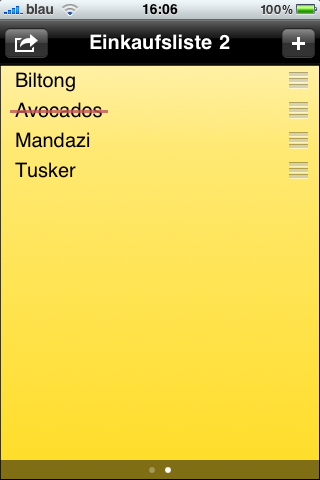
I got this German app called “ShopShop/Einkaufsliste” which does exactly what it’s supposed to do (providing a simple shopping list, see screenshot); I jailbroke my phone to display calendar events on the lock screen using “Lock Calendar” (which works better for me than “IntelliScreen”), and I also bought the pro version of “Read It Later” which btw also beautifully integrates into Tweetie and other apps. I also have accounts for Instapaper and Evernote.
IsEvernotethe solution to what I am looking for? Would it also display a to-do list on the lockscreen of my iPhone (or any other phone)? Or should I rather look for a browser plugin that enables me to quickly edit gmail calendar entries / notes (which would then also appear on the lockscreen)? You know I stepped away from my offline calendar and started using the Gmail solution instead because it seemed to be the smartest way for a quick sync between a web service and the phone – and then also display on the lockscreen.
I am sure I am not the first person asking for such a service, but there are about a million pages about “kewl iPhone apps” out there, so I got lost, somehow. Any guidance on this is very much appreciated. Thank you!
——————
* The story goes that I got so pissed off about Nokia’s Ovi store that I bought an old & broken iPhone 2G which obviously isn’t top-notch, but still does more for me than both my Nokia phones N95/E72 could ever do for me in terms of productivity. And yes, this may just be due to the awesome touchscreen on the iPhone; and yes, the Google Nexus One may be the best phone for me once it eventually arrives on the domestic market. It still surprises me though that a 3yr old phone boosts my productivity – more than a new phone by the “competitor” Nokia. And this although my E72 is supposed to be a business phone and most of my tasks on the phone are very much “business”-alike.
This website uses cookies to improve your experience. We'll assume you're ok with this, but you can opt-out if you wish. AcceptRejectPrivacy policy (German only)
Privacy & Cookies Policy
Privacy Overview
This website uses cookies to improve your experience while you navigate through the website. Out of these, the cookies that are categorized as necessary are stored on your browser as they are essential for the working of basic functionalities of the website. We also use third-party cookies that help us analyze and understand how you use this website. These cookies will be stored in your browser only with your consent. You also have the option to opt-out of these cookies. But opting out of some of these cookies may affect your browsing experience.
Necessary cookies are absolutely essential for the website to function properly. This category only includes cookies that ensures basic functionalities and security features of the website. These cookies do not store any personal information.
Any cookies that may not be particularly necessary for the website to function and is used specifically to collect user personal data via analytics, ads, other embedded contents are termed as non-necessary cookies. It is mandatory to procure user consent prior to running these cookies on your website.